
Tesla built the most powerful charging network on the planet — then slowly started letting outsiders in. Non-Tesla EVs can now access V3 Superchargers capable of 250 kW speeds, but “access” is doing a lot of heavy lifting in that sentence. Your car’s port, its software, and a web of automaker agreements all stand between you and that charge. Some EVs qualify with zero friction. Others hit invisible walls. Whether yours makes the cut depends on factors most drivers never think to check.
Which Non-Tesla EVs Can Actually Use V3 Superchargers?
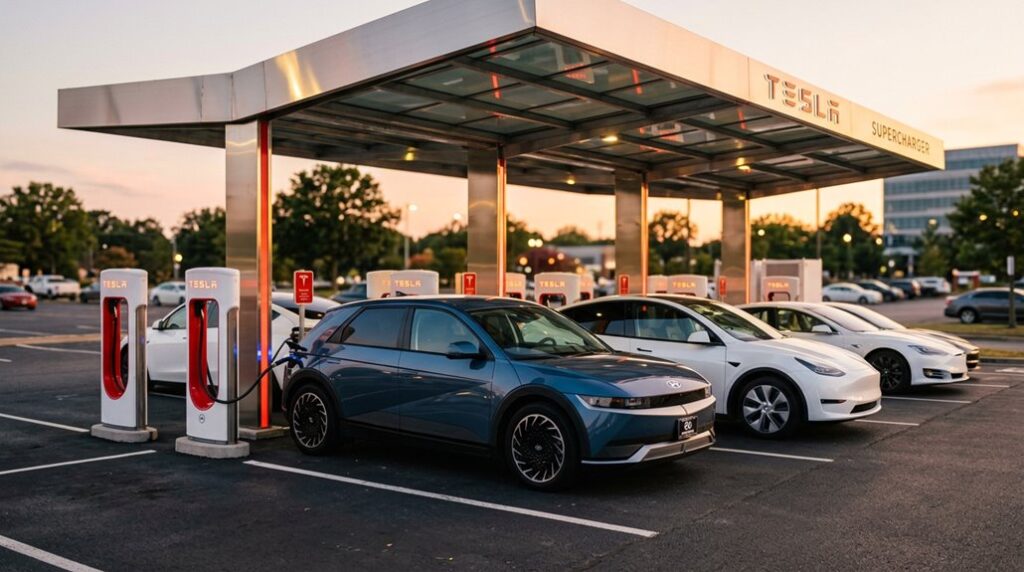
Not every V3 Supercharger stall on Tesla’s network is open to outside brands, but a substantial chunk of them are — Consumer Reports pegged roughly 15,000 of Tesla’s 17,000-plus ports as available to approved non-Tesla vehicles. That’s a significant slice of infrastructure, and your vehicle’s eligibility depends on three things: automaker approval, adapter or native NACS port support, and site-level software enablement.
Several brands have cleared all three obstacles. Ford Mustang Mach-E and F-150 Lightning owners can plug in. GM’s lineup — Silverado EV, Equinox EV, Blazer EV, and GMC Hummer EV — is covered. The NACS connector standard unifies Supercharger, Destination, and home charging under one plug design, simplifying access for non-Tesla EVs that have adopted it natively.
Hyundai Ioniq 5 (including pre-2025 CCS versions with an approved adapter) and Ioniq 6 are compatible, along with Kia’s EV6, EV9, and Niro EV. Rivian, BMW, Mercedes-Benz, Volkswagen, Volvo, Audi, and Polestar round out the commonly approved roster. If your EV isn’t on that list, compatibility is unlikely. Even when hardware qualifies, some stations lack the software enablement required to work with non-Tesla vehicles, so verifying through in-car or manufacturer apps before arriving is a practical necessity.
Does Your EV’s Charging Port Work at V3 Superchargers?
Whether your EV plugs straight into a V3 Supercharger or needs a hardware middleman comes down to one variable: what kind of port your car has from the factory.
One variable decides your Supercharger fate before anything else even matters: the port your car left the factory with.
Port type determines everything before software authorization even enters the conversation.
Here’s how port compatibility actually breaks down:
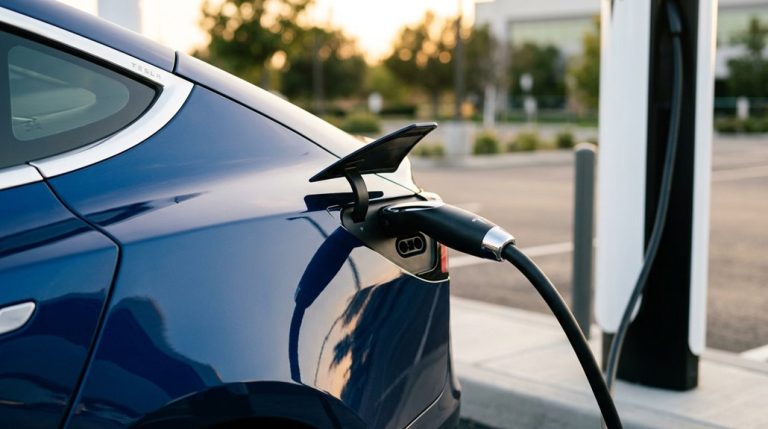
- NACS-equipped vehicles connect directly to V3 Superchargers without any adaptor
- CCS1-equipped EVs require a Tesla-approved adaptor with adequate adaptor ratings (up to 500A and 1000V on certified units)
- CHAdeMO vehicles (like older Nissan Leafs) have no compatible V3 access path
- J1772-only plug-in hybrids can’t access V3 DC fast charging regardless of any adaptor
- Physical compatibility alone isn’t enough—software authorization must still clear before charging begins
A correct port gets you to the door.
Software authorization actually opens it.
Miss either requirement, and that stall stays dark.
V3 Superchargers deliver up to 250 kW per stall independently, meaning compatible non-Tesla EVs are not throttled by a neighboring vehicle’s simultaneous charging session.
Non-Tesla EVs must use the Tesla app to initiate and manage charging sessions at Supercharger stations equipped with Magic Dock technology.
Where to Find V3 Superchargers Open to Non-Tesla EVs
Finding a V3 Supercharger that actually accepts your non-Tesla EV starts with one tool: the Tesla app. Download it, create a free account, and pull up the charging map. From there, use the live filters to isolate stations marked “Open to Other EVs” or “Superchargers Open to NACS.” Those labels matter because not every Supercharger site on the map qualifies—only a portion of Tesla’s total network participates in cross-brand access.
V3 stations represent the primary hardware tier available to non-Tesla drivers in North America, with older V2 sites excluded from the program entirely. Coverage concentrates along busy travel corridors and major metros, so rural stretches can look surprisingly sparse even where Superchargers technically exist. The Chevy Equinox EV can access over 17,800 Tesla Superchargers with the correct NACS adapter, making adapter selection a critical step before attempting to use the network.
The open-network footprint has crossed 15,000 ports, but that’s still a fraction of Tesla’s full infrastructure. Check the live map before every trip—availability shifts as Tesla adds sites incrementally. Google Maps and PlugShare also let you filter for NACS stations that accept non-Tesla EVs, giving you additional tools to plan routes and confirm access before you leave home.
How to Start a Charging Session at a V3 Supercharger
Pulling up to a V3 Supercharger in a non-Tesla EV is surprisingly straightforward once you grasp the two-part handshake: your vehicle’s software and the charger need to agree on who you’re before electrons start moving. App authorization handles your identity; the plugging procedure handles the physical connection. Get both right, and charging starts within seconds.
Follow this sequence precisely:
- Open your manufacturer’s app (myChevrolet, My BMW) and locate the station under the Map tab
- Grab the charging handle and attach your NACS DC adapter before approaching your charge port
- Insert the adapter-cable assembly firmly until your vehicle confirms engagement (chime, light, or haptic feedback)
- Tap “Start Charging” or “Charge Here” in your app and select the correct stall number
- Watch your charge port indicator — yellow typically means negotiating, blue or green means power’s flowing
Miss a step and you’ll be standing there confused. Don’t be that person. V3 Superchargers can deliver up to 250 kW, making them among the most capable DC fast chargers you’ll plug into regardless of what’s in your driveway. With over 130,000 chargers across the United States, the Supercharger network provides broad coverage that reduces the likelihood of being stranded far from a viable charging option.
Frequently Asked Questions
Can Non-Tesla EVS Use V3 Superchargers in Every Country or Region?
No, you can’t use V3 Superchargers everywhere. Regional availability and hardware compatibility determine your access, so you’ll need to check Tesla’s live map for participating locations in your specific country.
Do Non-Tesla Drivers Pay More per kWh Than Tesla Owners at V3 Superchargers?
Yes, you’ll often face a pricing disparity at V3 Superchargers—non-Tesla drivers typically pay higher per-kWh rates. Billing transparency varies by location, so always check the Tesla app beforehand to confirm your exact rate.
Can You Charge a Non-Tesla EV Without Using Any Mobile App?
In most cases, you can’t. You’ll need a mobile app to handle billing options and confirm adapter availability before starting your session—unless your EV supports Plug & Charge via a native NACS port.
Are V3 Supercharger Speeds the Same for Non-Tesla Vehicles as Tesla Vehicles?
Not always. While V3 Superchargers peak at 250 kW, your charge speeds depend on connector compatibility, battery temperature, and your vehicle’s design—meaning you’ll likely see different results than Tesla drivers do.
Will Older Non-Tesla EVS Ever Gain Access to V3 Superchargers?
Older non-Tesla EVs likely won’t gain V3 access. Your battery compatibility and connector type largely determine eligibility, and adapter evolution won’t help CHAdeMO or J1772-only vehicles—automaker agreements and software authorization remain the real gatekeepers.