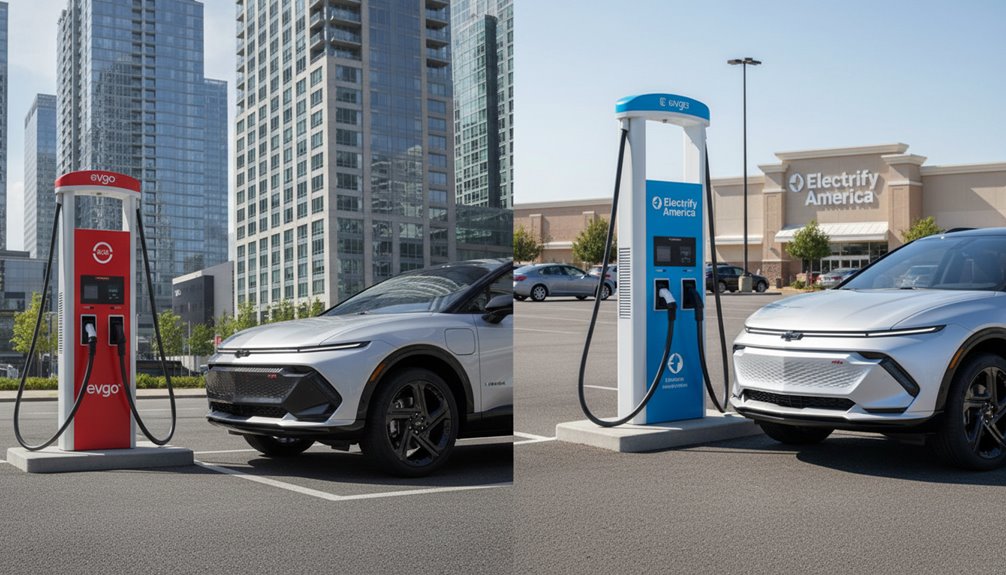

You’re about to waste money on the wrong charging network. EVgo offers manufacturer-backed convenience and gentler per-kWh pricing, while Electrify America delivers raw 350 kW power that’ll resurrect your battery in minutes—but only if you’re charging a Silverado EV on the highway. Most Chevy EV owners reflexively pick one based on an app download or wherever they stumbled upon first. That’s expensive laziness. Your driving patterns—not marketing hype or Reddit threads—should dictate which network deserves your credit card. Here’s how to stop overpaying and actually match your charging strategy to how you drive.
Electrify America vs. EVgo: Which Network for Chevy Owners?
When you’re considering which DC fast charging network to rely on for your Chevy EV, you’re fundamentally choosing between two different philosophies: raw speed or practical consistency. Electrify America dominates long-distance road trips.
Their 350kW chargers deliver 40% charge in 20 minutes—genuinely impressive for highway corridors where you need rapid turnaround. However, you’ll encounter occasional ramp-up failures and downtime issues that frustrate time-sensitive drivers. Pricing varies significantly by location, with non-member rates ranging from $0.48 to $0.59 per kWh, making membership discounts worthwhile for frequent users. For Chevy EV owners specifically, understanding your vehicle’s thermal throttling limitations helps you set realistic charging expectations rather than chasing peak speed promises.
EVgo, meanwhile, partners directly with GM, offering seamless AutoCharge+ integration through your Chevy’s native apps. That partnership matters.
You’re plugging in and charging within seconds, no app fumbling required. Their stations prove more regionally consistent, though they occasionally limit dual ports to single-cable operation.
For Chevy owners, EVgo represents belonging to a manufacturer-supported ecosystem. Electrify America offers superior peak performance but demands patience when infrastructure stumbles.
Where Each Network Operates
EVgo’s footprint spans 40 states with over 1,000 fast charging stations positioned strategically at high-traffic corridors—think highway travel centers, shopping districts, and grocery stores.
Their Pilot Flying J partnership adds another 130-plus locations across more than 25 states for interstate accessibility.
You’ll find their network particularly dense along California’s West Coast Electric Highway (DC fast chargers spaced every 25 to 50 miles) and major metropolitan areas from Maine to Los Angeles.
The search data doesn’t provide comparable Electrify America coverage for a direct geographic showdown.
The key difference: EVgo prioritizes that gas station-style convenience model along highways and urban centers, betting you’d rather charge during a quick shopping run than hunt for isolated chargers. You can use ChargeFinder’s map search functionality to locate available EVgo stations in your area and filter by charging speed to find the fastest options near your route.
Nationwide Highway Expansion
As you’re planning cross-country trips in your Equinox EV, you’ll want to know that EVgo’s got real geographic reach—we’re talking 850+ fast-charging stations across 40 states and 65+ metro areas, from Augusta, Maine to Los Angeles, California.
EVgo’s partnership with Pilot Flying J strategically plants chargers at travel centers nationwide, including Colorado, Georgia, Massachusetts, Michigan, Ohio, and Texas.
This means you’re not stuck hunting for charging in unfamiliar areas—stations sit at familiar roadside locations where you’d expect them.
Their network extends beyond typical urban clusters into rural and highway corridors, supporting both regional and cross-country travel patterns. With access to more than 20,000 Level 2 chargers through EVgo and partner networks, you’ll find charging options at various locations beyond just fast-charging hubs.
The strategic positioning demonstrates serious commitment to nationwide infrastructure rather than concentrated regional focus.
That’s infrastructure built for actual EV owners who actually drive places.
Urban Area Coverage Focus
Since you’re likely charging your Equinox EV in cities and suburbs rather than exclusively on highways, knowing where EVgo and Electrify America actually put their stations matters—and the two networks take markedly different strategic approaches.
EVgo blankets 65-plus metropolitan areas with over 1,100 stations, prioritizing retail dwell-time locations: shopping centers, grocery stores, restaurants, parking garages, and hotels.
They’ve strategically placed chargers where you’ll actually spend thirty minutes anyway.
Electrify America, meanwhile, operates 4,000+ chargers concentrated in dense urban cores and major metros—Los Angeles, New York, Chicago, Seattle—emphasizing big-box retail and highway edges.
Both networks use CCS1 connectors compatible with your Equinox EV.
EVgo’s broader geographic spread wins if you’re bouncing between smaller cities; Electrify America dominates if you’re urban-based and want maximum station density.
To find EVgo stations near you, use the EVgo app or website to search by city, address, or location and filter for compatible chargers with real-time availability information.
Highway Charging: Electrify America’s 350kW Advantage
What separates a highway road trip from a charging marathon? Speed—specifically, Electrify America’s 350kW charging capability that you won’t find elsewhere at scale.
Their highway-focused network strategically positions 350kW chargers near retail and dining at major corridors. You’re adding 20 miles of range per minute, which means 30-minute charges instead of hours. That’s seven times faster than competing 50kW stations. The Santa Monica hub, sitting right off I-10 freeway, exemplifies how on-site security and amenities make these stations convenient stops for both road-trippers and locals.
| Metric | Electrify America | Typical DC Fast Chargers |
|---|---|---|
| Max Power Output | 350kW | 50-150kW |
| Range Added/Minute | 20 miles | 3 miles |
| Charge Time | ~30 minutes | 45-90 minutes |
| Network Scale | 2,000+ DC chargers planned | Limited expansion |
With over 484 stations and dual-handle CCS1/CHAdeMO dispensers, you’ve got compatibility with virtually every EV. Their 2024 delivery of 600 GWh energy across 16 million sessions proves infrastructure reliability. For your Equinox EV highway journeys, Electrify America’s infrastructure investment translates to genuine time savings.
Urban Charging: EVgo’s City-Focused Network
While Electrify America dominates highway corridors with brute-force 350kW charging, EVgo’s real strength lies in where you’ll actually spend most of your time—your city.
The network operates 950+ urban and suburban stations across 40 states, strategizing placement in high-traffic metropolitan areas where you’re grabbing coffee or running errands. This isn’t accidental: EVgo’s infrastructure focuses on daily charging routines rather than cross-country sprints.
You’ll find DC fast-charging integrated into urban environments, with 4,350 total stalls providing consistent 88% uptime. The network maintains a 91% session success rate and 4.2/5 user rating, meaning your charging experience stays predictable. EVgo’s expansion aligns with the 1.3 million public charging points added globally in 2024, reflecting the industry’s commitment to urban accessibility.
EVgo’s $0.35/kWh member pricing undercuts competitors, and Q2 2025 data shows 281 kWh average daily throughput per stall—up 22% year-over-year. For Equinox EV owners maneuvering city life, EVgo’s customized urban strategy offers genuine convenience over raw megawatt theater.
How Fast Can You Actually Charge?
both EVgo and Electrify America advertise the same 350kW maximum, but the number you see on a screen rarely matches what your Equinox EV actually receives.
Real-world testing reveals the gap.
Electrify America delivers over 40% charge in 20 minutes on tested vehicles, while EVgo manages around 9% in the same window.
Electrify America charges over 40% in 20 minutes, while EVgo reaches only 9%—a critical difference for road trips.
That’s a significant difference when you’re plotting a road trip.
Several factors limit your actual speed: battery temperature, station output stability, and your vehicle’s acceptance level all play roles.
Your Equinox EV won’t pull maximum power until conditions align perfectly—rarely happening simultaneously.
Electrify America’s faster ramp-up and more consistent performance make it the speedier option, though occasional failures to reach full capacity occur at both networks.
Expect 30-45 minutes to 80% on either network under ideal conditions.
Real-World Test: 40% in 20 Minutes vs. 9-20
When you’re parked at a DC fast charger for just 20 minutes, Electrify America’s real-world test delivered a commanding 40% charge gain versus EVgo’s 9-20%, proving that network infrastructure age and connector compatibility matter more than you’d think.
The physics here’s straightforward: Electrify America’s newer stations ramped up faster and sustained higher kilowatt delivery, while EVgo’s older connectors couldn’t keep pace even though the network itself tops out at similar theoretical speeds.
You’re effectively choosing between a quick top-up strategy (Electrify America wins decisively) or a longer lunch-break charge session where EVgo’s lower cost-per-percentage becomes the smarter play.
Speed Test Results Breakdown
Comparing charging speeds between networks reveals a stark performance gap that’ll affect your real-world charging experience—and your wallet.
During testing, Electrify America charged to 40% capacity in 20 minutes, while EVgo managed only 20% in the same timeframe.
That’s a significant difference when you’re trying to grab a quick charge during your lunch break.
The cost disparity tells another story: Electrify America’s faster session ran $17 versus EVgo’s $8.
You’re effectively choosing between speed and price.
Electrify America’s advantage stems from its higher maximum power output capabilities—those stations can push more electricity into your battery simultaneously.
EVgo’s slower performance makes it acceptable for extended stops but less practical for rapid top-ups between errands.
Real-World Charging Performance
Since your Equinox EV’s charging speed depends heavily on which network you’re using, the difference between Electrify America and EVgo becomes immediately obvious at the connector.
Real-world testing reveals substantial performance gaps. Electrify America demonstrated a 40% charge gain in 20 minutes during ideal conditions, while EVgo achieved 20% in the same timeframe. That’s a significant disparity when you’re road-tripping and time matters.
| Metric | Electrify America | EVgo | Advantage |
|---|---|---|---|
| 20-Minute Charge | 40% | 20% | Electrify America |
| Speed Consistency | Inconsistent ramp-up | Stable output | EVgo |
| Battery Temperature Impact | Significant | Moderate | EVgo |
| Station Reliability | Variable | Documented stability | EVgo |
| Real-World Variability | High | Lower | EVgo |
However, Electrify America’s inconsistent power ramp-up (where chargers sometimes fail reaching full speed) undermines those headline numbers. EVgo stations haven’t exhibited similar issues, providing more predictable performance across locations.
Plug and Charge: Electrify America’s ISO 15118 vs. EVgo’s Autocharge
Two fundamentally different philosophies underpin how you’ll authenticate and pay at DC fast chargers: EVgo‘s proprietary Autocharge+ system uses your vehicle’s unique identifier to sidestep the app-and-tap routine, while Electrify America‘s ISO 15118 standard aims for true plug-in-and-go automation through direct vehicle-to-charger handshakes.
EVgo’s approach whitelist your Equinox EV’s VIN after you enroll in their app—no additional fees required. Once registered, you’ll simply plug in at any EVgo CCS station; fraud detection algorithms verify legitimacy by flagging improbable sessions (like simultaneous charges across distant locations).
Electrify America’s ISO 15118 goes further, enabling automatic authentication without app involvement whatsoever, though your Chevy must support the standard natively.
Both systems eliminate card swiping post-enrollment. EVgo’s Autocharge+ works today on most CCS vehicles, including older Chevy models, while Electrify America commits to broader rollout once certification challenges resolve. For Equinox EV owners prioritizing immediate convenience, EVgo delivers; those betting on industry-standard interoperability should monitor ISO 15118 adoption timelines.
Which Network Has Better Reliability?
When you’re hunting for reliable charging on road trips, uptime matters more than network size—and here’s where geography becomes your best friend or worst enemy.
Electrify America’s recent hardware upgrades have pushed typical speeds to 70-75 kW consistently, though regional performance still varies; EVgo’s 1,700+ ports sound impressive until you factor in that older stations charge noticeably slower and app reliability differs by location.
Your actual success rate hinges less on which network you choose and more on whether the specific station you’re hitting has been upgraded recently (Q1 2025 data shows both networks hovering around 84% successful attempts, though EVgo stations still draw more downtime complaints in user reports).
Uptime and Station Performance
If you’re planning road trips in your Equinox EV, you’ll want to know which network actually keeps its chargers running when you need them most.
EVgo leads with an 88% uptime rate and 91% session success rate across its 950+ urban and suburban stations.
Electrify America trails slightly at 82% reliability with 89% session success, though it operates 850+ highway-focused locations.
The gap narrows when you consider real-world problems: EVgo experiences issues 43% of the time according to Consumer Reports, while Electrify America hits 35%.
EVgo’s primary weakness involves payment bugs rather than hardware failures.
Electrify America’s 35% hardware break rate poses its own challenge.
For practical Equinox EV owners, EVgo’s uptime advantage makes it the more dependable choice for predictable charging sessions.
Regional Consistency Matters
| Metric | EVgo | Electrify America |
|---|---|---|
| Overall Reliability Rating | 579/1000 | 601/1000 |
| Session Success Rate | 91% | 89% |
| User Rating | 4.2/5 | 4.0/5 |
| Network Focus | Urban/suburban | Highway/cross-country |
| Fast Charger Count | 2,850 | 3,300 |
EVgo dominates metropolitan zones with 950+ stations prioritizing city accessibility, though app reliability varies regionally. Electrify America’s 750 stations emphasize highway spacing for long-distance travel, performing strongest on major interstates despite lower overall ratings. In Southern California testing, EVgo struggled with older connectors while Electrify America delivered faster speeds—but faced crowding issues. Your actual experience depends less on national averages than on network density where you charge most: urban commutes favor EVgo’s metro consistency; road trips reward Electrify America’s interstate infrastructure.
Why Electrify America Stations Underperform
Though Electrify America operates one of the nation’s largest fast-charging networks,
the infrastructure consistently fails to deliver the speeds and reliability that EV owners—particularly Equinox EV drivers relying on long-distance travel—actually need.
The root problem stems from fundamental operational choices.
Electrify America prioritizes expanding new stations over maintaining installed chargers, leaving utility managers scrambling without repair budgets.
When you pull up to a 350 kW station, you’re not getting 350 kW—you’re lucky to receive 50 kW.
Initial speeds cap at 7 kW before ramping after 10-20 minutes, effectively throttling your charging experience.
Technical failures compound these issues.
Excess power incidents trip EV fuses across multiple states.
Stations frequently drop offline for weeks or months.
Only one or two cables function at facilities with four to eight available.
Automakers privately rank Electrify America as their most unreliable network—a damning assessment from the companies that know these systems best.
You’re effectively paying premium rates for subpremium performance.
Pricing Breakdown: Per-Minute Costs Compared
What’re you actually paying when you plug into EVgo versus Electrify America?
EVgo’s shifted its model substantially. Historically, you’d pay $0.18–$0.35 per minute depending on membership status and location.
Now they’ve pivoted toward kWh billing with time-of-use (TOU) rates—meaning a 70 kWh session costs $35 at midnight but $48 during peak hours (38% premium). Their PlusMax subscription ($12.99/month) nets you 30% off, while Pay As You Go charges session fees at $0.99.
EVgo’s time-of-use billing charges $35 off-peak versus $48 peak for 70 kWh—PlusMax subscription saves 30%.
Electrify America typically sticks with kWh pricing, though exact per-minute comparisons remain elusive from current data. Both networks employ adaptive pricing algorithms adjusting rates based on demand and weather patterns.
For your 15–45 minute Equinox EV fast-charging sessions, subscription plans genuinely matter. You’re choosing between predictable monthly costs versus variable per-session pricing. Check the EVgo app for real-time rates before committing.
Membership Discounts and Saving Strategies
You’ll want to weigh Electrify America’s Pass+ membership ($7/month) against EVgo’s tiered options, since Pass+ delivers a consistent 25% discount across its per-minute ($0.12–$0.24/min) and per-kWh ($0.31/kWh) rates—making it profitable after roughly 65kWh monthly usage.
EVgo’s partnership perks program recognizes your GM EV through the Autocharge+ app, stacking discounts like the Plus plan’s 25% reduction or PlusMax’s deeper tier pricing (as low as $0.23/kWh in San Diego), which can compound to 20–30% savings when you time charging off-peak.
Per-charge math matters: a single full Equinox EV charge justifies Pass+ membership, while frequent fast-charging in Texas shows EVgo PlusMax at $0.29/kWh versus $0.42/kWh non-member rates—a gap that evaporates monthly fees within two sessions.
Electrify America’s Premium Discounts
Electrify America’s discount programs consistently reward different driver profiles with meaningful savings on fast charging—whether you’ve got a manufacturer partnership, an active Lyft gig, or you’re simply willing to commit to a Pass+ membership.
Your savings tier depends on your situation:
- Pass+ members save roughly 25% on standard rates via monthly subscription, with discounts varying by region
- Lyft drivers receive up to 23% off, climbing to 29% for Gold and Platinum tiers
- Premium Offer enrollees (Genesis, Hyundai, Kia, Volkswagen owners) access complimentary ultra-fast charging through manufacturer partnerships
- Discount structure applies either per-kWh ($0.14 reduction where applicable) or per-minute ($0.04-$0.09 depending on power output)
You’ll manage everything through the app, switching plans as your driving needs evolve.
Non-refundable monthly fees apply if you cancel mid-cycle, so plan accordingly.
EVgo Partnership Perks Program
Stacking rewards while you charge turns EVgo from a straightforward pay-per-session network into a genuinely cost-conscious option—particularly if you’re willing to engage with their membership structure and automaker partnerships. You’ll earn 5 points per dollar spent, accumulating toward $10 credits at 2,000 points. But here’s where it gets interesting: if you own specific EV models, you’re already sitting on substantial charging credits.
| Vehicle | Credit Amount | Duration |
|---|---|---|
| Chevrolet Bolt EV/EUV | $500 | One-time |
| Cadillac LYRIQ | Unlimited | 2 years |
| Acura ZDX | $750 | One-time |
| Honda Prologue | $750 | One-time |
| Toyota bZ4X | Unlimited | 1 year |
Rideshare drivers benefit most—Uber Pro and Lyft Rewards members save up to 45% versus standard rates. EVgo Access membership grants access to gated chargers nationwide without session fees, while their Autocharge+ feature eliminates tap-and-pay friction entirely.
Cost Comparison Per Charge
Once you’ve stashed those partnership credits, the real math kicks in—because what you actually pay per kWh or per minute determines whether EVgo’s rewards stack meaningfully or whether you’re chasing pocket change.
Here’s where membership plans separate the savvy from the casual charger:
- Electrify America Pass+ delivers 31% savings on sessions at $0.31 per kWh versus $0.43 guest pricing
- EVgo Member rates run $0.29–$0.35 per kWh in California, competitive but regionally variable
- Per-minute charging favors Electrify America Pass+ at $0.12–$0.24 versus EVgo’s $0.25–$0.31
- No session fees with Pass+ eliminate hidden charges EVgo’s Basic plan avoids through subscription
Electrify America emerges 50% cheaper overall when you factor idle fees and consistency. For Equinox EV owners charging frequently, Pass+ membership justifies its $4 monthly investment through volume alone.
Does EVgo’s GM Partnership Matter?
Securing preferred-provider status with General Motors gives EVgo something most charging networks don’t have: a guaranteed customer pipeline and deep integration into the vehicles you’re actually driving.
When you own an Equinox EV, that partnership translates into real benefits: Plug and Charge activation works seamlessly across EVgo’s entire network without requiring apps or payment cards—just authentication in seconds.
Plug and Charge works seamlessly across EVgo’s network—no apps or payment cards needed, just seconds of authentication.
Your myChevrolet app handles enrollment directly, eliminating friction at the charger.
EVgo maintains 98% uptime across thousands of stations, addressing the reliability demands GM fleet customers depend on for mission-critical operations.
The company’s installing 2,000 high-power stalls at Pilot and Flying J travel centers across 40 states, with flagship locations launching in 2025.
For Equinox EV owners planning road trips, that infrastructure matters.
You’re not choosing between equal competitors—you’re choosing between a network engineered specifically for GM vehicles and one playing catch-up.
Both Networks Support Chevy EVs via CCS
You’ll find that both EVgo and Electrify America support your Equinox EV through the CCS standard—no adapters required—with either network’s connector working seamlessly into your vehicle’s charge port.
Where they diverge is in activation speed: EVgo’s Plug&Charge via your connected GM account can fire up a session automatically (they call it Autocharge+), while Electrify America offers the same hands-free feature on select stations, though rollout varies by location.
The practical upshot is that you’re not locked into one network for DC fast charging; both deliver 50-350 kW depending on the station model and your battery’s state of charge, so your network choice hinges more on availability, membership discounts (typically 25-30%), and which app’s reliability suits your region.
CCS Connector Compatibility Standards
What makes charging your Chevy EV straightforward across different networks?
The CCS J1772 connector standard.
Both EVgo and Electrify America use this unified plug design, eliminating the adapter cable juggling that plagues less fortunate EV owners.
Here’s what standardization means for you:
- Single connector works at both networks without additional hardware
- Seamless switching between EVgo’s urban stations and Electrify America’s highway corridors
- Consistent activation protocols across the entire charging ecosystem
- Future-proof compatibility as infrastructure expands nationwide
This standardized approach isn’t accidentally convenient—it’s deliberate industry infrastructure.
When you pull up to any CCS-equipped charger, your Equinox EV plugs in the same way every time.
No guessing games.
No compatibility anxiety.
Just straightforward charging access whether you’re hitting a mall parking lot or cruising interstate highways.
Plug And Charge Activation
How does your Equinox EV actually start charging without fumbling through an app or card? Both EVgo and Electrify America handle this through Plug and Charge—a seamless CCS-based system where your vehicle communicates directly with the charger.
After enrolling via the EVgo app or your myChevrolet account, you simply plug in. The charger authenticates your Equinox EV automatically through two-way data sharing, initiating the session instantly. Electrify America works similarly for Chevy CCS vehicles, eliminating the extra steps entirely.
No tapping screens. No card fumbling. Your vehicle’s built-in CCS connector becomes your credential, meaning faster session starts and genuine convenience. Both networks prioritize this frictionless experience—because once you’ve experienced it, anything else feels unnecessarily complicated.
Activating Plug and Charge on Chevy Models
Plug and Charge technology eliminates the friction of swiping cards or fumbling through apps—your Equinox EV simply communicates with compatible chargers and initiates sessions automatically once you’ve set things up.
Setting this up differs slightly between networks, but the payoff’s worth the five-minute investment.
For Electrify America, you’ll:
- Open their mobile app and log in to your account
- Go to “Account,” then “Plans,” and select Premium Offer
- Scroll to “Plug&Charge Activate Now” and confirm activation
- Plug into any CCS dispenser for automatic charging sessions
For IONNA-enabled chargers, access your GM app, click your initials (top right), scroll to public charging, select IONNA, and toggle Plug and Charge on.
Set up payment if needed.
Once activated, you’re golden.
Drive to a compatible station, plug your CCS connector in, and charging starts automatically. No app fumbling required.
Finding Stations and Paying: App Differences
Once you’ve got Plug and Charge activated, you’re ready for the next layer: actually finding stations worth plugging into and figuring out how you’ll pay for them.
EVgo’s app filters by connector type and charger speed, integrating seamlessly with Google Maps and Apple Maps for directions.
You’ll see real-time charging details, session monitoring, and a charge curve displaying kW rates versus time—handy for predicting when you’re done.
Electrify America takes a narrower approach, focusing exclusively on its nearly 1,000 Level 3 DC fast chargers.
Their app notifies you when chargers become available, though you’re limited to their network.
Pricing differs substantially.
EVgo charges $0.99 per session plus $0.34 per kWh without membership, while their Plus plan ($6.99 monthly) reduces rates by 20%.
Electrify America’s Guest option runs $0.43 per kWh with no monthly commitment, versus their Pass+ plan for frequent users seeking reduced rates.
Off-Peak Savings: When to Charge on Each Network
When you’re charging your Equinox EV, timing matters more than you’d think—and both networks know it.
EVgo rewards you for charging during California’s 8am–4pm and 9pm–midnight windows, with Early Bird hours (12am–8am) offering rock-bottom rates.
Electrify America counters with midnight–7am off-peak pricing at $0.30/kWh or lower in select markets.
The real savings come from grasping your local grid’s demand patterns.
Here’s where strategic timing pays dividends:
- EVgo off-peak aligns with renewable energy abundance, reducing your environmental footprint
- Electrify America Passport members slash rates to $0.25/kWh off-peak versus $0.43 standard
- Both networks penalize peak charging (4pm–9pm), so avoid that window entirely
- Weekend extensions in certain Electrify America regions open up additional savings opportunities
Your Equinox EV’s flexible charging window means you’re not locked into peak rates. Check each app before plugging in—station-specific pricing varies substantially, and that five-minute planning investment often saves you real money.
Understanding CCS Connectors and Compatibility
Both EVgo and Electrify America support SAE CCS connectors, making them fully compatible with your Chevy without adapters.
This standardization means you’re not hunting for specialized equipment—just plug in and charge at either network.
Here’s where it gets practical: EVgo operates roughly 1,700 fast-charging ports across 850+ locations nationwide, while Electrify America runs approximately 4,799 ports.
Both deliver power outputs ranging from 50kW to 350kW depending on station age and capability.
The real difference emerges in performance.
Electrify America demonstrated faster real-world charging speeds during testing, achieving roughly 40% battery increase within 20 minutes.
EVgo’s varied infrastructure means performance depends heavily on individual station age and equipment condition.
Either network charges your Equinox EV reliably—your choice hinges on location convenience and charging speed priorities.
Which Network Should Chevy Owners Choose?
So which network actually makes sense for your Equinox EV?
Your choice depends on your driving patterns and priorities:
- Long-distance trips: Electrify America’s 150-350kW stations deliver 40%+ charge in 20 minutes, making highway corridors genuinely manageable
- Urban commuting: EVgo’s urban-focused network and AutoCharge+ technology (no app fumbling) suit city dwellers who need quick top-ups
- Cost consciousness: EVgo’s pricing runs substantially lower—$8 for 20% versus Electrify America’s $17 for 40%—though membership discounts (10-30%) help both
- Reliability: EVgo reports fewer ramp-up failures, while Electrify America occasionally struggles with downtime and single active ports during peak hours
Electrify America edges ahead for cross-country road trips thanks to nationwide highway coverage.
EVgo wins for frequent urban charging and wallet-friendly rates. Many Equinox owners subscribe to both networks, hedging against coverage gaps and maximizing flexibility. Your ideal choice honestly mirrors your real-world charging needs, not marketing promises.
Your Charging Playbook: When to Use Each Network
Think of EVgo as your urban lunch-break solution.
You’ve got an hour to kill downtown?
EVgo stations add 70-80% charge reliably, with faster activation thanks to AutoCharge+ technology.
Their dual-port setup and GM partnership mean consistent availability for Chevy owners traversing city grids.
Electrify America becomes your highway ally.
Planning a 300-mile road trip?
Their 350kW maximum speed delivers 40% in 20 minutes—genuine time savings when you’re stacking states.
Yes, you’ll pay more per session ($17 versus EVgo’s $8 for comparable gains), but highway efficiency justifies the cost.
The real play? Subscribe to both.
Use EVgo locally, Electrify America regionally.
This dual-network approach eliminates the frustration of network-specific downtime while giving you ideal charging speed for whatever your route demands.
Frequently Asked Questions
Can I Use My Chevy EV on Both Networks Without Switching Membership Plans?
You can use your Chevy EV on both EVgo and Electrify America without switching plans. Your existing account credentials work seamlessly across both networks, so you’re charging with one unified membership.
How Do Charging Times Vary Between 10-80% Versus Full Battery Capacity?
You’ll charge to 80% in 30-45 minutes on either network, but pushing to full capacity extends time beyond 45 minutes as charging tapers considerably. Plan accordingly for long trips.
What Happens if a Plug and Charge Station Malfunctions Mid-Session?
If you’re charging and the station malfunctions mid-session, you’ll need to use the app to manage your session—either restarting or ending it. You’re only billed for what you’ve actually received, so you won’t face idle fees.
Are There Differences in Charging Costs During Peak Versus Off-Peak Hours?
Yes, you’ll find peak and off-peak pricing differences—you’ll pay roughly double during peak hours, you’ll save substantially during off-peak charging, and you’ll maximize your Equinox EV’s value by timing strategically.
Which Network Offers Better Coverage in Rural Areas Outside Major Highways?
You won’t find significant differences between EVgo and Electrify America in rural areas. Both networks concentrate on highways and major metros, leaving off-highway rural coverage sparse. You’ll rely on Pilot Flying J’s travel centers for long-distance rural trips.


