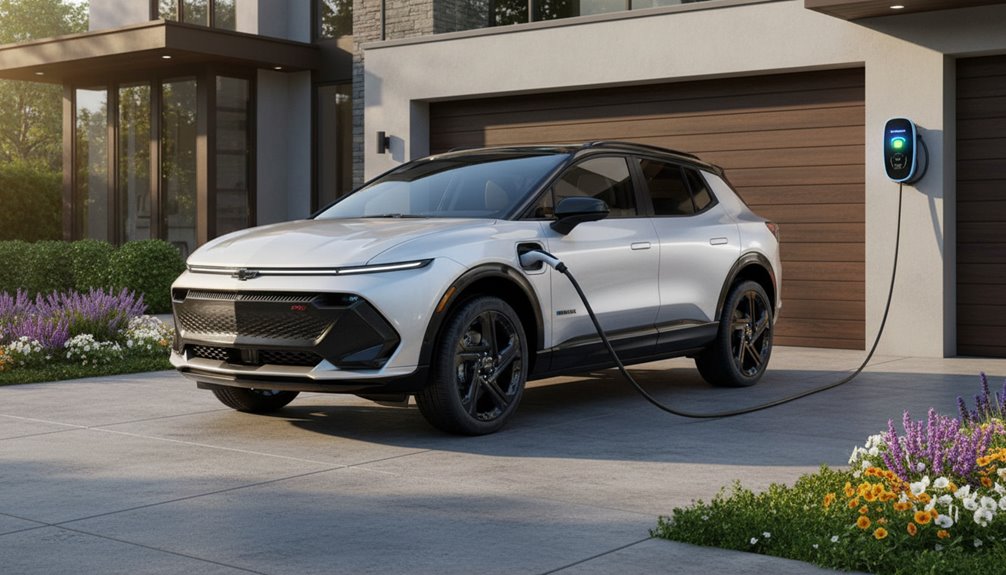

Picture this: You plug in your Equinox Ultium after work, expecting a full charge by morning, only to find your electrical panel can’t handle the load—and now you’re staring at a $3,000 upgrade bill. Most owners make this mistake because they assume any Level 2 charger will work with their home’s existing setup. The truth? Your panel’s amperage, wire gauge, and circuit availability determine whether you’ll wake up to 36 miles of range or a tripped breaker. The difference between a seamless installation and a costly nightmare comes down to three decisions most people get wrong.
Why Level 2 Charging Makes Sense for Equinox EV Owners
Because you’re going to spend most nights at home anyway, Level 2 charging converts your Equinox EV into a vehicle that’s perpetually ready for whatever tomorrow throws at you.
Here’s what makes this practical: Level 2 chargers deliver approximately 25 miles of range per hour—enough for typical daily commutes without requiring midday interventions. If you’ve got the standard 11.5 kW onboard charger, you’ll recover 34 miles within 60 minutes. Upgrading to the optional 19.2 kW charger bumps that to 51 miles hourly.
The physics work in your favor too. Slower charging rates reduce thermal stress on your battery, preserving chemistry integrity over the vehicle’s lifespan. You’re not hammering the pack like DC fast charging does. Installing a Level 2 charger at your Burbank home requires a licensed electrician to set up the 240V outlet infrastructure. This approach contrasts sharply with rapid charging from public stations, where thermal throttling issues can significantly reduce charging speed at higher state-of-charge levels.
Financially, overnight charging during off-peak electricity hours costs substantially less than public charging networks. Your home’s 240-volt infrastructure handles the workload seamlessly, eliminating premium fees altogether.
How Your Equinox’s Onboard Charger Works: 11.5 kW vs. 19.2 kW
Your Equinox EV’s onboard charger is the middleman between your home’s electrical system and that 85 kWh battery pack—it’s what actually converts the AC power flowing from your wall into the DC juice your battery can use.
You’ve got two options here: the standard 11.5 kW charger or the upgraded 19.2 kW unit.
The base charger delivers roughly 34–36 miles of range per hour at 240 volts, meaning a full overnight charge is totally feasible.
Step up to the optional 19.2 kW charger (compatible with GM PowerUP+ hardware), and you’re looking at 51–58 miles per hour—substantially faster, though it requires professional 240V hardwired installation.
Here’s the key: your charger’s rating, not your wall station’s maximum output, determines your actual charging speed. Think of it as a bottleneck. Both options are ENERGY STAR and UL-certified to ensure reliable performance and safety standards.
Battery temperature, state of charge, and grid capacity also influence real-world performance, but those specs give you solid baseline expectations for planning your charging routine.
Level 2 vs. Level 1: What You Actually Gain at Home
You’ll notice the difference immediately: Level 2 adds roughly 32 miles per hour versus Level 1’s measly 2–5 miles.
This means you’re either charging your Equinox overnight (Level 2, typically 4–10 hours to 80%) or spending two full days tethered to a standard outlet.
The physics here is straightforward—Level 2’s 240V circuit delivers 6–10x more power than Level 1’s 120V.
Most EV owners with daily driving over 40 miles find Level 2 charging essential for maintaining a fully charged vehicle each morning without the inconvenience of extended charging windows.
Speed Differences Matter Daily
While Level 1 charging tops out at a measly 2–5 miles of range per hour, Level 2 delivers 10–60 miles per hour—making it roughly 6 to 12 times faster depending on your specific setup. That’s the difference between crawling and actually getting somewhere.
Here’s what this means for your daily life: Level 1 requires 40–50+ hours to reach 80 percent charge, while Level 2 accomplishes the same overnight in 4–10 hours.
If you’re driving 30+ miles daily, Level 1 leaves you perpetually short. You’ll come home depleted, plug in, and wake up still depleted—forcing dependency on public chargers. Certified Level 2 chargers like those with UL/ETL certification ensure safety and reliability for long-term daily use.
Level 2 eliminates that anxiety entirely. You charge overnight and start each morning fully restored, no multi-day recovery cycles required.
Real-World Range Per Hour
The speed gap between Level 1 and Level 2 isn’t just theoretical—it’s measured in the actual miles you’ll add to your battery every single hour you’re plugged in at home. Your Level 1 setup (120V outlet) delivers roughly 4 miles per hour, which works fine if you’re topping off after short trips.
But Level 2 changes the equation entirely. The base 11.5 kW charger adds 34 miles hourly—that’s 8.5 times faster. Upgrade to the optional 19.2 kW setup, and you’re gaining 51 miles per hour, or 12 times Level 1’s pace. Installation of home chargers is supported with incentives available, making the upgrade more financially accessible.
Over a typical overnight charge, Level 2 replenishes 300+ miles versus Level 1’s 30-40. For daily commuters, that weekly difference translates to genuine freedom: consistent full batteries without public charging dependency.
Home Charging Time Comparison
When you’re staring at your Equinox EV’s battery indicator after a full day of driving, the difference between Level 1 and Level 2 charging isn’t academic—it’s the gap between waking up ready to go and waking up scrambling.
Level 2 operates roughly 10 times faster than Level 1, supplying 30 miles per hour versus 3 miles per hour. Here’s what that means for your actual charging needs:
- Quick recovery: Charging 58-80% takes 2 hours 15 minutes on Level 2 versus 12 hours 8 minutes on Level 1
- Overnight sufficiency: An 8-hour charge adds 56-320 miles on Level 2 compared to 8-32 miles on Level 1
- Commute reliability: Level 2 guarantees adequate morning charge regardless of previous day’s depletion
You’re not just charging faster—you’re eliminating range anxiety before your workday starts. Level 2 chargers use 240V power supply, making them substantially more efficient for residential installations than their Level 1 counterparts.
Your Home’s Electrical Panel: Do You Have the Capacity?
Before you schedule an electrician or shell out thousands for a panel upgrade, you need to know whether your home’s electrical panel can actually handle Level 2 charging—and honestly, there’s a decent chance it already can.
Most homes built in the last 20 years run 200-amp service, which comfortably supports a 40-amp Level 2 charger consuming just 20% of total capacity. Older homes, though, might have 100-amp panels—still workable if your current electrical load leaves headroom.
Here’s the reality check: find your panel’s label and calculate what you’re already running. Electric stoves, HVAC systems, and water heaters compete for those amps. If you’re hovering near 80% capacity, you’ve got a problem. About 20% of homes need upgrades.
Don’t guess. A professional electrical inspection clarifies whether you need a full panel replacement, a cost-effective subpanel, or just a dedicated circuit.
The GM PowerUp 2 Charger: Specs and What They Mean
Once you’ve confirmed your panel can handle the load, you’ll want to know what you’re actually installing—and that’s where the GM PowerUp 2 charger enters the conversation.
This hardwired unit delivers up to 11.5 kW at 48 amps using 240 volts, meaning you’re getting roughly eight times faster charging than a standard 120V outlet. The real-world payoff? You’ll gain 27.2 to 44.5 miles of range per hour, depending on your Equinox EV’s battery capacity and conditions.
Here’s what makes this charger practical for your home:
- Weather-resistant design with NEMA 4X rating handles indoor and outdoor installation
- Smart connectivity via Wi-Fi and Bluetooth lets you monitor sessions and schedule off-peak charging through GM’s mobile app
- Flexible amperage settings modify to your circuit’s capacity without requiring panel upgrades
Installation requires a licensed electrician for that 240V hardwired connection. At $899, you’re looking at Energy Star and UL certification backing unidirectional, efficient power delivery built specifically for Equinox ownership.
SAE J1772 Compatibility: Why It Matters for Equinox EV
While your GM PowerUp 2 charger handles the heavy lifting at home, you’ll want to understand the connector standard that makes it all possible—because the Equinox EV’s charging port isn’t proprietary, and that’s actually good news for your wallet and flexibility.
Your Equinox EV uses the SAE J1772 standard, the North American connector that governs AC charging from 120V Level 1 through 240V Level 2. This five-pin design (expandable to seven pins for DC fast charging via CCS Combo 1) ensures compatibility across Chevrolet, Ford, and Nissan EVs alike.
SAE J1772 standard charging ensures your Equinox EV works seamlessly across Chevrolet, Ford, and Nissan vehicles.
The Control Pilot pin communicates your requested charge current; the Proximity Pilot detects connector presence for safety. You’re not locked into proprietary infrastructure—you’re plugging into a standardized ecosystem that supports reliable, 10,000+ cycle durability.
That universality means today’s charger works with tomorrow’s vehicles, protecting your investment.
Hardwired vs. Plug-In: Choosing the Right Installation Method
You’ll choose between hardwired and plug-in based on whether you’re prioritizing permanent, faster charging (hardwired delivers up to 48 Amps at 240V) or flexibility across multiple vehicles and locations.
Hardwired installations require professional electrician work, panel integration, and permits—but they eliminate outlet wear and guarantee maximum power delivery, making them ideal for fixed garage spots.
Plug-in setups use your existing NEMA 14-50 outlet (the same receptacle as a dryer connection), skip the rewiring hassle, and let you relocate the charger if needed, though they demand that adequate 240V circuit already exists in your home.
Permanent Installation Benefits
Regarding charging your Equinox EV at home, the installation method you choose fundamentally shapes your charging experience—affecting everything from speed and convenience to long-term flexibility and cost.
Hardwired installations deliver genuine advantages worth considering:
- Dedicated circuit protection: Direct 240V connection eliminates shared electrical load, ensuring consistent nine-kilowatt charging output regardless of other household demands
- Professional safety compliance: Licensed electricians handle permit acquisition and circuit configuration, guaranteeing your setup meets local codes and UL certification standards
- Future-proof infrastructure: Permanent installations accommodate potential upgrades or additional chargers on your circuit without rewiring
You’re investing in reliability here.
Hardwired setups eliminate the appliance-outlet vulnerability of plug-in alternatives, providing the stability serious EV owners need.
That professional installation? It’s not overhead—it’s insurance against electrical complications down the road.
Flexibility Of Plug-In Options
What’s actually holding you back from choosing the right charging setup? It often comes down to installation flexibility.
You’ve got two main paths: hardwired direct 240V connections or plug-in options like the NEMA 14-50 specification.
Hardwired installations deliver maximum performance—up to 48 amps at 240 volts—but require professional electrician work and potentially higher upfront costs.
Plug-in alternatives offer easier installation and lower labor expenses, though you’re locked into specific outlet compatibility.
The GM PowerUp 2’s flexible amperage settings let you tailor for your home’s electrical capacity either way.
Extension cords? Off-limits with GM chargers, so placement decisions matter.
Your choice hinges on whether you prioritize installation simplicity or maximum charging speed and power delivery capabilities.
Circuit Compatibility And Safety
Now that you’ve settled on either hardwired or plug-in installation, the real safety question emerges: does your home’s electrical infrastructure actually support what you’re planning?
Your electrical panel needs breathing room. Here’s what matters:
- Hardwired setups demand 48-80 amps of dedicated circuit capacity, requiring a professional electrician to evaluate your panel’s headroom
- Plug-in options fit existing 240V outlets (think dryer connections), but undersized outlets risk overheating at sustained charging rates
- Both methods support NEMA 4X weather resistance and J1772 connector standards, though hardwired eliminates plug-failure risks entirely
The physics is straightforward: voltage times amperage equals power.
Your Equinox EV’s onboard charger maxes at 11.5 kW standard—that’s real current your home must safely deliver.
Plug-in delivers 7.7 kW reliably; hardwired reaches full 11.5 kW without compromise.
Panel compatibility isn’t optional; it’s foundational.
Professional Installation: Costs, Timeline, and What to Expect
Installing a Level 2 home charger for your Equinox EV requires professional skill—and grasping the costs, timeline, and process upfront helps you plan without surprises.
The GM PowerUp 2 charger runs $899 MSRP, though installation costs vary based on your electrical setup. Qmerit partners offer competitive quotes comparable to local electricians, and you’ll likely qualify for tax credits plus utility rebates through ENERGY STAR certification.
Expect Qmerit to contact you within three business days after submitting your installation form with location photos.
Your assigned licensed electrician handles permitting—the variable that most affects your final timeline. Once you accept the quote and review project scope, installation happens quickly. Post-installation, your electrician confirms the charger functions properly, leaving you with a weather-resistant unit featuring a 25-foot cable and Wi-Fi connectivity through myChevrolet app monitoring.
Recharge Overnight: How Level 2 Fully Powers Your 85 kWh Battery
You’ll need about 7.4 hours to fully recharge your Equinox EV’s 85 kWh battery using Level 2 charging at the maximum 11.5 kW output—assuming you’re starting from empty and conditions cooperate, which they usually don’t quite that perfectly.
That seemingly tidy calculation (85 kWh ÷ 11.5 kW = 7.4 hours) assumes 100% efficiency, but battery temperature, state of charge, and your home’s electrical circuit will nudge that number higher in real-world scenarios.
The payoff: you’ll restore roughly 19 miles of range per hour, meaning you can wake up to a fully charged vehicle without touching a public charger most days.
Overnight Charging Duration Explained
How long does it actually take to fully recharge your Equinox EV’s 85 kWh battery while you’re sleeping? The answer depends on your onboard charger’s power output, which directly determines overnight completion times.
Here’s what you’re working with:
- 11.5 kW charger: Completes a full charge in several hours, easily finishing during an 8-10 hour overnight window
- 19.2 kW charger: Achieves full recharge faster, typically within 5-7 hours of charging
- Either option: Adds sufficient range for typical daily commuting without daytime charging concerns
Your lower trims max out at 34 miles per hour, while higher trims reach 51 miles per hour with compatible equipment.
That translates to 272-510 miles recovered overnight—far exceeding most daily driving requirements. You’ll wake up with a fully charged battery and genuine peace of mind.
Power Requirements For Full Recharge
Let’s talk about what your home’s electrical system actually needs to deliver a full recharge to your Equinox EV’s 85 kWh battery.
Your Level 2 charger must supply enough power to overcome charging losses while replenishing that entire capacity.
The base 11.5 kW charger accomplishes this overnight, providing steady power through your 240-volt circuit.
If you opt for the 19.2 kW upgrade, you’re pushing 80 amps instead of 48—a significant demand requiring professional electrical assessment.
Your home’s service panel needs adequate capacity; most modern homes handle it fine, though older installations might need upgrades.
Bottom line: confirm your electrical infrastructure supports sustained 240V output before installation, and you’ll charge confidently every night.
WiFi Monitoring and Smart Charging Features That Lower Your Electric Bill
Maximizing your Equinox EV’s charging efficiency comes down to three interconnected systems: WiFi connectivity that gives you real-time control, smart scheduling that exploits your utility’s pricing structure, and energy monitoring that turns raw data into actual savings.
The GM PowerUp 2 charger’s WiFi capability lets you monitor sessions remotely and receive real-time notifications when charging completes or issues arise.
Here’s where savings accelerate:
- Smart scheduling adjusts your charge start times to off-peak hours, cutting bills by 20-50% depending on your utility rates
- Energy monitoring tracks kWh usage per session while comparing consumption against average bills for concrete savings tracking
- Flexible amperage settings fine-tune power draw for grid capacity while integrating with demand response programs
Your 11.5 kW onboard charger syncs with myChevrolet app for bill optimization.
By scheduling around time-of-use pricing structures and leveraging detailed usage logs for utility rebates, you’re not just charging—you’re strategically managing costs.
The data’s clear: smart features add 7-40 miles range per hour at 240V while systematically reducing what you owe.
Weatherproofing and Durability: Indoor and Outdoor Mounting Options
Built to handle whatever Mother Nature—or your driveway—throws at it, your GM PowerUp 2 charger’s NEMA 4X ingress protection rating means you’re getting genuine weather resistance, not just a marketing term. This classification protects against corrosion, salt spray, moisture, and temperature swings—basically everything that attacks outdoor equipment.
You’ll mount your charger on either a wall or post, depending on your garage layout and driveway configuration. The rugged assembly design withstands permanent installation in virtually any climate zone across the continental U.S.
| Installation Location | Protection Level | Cable Management | Durability Factor |
|---|---|---|---|
| Indoor garage | Maximum | Integrated dock | Exceptional |
| Outdoor wall | NEMA 4X rated | Weather-shielded | High |
| Driveway post | NEMA 4X rated | Protected storage | High |
| Covered carport | Improved | Dock-supported | Very high |
Professional electrician installation’s mandatory—this isn’t a DIY situation. That direct 240V hardwired connection demands proper electrical compliance, ensuring your charger operates safely for years.
Flexible Amperage Settings: Matching Your Charger to Your Electrical Panel
Why does your home’s electrical panel matter more than your charger’s maximum output? Your panel’s amperage capacity—typically 100–200 amps—sets the actual ceiling for charging speed, not the GM PowerUp 2’s 48-amp capability.
Your home’s electrical panel capacity—not your charger’s maximum output—determines your actual charging speed.
Here’s what you need to know:
- 40-amp circuits support 32 amps continuous (per NEC’s 125% rule), adding roughly 7.7kW and 18.4 miles hourly
- 50-amp circuits enable full 40 amps for 11.5kW performance—ideal for most Equinox EV owners
- 60-amp circuits enable the charger’s maximum 48-amp output, providing 27.2 miles per hour
Your electrician assesses your panel’s available capacity during installation.
The beauty? You’re not locked in.
Adjustable settings from 16–48 amps let you scale charging to your existing infrastructure.
This flexibility prevents costly panel upgrades (typically $1,500–$3,000) while optimizing for grid conditions and utility rates through the charger’s WiFi app.
Maintenance and Troubleshooting for Long-Term Charger Performance
Once you’ve got your GM PowerUp 2 installed and dialed in to your home’s electrical capacity, the real work begins—keeping it running smoothly for years to come.
Your charger needs quarterly visual inspections.
Check the plug and cord for melting, scorching, or discoloration—signs of electrical resistance building heat.
Verify the switchable plug sits fully in the control box.
That “barn” shape connection? It should fit snug.
LED indicators tell you everything: solid green means you’re golden; amber signals a fault requiring diagnosis.
Software updates matter more than you’d think.
Chevrolet releases firmware patches that fine-tune charging behavior and battery conditioning through the myChevrolet app.
Schedule these proactively rather than encountering problems mid-winter.
Keep an EV-certified technician’s number handy.
They’ll diagnose battery or charger issues that DIY troubleshooting can’t catch.
Neglecting maintenance now means expensive problems later.
Frequently Asked Questions
Can I Use My Level 2 Charger With Other Electric Vehicles Besides Equinox EV?
Yes, you’ll use your Level 2 charger with most EVs. If you’ve got a J1772 connector, it’s compatible with Chevy Bolts, Nissan Leafs, and Ford EVs. Tesla owners need adapters.
What’s the Difference in Electricity Costs Between Level 1 and Level 2 Charging Monthly?
Sure, you’ll love waiting 60+ hours for Level 1 to charge your Equinox EV. You’re paying virtually identical rates, but Level 2’s speed cuts your effective monthly costs substantially while you actually drive somewhere.
How Long Does Professional Installation Typically Take From Start to Finish?
You’re looking at roughly 3-6 weeks total. You’ll submit your form, wait for Qmerit’s electrician assignment within 3 business days, then permits and scheduling determine your final timeline. Installation itself takes one day.
Will Adding a Level 2 Charger Significantly Increase My Home Insurance Premiums?
Your premiums likely won’t spike—like telegraph operators adjusting to phones, insurers are still learning EV charging risk. You’ll want professional installation and permits; that documentation keeps you in good standing with your fellow EV owners.
Can I Install a Level 2 Charger in an Apartment or Rental Property?
You’ll need your landlord’s or property manager’s approval first. Some states like California legally protect your installation rights. Check your lease, get written permission, and you’re joining thousands of apartment EV owners.


