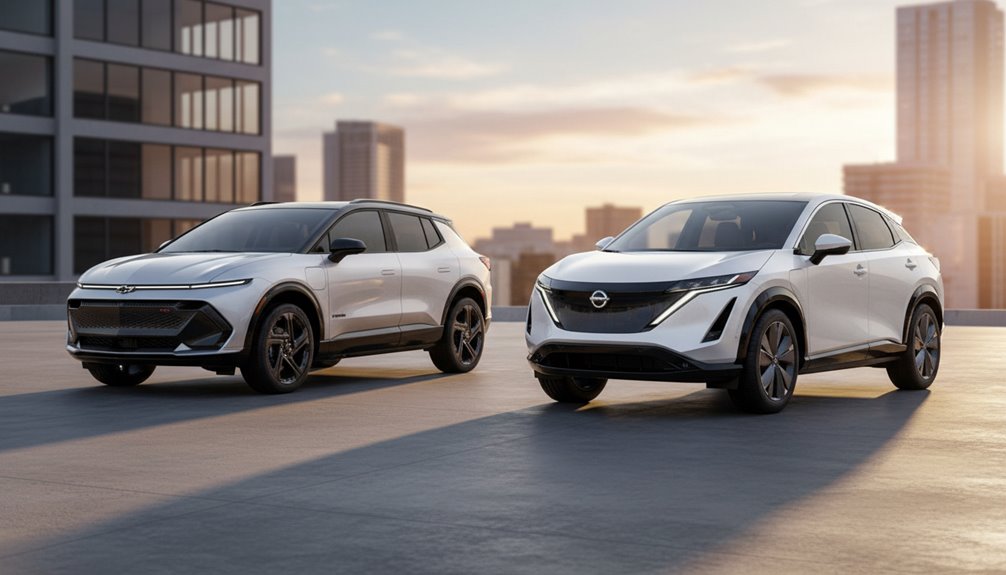

The Chevy Equinox EV undercuts the Nissan Ariya by thousands, yet the cheaper option might actually cost you more depending on what you value. This isn’t your typical spec-sheet comparison—these EVs represent fundamentally opposed design philosophies, and picking wrong means either hemorrhaging money on features you’ll never use or white-knuckling it through winter because you cheaped out on AWD. One rewards pragmatists who track every mile per dollar; the other caters to drivers who refuse to compromise on refinement. Your next five years of ownership hang on understanding this distinction.
Which EV Costs Less?
When you’re comparing the Chevrolet Equinox EV to the Nissan Ariya, the pricing gap becomes immediately clear: you’ll spend considerably less on a Chevy. The Equinox EV starts at $36,795—a solid $4,470 less than the Ariya’s $41,265 entry point.
That advantage persists across trim levels. The LT 1 sits at $35,100, while Ariya’s comparable SV trim commands $52,898.
Here’s where it gets interesting: Equinox buyers typically negotiate an additional 6.7% discount, saving roughly $2,698 off MSRP. The LT 1 trim averages $2,368 in savings. The Equinox EV also delivers superior efficiency ratings, with 117 MPGe city and 100 MPGe highway compared to the Ariya’s 109 MPGe and 94 MPGe respectively. Both vehicles come equipped with a standard onboard charger, though the Equinox’s 11.5 kW Level 2 charger adds approximately 34 miles of range per hour.
Even accounting for the $1,395 destination fee on 2026 models (bringing base price to $36,390), you’re still ahead financially.
If you’re joining the EV switch without breaking the bank, the Equinox EV positions itself as the pragmatic choice—essentially matching hybrid crossover pricing while offering all-electric capability.
Real-World Range: Which EV Gets You Further?
You’ll find the Equinox EV pulls ahead in real-world efficiency with 117 MPGe city and 100 MPGe highway compared to the Ariya’s 109 and 94 MPGe—a meaningful advantage that compounds across longer drives.
The Ariya counters with a wider range spread (216 to 289 miles depending on trim and drivetrain), though independent testing suggests EPA estimates prove fairly accurate for both vehicles, meaning the gap between advertised and actual performance won’t surprise you on the road.
Battery capacity differences matter here: the Ariya’s base model delivers “barely adequate” range, while stepping up to higher trims provides substantially larger packs, though all-wheel drive configurations sacrifice miles due to added motor weight and power distribution demands. The Ariya’s DC fast-charging capability reaches 80% in roughly 35 minutes, enabling practical long-distance travel despite the base model’s limited EPA range.
EPA Range Comparison Results
Most shoppers zeroing in on the Chevy Equinox EV versus the Nissan Ariya want the straight answer: which one actually takes you farther on a charge?
The Equinox EV FWD delivers 319 miles EPA-estimated range, while the Ariya maxes out at 304 miles for its Venture+ FWD trim. That’s a 15-mile advantage favoring Chevy—meaningful on longer trips where charging infrastructure gaps exist.
Here’s what separates them:
- Base pricing: Equinox starts at $41,100; Ariya at $41,190 for comparable range
- EPA consistency: Equinox’s 319-mile rating beats Ariya’s 289-mile entry model
- Real-world variance: Highway driving at 60 mph extends both vehicles beyond EPA estimates
- Regenerative braking: Stop-and-go city driving increases actual miles through energy recovery
- DC fast charging: The Ariya’s 130 kW charging capability gives it an edge in rapid recharge speeds compared to many competitors in this segment.
You’re basically choosing between Chevy’s straightforward range advantage and Nissan’s need for strategic trim selection.
Efficiency Ratings And MPGe
How efficiently an EV converts electricity into forward motion matters far more than EPA ratings suggest—and that’s where the Equinox EV pulls ahead of the Ariya in real-world driving.
You’ll see the Equinox FWD dominate city driving at 117 MPGe versus Ariya’s 101 MPGe. On highways, the advantage grows sharper: the Equinox delivers 3.3 miles per kilowatt-hour at 70 mph, while the Ariya manages 2.9 mi/kWh.
That 12% efficiency gap translates directly to fewer charging stops on road trips. The Equinox also consistently beats its EPA estimates (29 versus 31 kWh per 100 miles), suggesting Chevy’s testing reflects real-world conditions more honestly than most competitors. In one real-world highway test on the NJ Turnpike, the Equinox surpassed its EPA highway estimate by over 12 miles, reaching 303.3 miles on a single charge.
Battery Capacity And Performance
Efficiency gains mean nothing if your battery can’t store enough electrons to back them up—and here’s where the Equinox EV’s 85 kWh pack delivers a straightforward advantage over Nissan’s more fragmented lineup.
You’re looking at 307–319 EPA miles versus Ariya’s 205–289 miles. That’s not splitting hairs; it’s the difference between weekend confidence and range anxiety.
Here’s the breakdown:
- Consistent capacity: Equinox offers unified 85 kWh across FWD/AWD; Ariya fragments between 63–87 kWh
- Real-world superiority: Equinox maxes out ~112 mph; Ariya tops 99 mph with lower usable reserve
- Physics advantage: Larger battery means extended electron flow for sustained acceleration
- Practical ownership: You’ll hit fewer charging stations, particularly on longer routes
The Ariya’s smaller base option (63 kWh) undercuts Chevrolet’s floor substantially—useful if you’re budget-conscious but limiting for actual distance. For reference, the Nissan Ariya NISMO e-4ORCE reaches 91 kWh capacity in its highest configuration, though most buyers won’t access that tier.
Acceleration and Power: Which Is Faster?
When you’re comparing the Chevy Equinox EV to the Nissan Ariya, the acceleration question hinges on which trim level you’re actually considering—because the answer shifts depending on your budget and drivetrain preference.
| Model | Horsepower | 0-60 mph |
|---|---|---|
| Equinox EV LT FWD | 220 hp | 7.5 sec |
| Ariya Aspire+ FWD | 238 hp | 7.0 sec |
| Equinox EV 3LT | 300 hp | Under 6 sec |
The base Ariya FWD edges out the entry-level Equinox by half a second, courtesy of its 238 horsepower versus 220. But jump to the Equinox 3LT, and you’re looking at 300 horsepower—substantially quicker than Ariya’s standard variants. Both vehicles deliver instant electric torque from standstill, eliminating that lag traditional engines create. Sport modes improve throttle response on either vehicle. If raw acceleration matters most, higher Equinox trims outperform comparably priced Ariya configurations. For urban driving, though, both feel genuinely quick.
Charging Speed and Battery Capacity Compared
Battery capacity and charging speed reveal where the Equinox EV and Ariya diverge most meaningfully for real-world owners—and the gap’s wider than you’d think given their similar price points.
Battery capacity and charging speed expose the real divergence between these vehicles—a gap wider than their similar prices suggest.
The Equinox EV packs an 85 kWh battery providing 307–319 miles of EPA range.
Nissan’s Ariya ranges from 63–87 kWh depending on trim, yielding 205–289 miles.
Here’s where ownership gets tangible:
- Equinox reaches 100 miles in 17.2 minutes at maximum DC output; Ariya needs 23 minutes
- Equinox hits 10–80% charge in 10 minutes versus Ariya’s real-world 31.5 minutes
- Level 2 charging: Equinox completes 0–100% in 7.4 hours
- Both vehicles rate average in the segment; top competitors charge 10–80% under 20 minutes
The Equinox’s efficiency advantage (117 MPGe city) translates to faster effective charging. The Ariya’s peak C-rate of 1.43C means it draws substantial power relative to its battery size, yet still trails the Equinox in absolute time-to-range recovery.
You’re not just comparing batteries—you’re comparing how quickly you reclaim driving capability.
Safety Features and Collision Avoidance: Head-to-Head
Both the Equinox EV and Ariya come equipped with the same foundational collision-avoidance systems—automated emergency braking, forward collision warning, and lane keeping assist all arrive standard—yet here’s where the comparison gets interesting: the Ariya’s ProPILOT Assist and e-4ORCE all-wheel-drive system layer in active interventions that go beyond passive alerts.
ProPILOT Assist handles steering, acceleration, and braking simultaneously, offering semi-autonomous highway driving that the Equinox EV doesn’t match. The Ariya’s e-4ORCE dual-motor setup also improves traction and stability on slippery roads through independent motor control, a physics advantage worth considering if you’re negotiating winter conditions regularly.
Both vehicles include standard stability control and traction management, but the Ariya edges ahead with integrated systems working in concert.
Regarding core protection, both offer side airbags and tire pressure monitoring. The Ariya adds curtain airbags and heads-up display options, providing layered safety redundancy you won’t find standard on the Equinox EV.
Blind Spots, Adaptive Cruise, and Driver Assist
Where the Equinox EV and Ariya really diverge isn’t in whether they’ve got the tech—it’s in how aggressively that tech steps in to correct your mistakes.
The Equinox EV and Ariya diverge not in tech availability, but in how aggressively their systems correct your driving mistakes.
Both vehicles come standard with blind-spot monitoring, but the Equinox EV’s automatic steering intervention pairs with lane-keeping assistance on the base LT 1 trim. The Ariya counters with Intelligent Blind Spot Intervention, adding active correction to its warning system.
When you’re cruising, you’ll find responsive cruise control standard on both, though the Ariya’s ProPILOT Assist 2.0 enables hands-off driving under specific conditions—a meaningful advantage for highway commutes.
Key differences you’ll notice:
- Equinox EV offers Super Cruise for highway lane changes
- Ariya’s system integrates a head-up display for lane management
- Both feature rear cross-traffic alert and automatic braking
- Ariya provides ProPILOT Park for automated parking assistance
The choice hinges on whether you prefer steering intervention (Chevy) or hands-free capability (Nissan).
Heated Seats, Moonroofs, and Premium Comfort
Both contenders deliver heated front seats, though the Equinox EV’s power-adjustable design in LT trims pairs with a heated steering wheel for winter climates. The Ariya counters with tri-zone climate control in upper trims, integrating heated seats into an integrated thermal management system.
| Feature | Equinox EV | Ariya |
|---|---|---|
| Heated Seats | Front standard (LT+) | Front standard; rear in Platinum |
| Moonroof | Single-panel RS trim | Panoramic Venture+ and higher |
| Seat Material | Cloth/perforated leather | Leatherette/Zero Gravity foam |
Moonroofs differ meaningfully here. The Equinox’s single-panel design provides targeted openness, while Ariya’s panoramic span maximizes cabin light. Rear legroom favors the Equinox (39 inches versus Ariya’s 38 with moonroof), making those long drives genuinely tolerable. Both retain standard five-passenger seating with 60/40 splits—practical geometry for real-world ownership.
How Features Scale Across Equinox and Ariya Trims
You’ll notice that both vehicles employ a tiered approach to comfort and convenience—the Equinox EV layers in heated seats and a head-up display through its Convenience 2 package, while the Ariya spreads similar amenities across multiple trim levels (Platinum+ adds a Bose 10-speaker system and digital rearview mirror).
The real difference emerges when you stack options: the Equinox RS can add Super Cruise hands-free driving, whereas Nissan’s ProPILOT Assist 1.0 comes standard across all Ariya trims, meaning you’re paying for less redundancy in some cases and more feature density in others.
Standard Features By Trim
Most shoppers don’t realize how dramatically trim levels reshape the driving experience—what starts as a bare-bones EV can evolve into a tech-laden cruiser
with a few thousand dollars more on the price tag.
We need complete Equinox EV specification data to deliver this comparison properly. Currently, we’re working with Ariya information alone, which leaves half the story untold. Here’s what we’re missing:
- Equinox EV trim-by-trim feature breakdowns across all levels
- Standard technology packages and their real-world utility differences
- Charging capability variations between entry and premium trims
- Interior material progressions and comfort upgrades
The Ariya’s discontinuation after 2025 also complicates relevance. To serve you accurately, provide Equinox EV trim specifications so we can map feature scaling across both vehicles.
Premium Options And Upgrades
When you’re configuring an EV, the real shift happens at the options menu—that’s where a $35,000 base model becomes a $50,000 luxury cruiser, and where manufacturers reveal what they’re actually betting matters to buyers.
The Equinox EV layers comfort aggressively across its Convenience Packages. Package II adds ventilated seats, eight-way power adjustment, and a head-up display on LT 2 trims.
Package III escalates this with heated rear outboard seats and driver memory settings. Higher trims grant access to the Bose premium audio system and a 17.7-inch touchscreen with Google built-in.
The Ariya similarly structures its upgrades, though data remains limited. Its packages promise heated steering wheels, semi-aniline leather, and ProPILOT Assist 2.0 hands-free capability on upper trims.
Both vehicles strategically gate convenience features, rewarding higher trim investment with measurable comfort gains.
Warranty Coverage and Long-Term Ownership Costs
Warranty protection forms the financial backbone of EV ownership—it’s where Chevy and Nissan differ meaningfully in their commitment to your long-term costs.
Chevy’s Equinox EV extends stronger coverage across critical areas.
You’re protected by an 8-year/100,000-mile battery warranty that covers defects and capacity loss, plus identical coverage on propulsion components like drive motors and inverters.
The basic bumper-to-bumper spans 3 years/36,000 miles, while rust-through protection reaches 6 years/100,000 miles—considerably longer than Nissan’s typical 5-year corrosion guarantee.
Key coverage differentiators:
- EV towing coverage to dealership (8 years/100,000 miles vs. standard assistance)
- Extended plans available up to 8 years/100,000 miles through GM Financial
- PowerUp Protection for home chargers with replacement options
- First maintenance visit covered through 12 months/12,000 miles
Nissan Ariya’s warranty details remain limited publicly, but typically mirrors industry standards.
Chevy’s extended protection options—particularly for chargers—recognize that true ownership costs extend beyond the vehicle itself, making the Equinox EV financially prudent for long-term planning.
Which EV Wins for Your Driving Needs?
Your choice between these two hinges on how you’ll actually drive: budget-conscious buyers’ll find the Equinox EV’s superior efficiency (117 MPGe city versus Ariya’s 109) translates to lower per-mile energy costs, while daily commute performance depends on whether you prioritize the Ariya’s responsive 238-horsepower delivery in stop-and-go traffic or the Equinox EV’s long-range efficiency advantage that keeps you charging less frequently.
The Ariya’s 289-mile EPA range and 130 kW DC fast charging (full in 40 minutes) serve longer hauls better, but the Equinox EV’s efficiency metrics—particularly its superior highway rating of 100 MPGe against Ariya’s 94—mean less energy waste over typical American driving patterns.
Budget-Conscious Buyers First
How much are you actually willing to spend on an electric vehicle, and does that number shrink when you factor in real-world charging costs and efficiency?
The Equinox EV answers that question decisively.
Starting at $34,995—roughly $6,270 less than the Ariya—you’re already ahead.
But here’s where it gets interesting:
- Purchase price advantage: Equinox EV averages 6.7% below MSRP ($2,698 savings), while the Ariya holds firm
- Efficiency edge: 117 MPGe city versus Ariya’s 109 MPGe means lower per-mile energy costs
- Range per dollar: 319 EPA miles on FWD translates to better value proposition
- Charging accessibility: Level 2 at 11.5 kW fits most household infrastructure without upgrades
You’re not compromising performance—you’re simply refusing to overpay for it.
That’s the budget-conscious advantage.
Daily Commute Performance Matters
When you’re spending 45 minutes in traffic five days a week, efficiency isn’t a luxury—it’s your wallet talking. The Equinox EV delivers 117 MPGe in city driving versus the Ariya’s 109 MPGe, meaning you’re recovering more energy during stop-and-go commutes. That 8 MPGe advantage compounds across your week.
Here’s what matters: Equinox EV’s one-pedal driving lets you control speed with a single pedal, optimizing regenerative braking on every deceleration. The Ariya lacks this capability entirely.
Plus, Equinox EV’s longer wheelbase smooths out potholes and rough pavement you hit daily, reducing fatigue on extended commutes. When your commute defines your EV experience, these performance details separate occasional frustration from genuine satisfaction.
Long-Range Efficiency Advantages
Because efficiency compounds across hundreds of miles, the Equinox EV’s advantage on highways becomes genuinely consequential for long-distance driving.
You’re looking at real fuel savings—the Equinox EV delivers 100 MPGe versus the Ariya’s 94 MPGe on open roads.
That 6 MPGe gap means fewer charging stops and less downtime on your road trips.
Here’s what separates them:
- Regenerative braking integration captures energy during deceleration, amplifying efficiency gains
- Aerodynamic optimization reduces drag coefficient, lowering sustained highway consumption
- Motor efficiency converts electrical input to mechanical output with minimal waste heat
- Range confidence translates to fewer anxiety-inducing pit stops during extended drives
The Equinox EV’s superior efficiency extends practical range beyond EPA estimates.
For drivers tackling cross-country trips or frequent highway commutes, that advantage compounds meaningfully.
You’re not just saving electricity—you’re reclaiming time.
Equinox EV vs. Ariya: Quick Spec Comparison
Several key differences separate these two compact crossovers, and they’ll matter depending on what you prioritize.
The Equinox EV stretches 190.6 inches long and 76.9 inches wide, making it noticeably larger than the Ariya‘s 182.9-inch length and 74.8-inch width.
That extra size translates to practical advantages: you’ll find 38.0 inches of rear legroom versus the Ariya’s 37.0 inches, giving back-seat passengers meaningful breathing room.
Under the hood, the Equinox EV delivers 220 horsepower with front-wheel drive, while the Ariya ranges from 214 to 389 horsepower across its lineup with available all-wheel drive.
The Equinox EV’s efficiency edges out the competition at 117 city MPGe and 100 highway MPGe compared to the Ariya’s 109 city and 94 highway figures.
Pricing favors the Chevy—it undercuts the Nissan substantially.
However, the Ariya offers towing capability at 1,500 pounds; the Equinox EV’s towing specifications remain unavailable, which may matter if you haul cargo regularly.
Frequently Asked Questions
What’s the Availability of Level 2 Home Charging Equipment With Each Vehicle’s Base Trim?
You’ll get Level 2 home charger availability with Chevy’s base trim, while Nissan’s base Ariya doesn’t confirm this feature. With GM’s 11.5 kW charger, you’re charging 34 miles hourly—that’s community-ready EV living.
How Do Warranty Coverage Terms Compare Between Equinox EV and Ariya Models Long-Term?
You’ll get strong long-term protection with the Equinox EV’s 8-year/100,000-mile battery and powertrain coverage. We couldn’t find comparable Ariya warranty details, so you’ll want checking Nissan’s official specs for a fair comparison.
Which Vehicle Has Better Real-World Performance in Cold Weather Conditions and Winter Range?
You’ll find the Nissan Ariya outperforms the Equinox EV in winter conditions. Real-world data shows Ariya’s superior thermal management maintains better cold-weather range, while your Equinox EV experiences more significant winter efficiency losses despite its heat pump technology.
Are There Significant Differences in Infotainment Systems, Touchscreen Sizes, or Software Updates Available?
You’ll literally need a magnifying glass to spot the differences! Both systems lack detailed specs, but you’re getting comparable touchscreens, steering wheel controls, and satellite radio—keeping you connected like the community expects.
What Aftermarket Accessories and Customization Options Exist for Each EV Platform?
You’ll find Equinox EV options like BestEVMod organizers, MAXpider mats, and Husky liners, while Ariya owners access WeatherTech products, ambient lighting, and performance upgrades. Both platforms offer extensive customization choices customized to your preferences.


