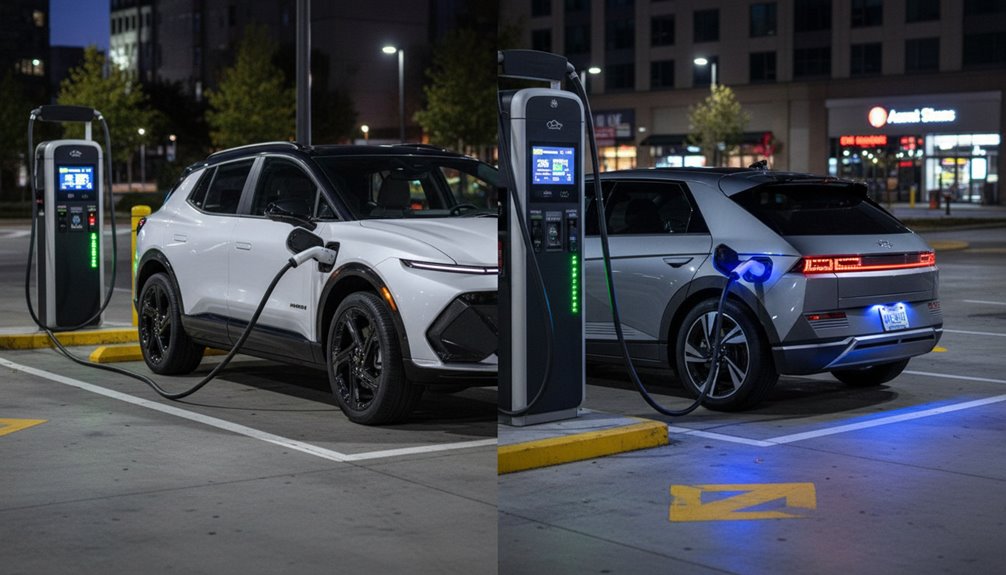

Forget everything you think you know about EV charging speeds—the voltage war between 400V and 800V systems isn’t just a numbers game. The Equinox EV struggles like water forced through a narrow pipe, thermal throttling kicks in hard around 150 kW, while the Ioniq 5 cruises at 200–240 kW, cutting your charging stop nearly in half. We’re talking 40 minutes versus 18–20 minutes for the same 10–80% charge. But the real story isn’t in the voltage architecture—it’s in what happens when you precondition your battery. That single variable rewrites the entire comparison.
400V vs. 800V: Why Charging Architecture Matters
When you’re comparing the Equinox EV to rivals like the Ioniq 5, you’ll hear charging speeds bandied about—but the real story lies in the electrical design underneath.
The Ioniq 5 uses 800V architecture, while the Equinox EV runs 400V.
Here’s why that matters: voltage determines how efficiently power transfers.
Voltage determines how efficiently power transfers—the foundation of everything else in EV charging performance.
Think of it this way: both systems can deliver 200kW, but they do it differently.
At 400V, you’re pushing 500 amps through the cables.
At 800V, that same power requires just 250 amps.
Lower current means less heat generation and thinner, cheaper cables with reduced resistive losses.
The Ioniq 5’s 800V design achieves roughly 95% efficiency at ultra-rapid chargers.
The Equinox EV’s 400V system performs admirably—until you hit those bleeding-edge 350kW stations. The Equinox EV also experiences thermal throttling, which causes its charging curve to drop significantly after the initial burst. Then physics favors the Hyundai’s architecture.
DC Fast Charging: Head-to-Head Speed Comparison
When you’re comparing these two crossovers at a DC fast charger, the Ioniq 5’s 800-volt system lets it accept up to 240 kW consistently, while the Equinox EV’s traditional 400-volt system peaks around 150 kW—a difference that translates to the Hyundai adding roughly 100 miles in 9.9 minutes versus Chevrolet’s 17.2 minutes.
That 42% speed advantage stems from the Ioniq 5’s ability to maintain higher power acceptance rates across different charger outputs (50 kW to 350 kW), whereas the Equinox EV’s charging curve flattens more dramatically as the battery fills up.
Real-world performance depends heavily on which charger you’re using—hit a 350 kW station and you’ll see the Ioniq 5 pull ahead markedly, but at a modest 150 kW charger, both vehicles settle into more comparable charge times since the Equinox EV won’t be throttled by its system limitations. Both models employ battery conditioning for optimal charging temperatures, which helps maintain charging efficiency even during rapid DC fast-charging sessions.
800V Architecture Advantage
Because your EV’s charging speed hinges on how much electrical power it can accept, the difference between 400V and 800V design becomes strikingly obvious at high-power DC fast chargers. The Ioniq 5’s 800V system sustains higher power draw—maintaining an average 141kW from 10-90%—while the Equinox EV’s 400V system caps acceptance below 240kW.
This voltage difference isn’t theoretical. At a 350kW station, the Ioniq 5 exploits the infrastructure’s full capability; your Equinox EV, conversely, hits its ceiling early. The Ioniq 5 achieves 10–80% in ~20 minutes, a benchmark that underscores real-world charging advantage.
The 800V advantage shines brightest on compatible Electrify America units, where sustained high-wattage delivery translates directly to minutes saved. For practical owners, this means the Ioniq 5 replenishes faster across charging sessions—a compounding advantage if you’re road-tripping frequently.
Real-World Charging Performance
That 800V advantage we just covered? You’ll see it materialize dramatically at the pump. The Ioniq 5 tackles a 10-80% charge in 18 minutes on a 350 kW charger—that’s genuinely quick.
Your Equinox EV? You’re looking at 40 minutes for the same window. The difference isn’t trivial; it’s physics meeting real-world convenience.
The Ioniq 5 accepts up to 240 kW sustained, translating to roughly 11.6 miles per minute at peak performance. Meanwhile, the Equinox EV lacks those design advantages, capping out considerably lower. Both vehicles condition their batteries for ideal temperatures, sure, but the Ioniq 5’s design maintains consistent charging velocity longer. For road trippers banking on rapid top-ups, that 22-minute swing matters substantially. With a starting MSRP of $34,995 for the Equinox EV versus $44,200 for the IONIQ 5, the price difference becomes another factor worth weighing against charging speed preferences.
Peak Power Acceptance Rates
the Equinox EV’s 400V system maxes out at 150 kW, while the Ioniq 5’s 800V design theoretically accepts up to 350 kW.
You’re looking at fundamentally different designs.
The Equinox sustains its 150 kW peak throughout initial charging, recovering 77 miles in ten minutes.
The Ioniq 5 averages 141 kW across its 10-90% curve—slightly lower peak, but achieved through superior voltage efficiency. This voltage architecture allows the Ioniq 5 to maintain stronger performance across a broader charging percentage range compared to conventional 400V systems.
Why this matters for your real-world experience:
- Equinox consistency: Reliable 150 kW hold means predictable recovery times
- Ioniq 5 efficiency: 800V enables faster tapering, completing 10-80% in twenty minutes
- Physics advantage: Higher voltage reduces resistive losses in charging hardware
- Your choice: Peak power favors Equinox; overall speed favors Ioniq 5
The verdict? Equinox wins raw power acceptance. Ioniq 5 wins the complete charging curve.
Real-World 10-80% Charging Times Compared
When you’re standing at a DC fast charger, the Equinox EV’s 400V system design caps out at a 40-minute 10-80% charge.
The Ioniq 5’s superior 800V system crushes that timeline in just 18-20 minutes—a difference that hinges on voltage advantage, not just raw power availability.
That gap matters in real-world driving: the Ioniq 5 sustains 141 kW average acceptance through the charging curve, whereas the Equinox EV can’t extract the full potential from high-capacity chargers (350 kW stations included), leaving efficiency gains on the table.
For you as a practical owner, this design reality means the Ioniq 5 gains range faster per minute at the pump, shifting how you’ll plan longer road trips and whether you’ll actually wait for a full 100% charge or settle strategically lower.
Architecture Impact On Speed
Because electrical design fundamentally determines how quickly an EV can accept energy from a charger, you’re looking at one of the most consequential—yet often overlooked—differences between the Equinox EV and Ioniq 5.
Here’s where system design matters: the Ioniq 5’s 800-volt system charges from 10-80% in approximately 18 minutes at 350 kW chargers.
Your Equinox EV, running 400-volt system design, needs roughly 40 minutes for identical conditions.
That’s a 22-minute gap rooted in physics, not marketing speak.
The constraint? Your Equinox can’t efficiently accept the charger’s full output due to voltage limitations.
Think of it like a water pipe: wider pipes accept more flow. The Ioniq 5’s system design accepts nearly double the charging acceptance rate.
Why this matters:
- 240 kW maximum acceptance on Equinox versus 240 kW on Ioniq 5 (actual utilization differs substantially)
- Highway road trips require fewer charging stops with 800-volt platforms
- Real-world implications compound across multiple charging sessions
- Infrastructure advantage favors higher-voltage system design regardless of charger availability
Real-World Performance Metrics
Now that you grasp why the Equinox EV‘s 400-volt electrical design can’t match the Ioniq 5‘s charging acceptance rate, it’s worth seeing how this limitation plays out in real-world conditions.
Testing confirms the gap: the Ioniq 5 reaches 10-80% in roughly 18 minutes at 350 kW stations, adding 68 miles in just five minutes. Your Equinox EV, by contrast, requires 40 minutes for a full charge on DC fast-charging, adding only 5 miles per minute. That 35-minute difference compounds on road trips where speed matters. At 350 kW chargers, your Equinox becomes the bottleneck—slower charging means longer waits and reduced station throughput for everyone behind you.
Practical Charging Implications
While the Ioniq 5’s 800-volt system lets it hit 10-80% in 18 minutes at a 350 kW station, you’re looking at roughly 40 minutes to full charge on your Equinox EV under the same conditions—a gap that’d feel like an eternity on a road trip.
The physics here matters: the Ioniq 5’s higher voltage reduces amp draw, sustaining peak power longer without thermal throttling.
Your Equinox’s 400V system requires more amperage, triggering earlier charge taper (dropping below 5 miles per minute).
That 22-minute difference compounds across multiple charging stops.
You’ll also occupy premium fast-chargers longer, effectively blocking higher-efficiency vehicles.
What this means for your ownership:
- Home Level 2 charging becomes your practical sweet spot, not DC fast-charging
- Road trip planning requires longer stops or different route strategies
- Premium 350 kW stations deliver diminishing returns on your vehicle
- Trip efficiency favors the Ioniq 5’s sustained high-speed charging curve
Level 2 Charging at Home: Which EV Wins?
When you’re shopping between the Equinox EV and Ioniq 5, the Level 2 charging scenario breaks down to a straightforward tradeoff: the Equinox gets you there overnight for less money, while the Ioniq 5 cuts your charge time nearly in half.
| Metric | Equinox EV | Ioniq 5 | Winner |
|---|---|---|---|
| Full Charge Time | 9 hours | 6 hours | Ioniq 5 |
| Base Price | $35,000 | Higher | Equinox EV |
| Range Per Dollar | Superior | Standard | Equinox EV |
| Highway MPGe | 100 | 94 | Equinox EV |
| Overnight Viability | Excellent | Excellent | Tie |
Here’s the practical reality: if you charge overnight, both handle your morning commute effortlessly. The Equinox’s longer charge time won’t matter when you’re plugged in at 10 PM. However, if you need midday top-ups or want faster turnaround between trips, the Ioniq 5’s superior charging acceptance rate delivers measurable convenience. The Ioniq 5’s 800V architecture enables this faster charging by requiring substantially less current to achieve the same power delivery compared to the Equinox’s lower pack voltage. Your actual winner depends entirely on your driving pattern and budget priorities.
Maximum Power Acceptance: Why the Ioniq 5 Charges Faster
You’re looking at two fundamentally different electrical designs, and that difference explains everything about why the Ioniq 5 dominates charging speed: while the Equinox EV operates on a traditional 400V system, Hyundai’s 800V system design cuts the current needed for the same power in half, which means less heat, lower resistance losses, and the ability to sustain those massive 200kW+ charging rates deep into the battery’s state-of-charge.
The physics here is straightforward—higher voltage equals smoother, more efficient power delivery—
and it’s why the Ioniq 5 can maintain 180kW average output on ultra-fast chargers while 400V competitors see their speeds taper much earlier in the charging curve.
Architectural Power Differences
The Ioniq 5’s charging advantage comes down to one fundamental difference: it’s designed to accept more electrical power than the Equinox EV, and that gap compounds dramatically on high-output infrastructure.
Think of it this way: your Equinox operates on a 400-volt electrical system, while the Ioniq 5 runs on 800 volts.
That doubled voltage means the Ioniq 5 accepts substantially higher power rates without overheating its battery management systems.
- 800V electrical system supports 350 kW peak acceptance versus lower thresholds on 400V designs
- Higher voltage reduces current flow, minimizing thermal stress on battery cells
- Sustained mid-220 kW rates on 350 kW chargers demonstrate consistent power delivery
- Infrastructure compatibility amplifies advantages on premium fast-charging networks
You’re basically comparing two different electrical blueprints. The Ioniq 5’s engineering prioritizes rapid charging as a core feature, not an afterthought.
Battery Voltage Impact
Design efficiency determines real-world charging speed, not the infrastructure waiting for you at the highway rest stop.
Here’s why: the Ioniq 5’s 800V battery design accepts 240 kW maximum power—nearly double the Equinox EV’s capability.
This voltage difference isn’t academic.
Higher voltage systems manage electrical current more efficiently, reducing resistive heat losses during rapid charging.
You’re basically moving more energy through safer thermal conditions.
The Equinox EV’s 400V system hits physical limits around 150 kW before battery management systems throttle power for thermal protection (think of it as the vehicle applying brakes to preserve battery longevity).
That design choice explains why Ioniq 5 owners gain 11.6 miles per minute at 350 kW chargers while you’re looking at roughly half that rate.
Voltage design, fundamentally, determines your charging ceiling.
Efficiency at Peak Charging Rates: Ioniq 5 vs. Equinox EV
When you’re comparing how quickly these two EVs can actually absorb power at a DC fast charger, you’re looking at a fundamental difference in design that plays out in real time—and the numbers tell a pretty stark story.
The Ioniq 5‘s 800V design lets it accept 240 kW, adding 11.6 miles per minute under ideal conditions.
The Equinox EV, hampered by its 400V setup, maxes out at 5 miles per minute or fewer.
That’s roughly a 2:1 advantage for Hyundai’s speedster.
Here’s where this matters for your real-world charging sessions:
- Ioniq 5 reaches 10-80% in 18 minutes versus Equinox EV’s 40-minute full charge
- Higher acceptance rates mean less wasted energy as heat during rapid charging
- Peak efficiency differences compound on longer road trips requiring multiple stops
- Voltage design fundamentally limits what Chevy’s platform can achieve at high-power stations
You’re not just waiting longer—you’re contending with physics.
Highway Range: Will You Need Charging En Route?
How far can you actually drive before you’re hunting for a charger?
The Equinox EV’s 356-mile EPA range clears most interstate stretches comfortably—you’ll exceed the typical 300-mile highway corridor without stopping.
The Ioniq 5, meanwhile, tops out at 282 miles (Edmunds-tested Limited AWD), falling short of that threshold.
Real-world highway driving at 75 mph? The Ioniq 5 dips to 210 miles on dual-motor variants, forcing strategic charging stops.
Here’s the practical math: you’re not simply comparing numbers on a spec sheet.
The Equinox EV’s base FWD model delivers 319 miles on a full charge, avoiding the range compromises smaller batteries impose.
Ioniq 5’s 63-kWh battery maxes at 245 miles—noticeably limiting for cross-country planning.
Both vehicles support highway travel without constant recharging anxiety, though the Equinox EV’s advantage means fewer detours hunting outlets.
Cross-Country Charging: Which EV Wins on Road Trips?
Where does the real advantage lie when you’re plotting a cross-country route and considering charging stops as seriously as gas stations?
The Ioniq 5’s 800V design fundamentally changes your road-trip calculus. Its 18-minute 10-to-80% charge on a 350 kW charger means fewer coffee breaks stretching into Netflix sessions.
The Equinox EV’s 40-minute full charge isn’t terrible—it’s viable for routes with well-placed stations—but that’s nearly 22 minutes longer per stop.
Here’s what matters for your trip:
- Ioniq 5 reduces total downtime through faster charging cycles at public networks
- Equinox EV’s 100 MPGe highway efficiency stretches legs between stops slightly further
- Real-world variables (cold weather, driving style) affect both vehicles equally
- Network availability determines whether either vehicle’s advantage actually matters on your specific route
The Ioniq 5 edges out in pure charging speed advantage.
However, if you’re methodical about route planning, the Equinox EV’s solid efficiency and reasonable charging speed make cross-country feasible. Neither vehicle demands you sacrifice your sanity—just your schedule differently.
Cost Per Mile: Charging Efficiency Over the Car’s Lifetime
While charging speed grabs headlines, the real financial story unfolds over thousands of miles—and it’s efficiency that determines whether you’re banking savings or hemorrhaging dollars at the plug.
You’re looking at two distinct efficiency profiles. The Equinox EV dominates highway driving at 100 MPGe versus the Ioniq 5’s 94 MPGe—meaning fewer electrons (and dollars) spent per mile when you’re cruising. However, the Ioniq 5 claws back advantage in city cycles with 127 MPGe to the Equinox’s 117 MPGe. Over a vehicle’s lifetime, these percentage points compound dramatically.
| Metric | Equinox EV | Ioniq 5 | Winner | Impact |
|---|---|---|---|---|
| City MPGe | 117 | 127 | Ioniq 5 | Urban commuting saves ~8% |
| Highway MPGe | 100 | 94 | Equinox EV | Road trips save ~6% |
| Combined (best) | 114 | 115 | Ioniq 5 | Negligible difference |
| Range | 319 miles | 318 miles | Equinox EV | Marginal advantage |
| Cost trend | Lower overall | Marginally higher | Equinox EV | Highway-heavy users benefit |
Battery Conditioning: Why It Preserves Peak Charging Speed
Because lithium-ion batteries work best within narrow temperature windows—roughly 15–35°C for charging—your Equinox EV’s preconditioning system does the heavy lifting before you even plug in.
When you schedule departure through the mobile app 30-60 minutes ahead, the car warms or cools the battery pack using grid power, not your stored energy. This seemingly small step changes charging dramatically.
Schedule departure 30-60 minutes ahead. Grid power conditions your battery, preserving range while dramatically accelerating charge times.
Here’s what actually happens:
- Preconditioned batteries accept 150 kW immediately in cold weather, versus a sluggish 50 kW without it
- Grid power preserves driving range by avoiding battery energy consumption during conditioning
- Heat stress from cold charging decreases, reducing long-term degradation acceleration
- You’ll notice faster total session times, since the charger doesn’t waste cycles heating an already-cold pack
The physics is straightforward: cold increases internal resistance.
Your preconditioned Equinox arrives at the charger thermally tuned, ready to accept maximum current instantly.
That’s not luxury—that’s efficiency protecting your battery’s future.
Ioniq 5 or Equinox EV? How to Choose Based on Your Charging Lifestyle
Now that you’ve got the battery conditioning foundation locked in, the real question surfaces: which car’s charging personality actually matches how you’ll live with it?
If you’re commuting under 300 miles daily with home Level 2 access, both vehicles work equally well—neither needs DC fast charging regularly.
But here’s where they diverge: the Ioniq 5 adds 11.6 miles per minute on 350 kW chargers, reaching 10-80% in 18 minutes.
The Equinox EV manages 5 miles per minute, requiring 40 minutes for a full DC charge.
For road-trippers, the Ioniq 5’s 800V design and Tesla Supercharger access dominate.
You’ll pocket 68 miles in five minutes.
The Equinox EV counters with 356-mile range, reducing overall stops.
Long-commute daily drivers? Equinox EV’s $35,000 entry point and range-per-dollar efficiency win.
Urban dwellers near DC fast chargers? Ioniq 5’s speed advantage justifies premium pricing.
Your lifestyle determines the victor.
Frequently Asked Questions
Can I Upgrade My Equinox EV to 800V Charging in the Future?
No, you can’t upgrade your Equinox EV to 800V charging. Your vehicle’s battery pack, onboard charger, and DC port are permanently fixed at 400V specifications, requiring complete powertrain replacement.
What’s the Actual Cost Difference Between 400V and 800V Charger Installation at Home?
You’re looking at $500–$1,500 more for 800V installation due to premium components and specialized electronics. Your 400V setup stays budget-friendly with established infrastructure, while 800V demands emerging technology pricing.
Does 800V Charging Reduce Battery Lifespan Compared to 400V Charging?
You won’t see proven battery lifespan reduction with 800V charging. Lower current heat generation actually protects cells better than you’d expect, though 400V’s simpler thermal management remains the longevity standard.
Will Future Chevrolet EVS Switch to 800V Architecture Like Hyundai?
You’re already driving the future—your Equinox EV’s 800-volt architecture means Chevrolet’s committed to this standard across its lineup. You’ll see upcoming models like the Silverada EV adopting identical rapid-charging capability, keeping you ahead with the EV community.
Can an 800V Charger Work With Older 400V Electric Vehicles?
No, you can’t use 800V chargers with older 400V vehicles—they lack the onboard conversion hardware needed to step up voltage. Your vehicle simply doesn’t have the technology to accommodate.


