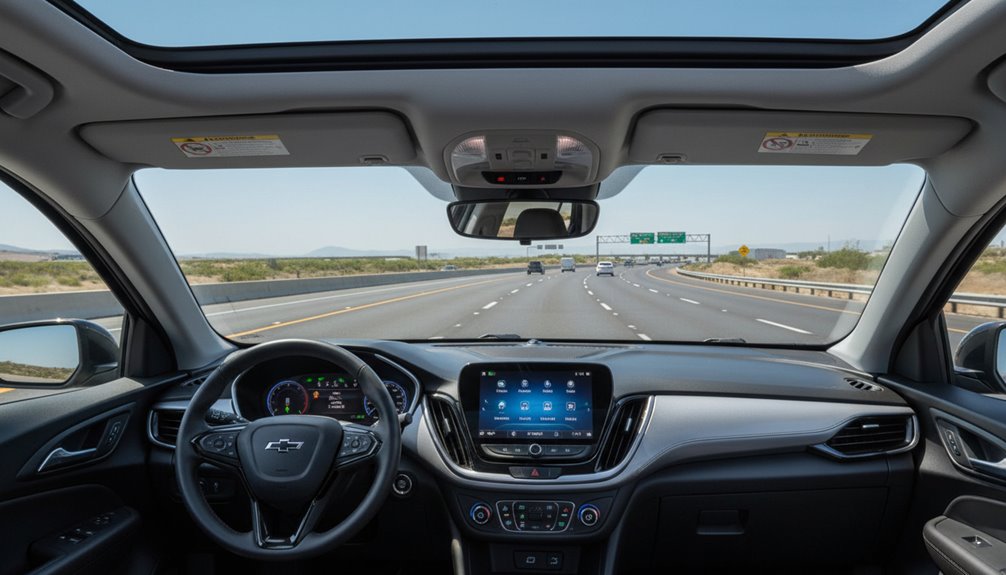

Your Equinox EV steers itself down the highway while you sit back, hands free—but an infrared camera never stops watching your face. Super Cruise promises liberation from the steering wheel, yet demands your constant attention in return. This technology fuses GPS, LiDAR maps, radar, and cameras into a single brain that makes split-second decisions, but only under conditions so specific they might surprise you. The question isn’t whether the car can drive itself—it’s whether you’re comfortable being monitored the entire time it does.
Super Cruise Explained: Hands-Free Driving Basics
Since General Motors introduced Super Cruise in 2017, the technology’s evolved from a novelty into the largest hands-free driving network across North America—and your Equinox EV can tap into it.
Here’s what’s actually happening when you engage Super Cruise: precision LiDAR maps feed your vehicle high-definition road data, while GPS pinpoints your exact location in real-time.
Cameras identify lane markings, sensors validate road conditions, and an infrared driver attention camera monitors whether your eyes stay on the road.
The system steers your Equinox EV to maintain lane position, manages speed and following distance through dynamic cruise control, and even handles lane changes for passing or merging—all without your hands on the wheel.
But Super Cruise isn’t autonomous driving. You remain responsible. The driver attention system ensures you stay engaged and ready to take control at any moment. Super Cruise operates exclusively on mapped highways, limiting its availability to predetermined routes across North America.
The steering wheel light bar glows green when hands-free operation’s active; blue indicates you need manual control immediately.
Ignore alerts, and the system shuts down. It’s partnership, not autopilot.
Activate Super Cruise in Three Steps
You’re three button presses away from hands-free driving—assuming you’re on a compatible road with visible lane markings and decent GPS signal.
Here’s the activation sequence:
1. Press the Dynamic Cruise Control button** on your steering wheel (it resembles a speedometer with an arrow**).
This prerequisite enables the system and displays a white or green icon on your instrument cluster.
2. Confirm the white Super Cruise symbol**** appears on your driver display.
This indicates all conditions are met—visible lane markings, GPS lock, and proper lane centering.
A blue symbol means you’re off-center; adjust steering until it turns white.
3. Press the dedicated Super Cruise button when safe.
Your steering wheel icon and light bar shift green, signaling hands-off permission.
The system simultaneously activates Improved Automatic Emergency Braking. Enhanced Automatic Emergency Braking also activates automatically whenever Super Cruise is engaged.
4. Monitor the head-up display (on equipped models) confirming active status.
You’re now engaged in true hands-free operation—though stay alert for red alerts demanding immediate control.
Where Super Cruise Works: Roads and Conditions
Now that you’ve got Super Cruise activated, here’s the reality check: it won’t work everywhere you drive.
The system operates on over 400,000 miles of compatible divided highways—soon expanding to 585,000 miles, with projections hitting 750,000 by end of 2025.
But those numbers only tell half the story.
Super Cruise demands divided, limited-access highways where opposing traffic stays separated.
City streets, intersections, rural roads, and suburban drives? Off-limits.
Exit lanes and service roads won’t engage the system either.
Beyond road type, you’ll need crisp lane markings and solid GPS signal.
Snow covering lines or poor visibility kills activation instantly.
Rain, fog, ice, and sleet force disengagement—the system hands control back to you when conditions turn sketchy.
The driver-facing camera enforces attention monitoring throughout operation to ensure you remain engaged with the road.
Think of Super Cruise as a highway specialist, not an all-purpose chauffeur.
It’s powerful within its lane (literally), but limitations exist for safety reasons.
Adaptive Cruise Control and Intelligent Spacing
You’ll appreciate how Responsive Cruise Control handles the real work of highway driving by automatically maintaining your chosen following distance from the vehicle ahead, using forward-facing cameras and radar sensors that continuously measure speed and spacing to keep you safely positioned.
When traffic inevitably slows to a crawl or stops entirely, the system smoothly decelerates without jerky inputs, then accelerates back to your set speed once the road clears—no stomping on pedals required. The Driver Attention System monitors your head position to ensure you remain alert and ready to take control whenever needed.
You can customize your following gap time (typically ranging from roughly 1 to 4 seconds of separation) through steering wheel controls, giving you control over how aggressive or conservative the spacing feels for your driving preferences.
Maintaining Safe Following Distance
When traffic ahead slows unexpectedly, intelligent cruise control does the heavy lifting—automatically adjusting your Equinox EV’s speed to maintain a preset gap between your vehicle and the one in front of you.
You’re in control of the spacing you want:
- Select your following distance as gap time (typically 1-4 seconds) or fixed distance measurements
- Let cameras and sensors continuously monitor the leading vehicle’s position and speed
- Watch the system automatically brake and accelerate through traffic flow changes
- Rely on GPS and LiDAR mapping to maintain spacing even through curves
The technology maintains safe distances during both acceleration and braking phases. Your Super Cruise system requires active Super Cruise Plan subscription to enable this adaptive cruise functionality on compatible roads.
Your Equinox EV adjusts seamlessly, keeping you positioned safely without constant pedal adjustments—exactly what modern highway driving demands.
Stop-And-Go Traffic Management
Maintaining that preset gap works beautifully on open highways, but stop-and-go traffic presents a different animal altogether—one where your Equinox EV’s Super Cruise system truly earns its keep.
The system automatically detects slower vehicles ahead and adjusts your speed accordingly, smoothly decelerating as traffic congests. When the lead vehicle stops, your Equinox EV follows suit, braking without your input. Once traffic resumes, Super Cruise seamlessly accelerates back to your selected following distance. Super Cruise works with Adaptive Cruise Control to maintain your driver-selected following gap while controlling both acceleration and braking in stop-and-go traffic.
This continuous adjustment eliminates the energy-draining pattern of abrupt stops and starts that plague manual driving in congested conditions. For your battery, that matters substantially—optimized speed management reduces drain while maintaining safety within ±4 inches of your target gap. Your hands stay free; physics handles the rest.
Customizable Gap Selection Options
Rather than accepting whatever following distance your Equinox EV defaults to, you’ve got genuine control over the spacing between your vehicle and the one ahead—and that control lives on your steering wheel.
The gap adjustment button cycles through predefined time-based intervals—typically ranging from 1 to 2 seconds—letting you customize how closely you follow traffic.
You’re not guessing; the system maintains your chosen distance by automatically adjusting speed relative to the vehicle ahead.
Here’s what you can do:
- Press the gap button to cycle through short, medium, and long spacing options
- Watch your cluster display confirm the selected setting in real-time
- Combine gap adjustments with Resume/+ buttons for integrated speed and spacing control
- Save your preferred gap as a driver profile default for tailored convenience
This flexibility elevates commutes from reactive driving into genuinely streamlined following patterns.
Lane Centering: How It Keeps You Centered
As you’re cruising down the highway, Super Cruise’s lane centering system works behind the scenes to keep your Equinox EV precisely positioned between the lines.
And it’s doing so through a sophisticated interplay of hardware and software that’d make a tightrope walker jealous.
Your vehicle’s cameras detect lane markings.
LiDAR maps provide high-definition road curvature data.
GPS with real-time corrections pinpoints your exact location.
The Unified Lateral Controller processes these inputs within seconds, calculating steering adjustments based on vehicle path, speed, and load.
It’s basically running physics equations constantly.
Here’s the catch: you’re not truly hands-free.
A driver attention camera monitors your head and eye position.
If you’re not looking at the road, a green light bar flashes as your first warning.
Ignore it, and the system prompts manual steering.
Super Cruise maintains centered control only when you’re engaged—a safety feature that keeps responsibility where it belongs: with you.
Automatic Lane Changes: Passing Safely
When you activate the turn signal without fully latching it, Super Cruise searches for an acceptable opening in the target lane while your Equinox EV monitors via Lane Sensing Camera and Side Blind Zone Alert—it won’t budge if conditions aren’t safe.
The system integrates with your self-adjusting cruise control to maintain proper following distance, then executes the pass and returns you to the original lane with a confirmation message, all while keeping you centered within ±4 inches. Think of it as an extremely cautious co-pilot who refuses to take risks; if no safe opening materializes within the time limit, the lane change simply cancels rather than forcing a marginal maneuver.
How Automatic Lane Changes Work
Once Super Cruise detects slower traffic ahead, your Equinox EV’s lane-change system takes over—literally.
Here’s what happens during an automatic pass:
- System verifies the adjacent lane is clear before committing to any maneuver
- Your turn signal activates automatically to alert surrounding drivers
- The vehicle executes the lane change while you keep your hands off the wheel
- A signal fires again before returning to your original lane
The Driver Information Center guides you through each phase with real-time messages: “looking for opening,” then “changing lanes,” and finally “lane change complete.”
If no safe opportunity appears within the allotted timeframe, the system cancels the attempt.
It’s passive automation that respects traffic flow while you maintain focus on the road ahead—no steering inputs required.
Safety Features During Passing
Before your Equinox EV commits to any lane change, Super Cruise runs a thorough safety gauntlet that’d make a defensive driving instructor nod approvingly. The system verifies your attentiveness through camera monitoring—checking head and eye position to confirm you’re engaged. Simultaneously, it demands active Dynamic Cruise Control and Forward Collision Alert to operate. Your vehicle’s Upgraded Automatic Emergency Braking stands ready on select models, while Lane Change Alert monitors your blind zones with radar precision.
| Safety Layer | Function | Status |
|---|---|---|
| Driver Attention | Camera monitors head/eye position | Required |
| Sensor Systems | Radar and camera verification | Active |
| Emergency Response | Upgraded braking activation | Standby |
You’ll remain in control—the system alerts you through steering wheel indicators, beeps, or seat pulses if intervention becomes necessary.
Eye Tracking and Driver Monitoring: Staying Attentive
Because Super Cruise relies on your hands staying off the wheel, Chevrolet engineered a sophisticated driver-monitoring system to make sure you’re actually paying attention to the road—not your phone, the scenery, or the particularly interesting billboard.
Your Equinox EV’s attention-monitoring setup combines several technologies working in concert:
- Small steering-column camera tracks your head position in real time
- Infrared LEDs embedded in the steering wheel monitor exactly where your eyes are focused
- Proprietary software analyzes gaze patterns to confirm road attention continuously
- Multi-sensor integration (cameras, radar, GPS) validates system conditions simultaneously
The system’s alert progression escalates logically. Green flashing lights on your steering wheel offer the first gentle nudge.
Ignore that, and you’ll get red flashing lights paired with beeps or Safety Alert Seat vibrations. Chevrolet’s messaging keeps you informed through your Driver Information Center about why alerts triggered, ensuring you know what the system detected rather than guessing.
Emergency Braking and Collision Alerts
While the driver-monitoring system keeps you accountable behind the wheel, Chevrolet’s braking and collision detection suite works to prevent accidents from happening in the first place.
When Super Cruise activates, Advanced Automatic Emergency Braking engages automatically—even if you’ve previously disabled it—applying autonomous braking pressure at certain speeds to stop front-end collisions.
Advanced Automatic Emergency Braking activates with Super Cruise, overriding previous settings to autonomously prevent front-end collisions.
Forward Collision Alert complements this by issuing visual and audible warnings before braking intervention occurs, giving you advance notice of potential hazards.
Intersection Automatic Emergency Braking operates independently, detecting cross-traffic vehicles approaching from either side and issuing alerts before automatically applying brakes.
This standard feature particularly shields you during urban driving when negligent drivers might enter intersections unexpectedly.
These systems override your previous settings while Super Cruise runs, then revert upon deactivation.
You’re never truly hands-off—manual braking remains available despite system operation, ensuring you maintain absolute control.
Trailering With Super Cruise: What Changes
When you’re towing with your Equinox EV, Super Cruise automatically extends the following gap to your vehicle ahead—a physics-based adjustment that accounts for your trailer’s added mass and braking limitations.
Here’s the trade-off: the system disables all automatic lane-change functions (Automatic Lane Change, Turn Signal Activated Lane Change, and Lane Change On Demand), though your Responsive Cruise Control continues operating with these modified parameters on compatible divided highways.
Think of it as Super Cruise playing it safe—hands-free steering and responsive speed management stay active, but lane changes become your responsibility.
Extended Following Distance Requirements
One of the most significant changes you’ll experience when towing with Super Cruise is how the system automatically extends the gap between your Equinox EV and the vehicle ahead—
and it does this without requiring a single manual adjustment on your part.
Here’s what the extended following distance actually does:
- Adds extra stopping distance specifically engineered for trailer braking characteristics
- Maintains the gap automatically, even during stop-and-go highway traffic
- Builds on standard Smart Cruise Control spacing while prioritizing trailer safety
- Adjusts seamlessly as you maintain your driver-selected speed
Your Equinox EV’s trailering detection system recognizes when you’re pulling a compatible trailer and recalibrates stopping distances accordingly.
Think of it as the vehicle anticipating physics—trailers require longer deceleration zones.
The system handles this calculation continuously, so you’re free to focus on steering while knowing you’ve got adequate stopping room built in.
Automatic Lane Change Restrictions
Because you’re towing a trailer, Super Cruise’s automatic lane change features—the ones that’d normally let the system smoothly shift between lanes for passing or lane endings—get completely disabled.
| Feature | Normal Operation | With Trailer |
|---|---|---|
| Automatic Passing | System initiates lane change | Blocked entirely |
| Lane Ending Response | Moves to adjacent lane automatically | Driver must maneuver manually |
| Turn Signal Activation | System searches for opening | Feature unavailable |
Here’s what changes: you’ll handle all lane changes yourself. The system won’t search for gaps, won’t shift left or right for passing, and won’t respond to turn signal activation. Your Equinox EV maintains lane position through LiDAR mapping and GPS sensors, but those lane-change capabilities vanish once that trailer’s attached. Driver attention becomes non-negotiable—Super Cruise reverts to basic lane maintenance, nothing more.
Adaptive Cruise Control Operation
While your Equinox EV’s Smart Cruise Control still functions when you’ve got a trailer hitched, it’s operating under modified parameters that account for the added mass and altered weight distribution you’re dragging behind you.
Here’s what changes:
- Speed adjustments compensate for trailer weight effects on acceleration and deceleration
- Following distance expands automatically to accommodate reduced braking responsiveness
- Radar and camera calibration recalibrates for modified vehicle behavior
- Hands-free capability remains active on compatible highways with stable distance maintenance
The system doesn’t abandon you on the open road—it simply recalibrates its physics calculations.
Your Equinox EV’s sensors recognize that stopping 8,000 pounds requires different spacing than solo operation.
The responsive logic handles this seamlessly, maintaining safe intervals despite the trailer’s inertia fighting your braking efforts.
You’re still part of the hands-free revolution; the math just got more complicated.
When Super Cruise Won’t Work: Key Limitations
Super Cruise is impressive on paper—until you encounter one of its numerous operational limitations.
Your Equinox EV won’t engage Super Cruise on highways lacking clearly visible lane markings, in tunnels, construction zones, or during adverse weather—rain, snow, ice, and fog all disable the system.
Super Cruise disengages in tunnels, construction zones, poor lane markings, and adverse weather—rain, snow, ice, and fog all shut it down.
Poor visibility doesn’t just inconvenience you; it fundamentally prevents camera and radar sensors from functioning reliably.
You’ll also find Super Cruise unavailable when towing without proper trailering capability, when map data exceeds seven months old (requiring OnStar connectivity), or if you’ve activated Teen Driver mode.
The system demands constant driver attentiveness—your eyes must stay on the road.
Look away too long, and the Driver Attention System shuts everything down.
Here’s the catch: Super Cruise can’t detect crossing vehicles at intersections or automatically brake for collision prevention.
At extended stops like stoplights, you’re manually controlling acceleration.
These aren’t bugs—they’re fundamental system constraints you’ll contend with regularly.
Frequently Asked Questions
Does Super Cruise Work on Private Roads, Driveways, or Off-Highway Terrain?
No, Super Cruise won’t work on private roads, driveways, or off-highway terrain. You’ll need compatible, LiDAR-mapped public highways with divided lanes and clear lane markings for hands-free operation to engage.
How Much Does the Onstar Subscription Cost After the Included Three Years Expire?
Your Equinox EV includes eight years of core OnStar features, not three. After that, you’ll pay $34.99 monthly for OnStar Basics or upgrade to premium plans starting at $64.99 monthly for Super Cruise access.
Can Super Cruise Be Used During Rain, Snow, or Heavy Weather Conditions?
You shouldn’t use Super Cruise during rain, snow, or heavy weather. Your system relies on clear lane markings and unobstructed sensors that rain, snow, and fog compromise, disabling the hands-free functionality you’re counting on.
What Vehicles Besides Equinox EV Are Compatible With Super Cruise Technology?
You’ll find Super Cruise on select Cadillac models like the LYRIQ and CT5, plus certain GMC and Chevrolet vehicles. Chevy’s Silverado EV and Blazer EV join you in the hands-free driving experience.
Does Super Cruise Function on International Roads Outside the US and Canada?
Like a bird confined to its nest, your Super Cruise won’t engage beyond US and Canadian borders. You’re limited to North American mapped roads—international routes lack the precision LiDAR data your Equinox EV requires.


