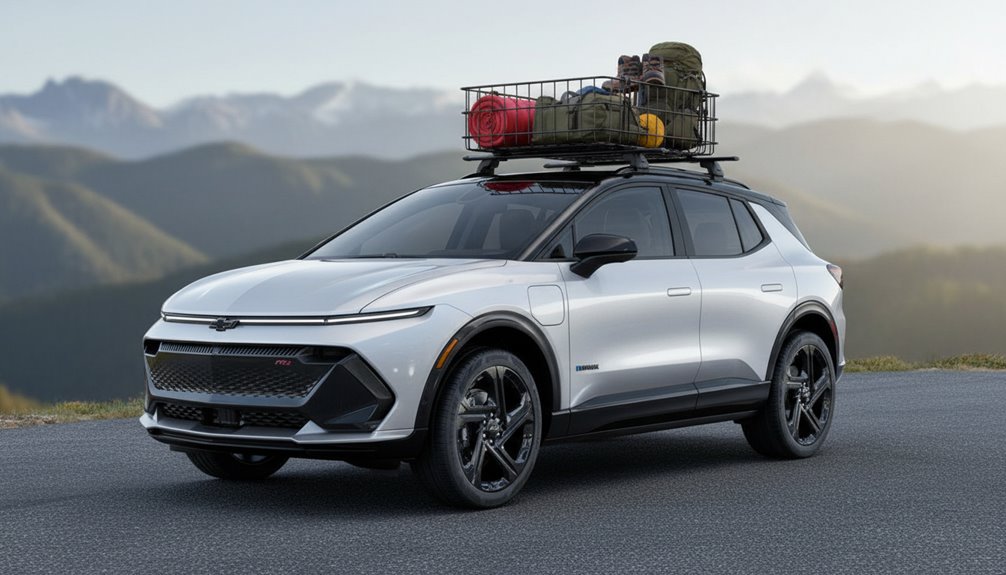

Most Equinox owners ignore 220 pounds of usable cargo space—the roof. Your LT or RS trim came with mounting points designed for rails and crossbars, yet the gap between bolting something on and safely hauling bikes, kayaks, or cargo boxes is wider than you think. One wrong torque setting or misaligned clamp turns that rooftop real estate into a highway hazard. OEM versus aftermarket isn’t just a price debate—it’s about whether your gear stays put at 70 mph or becomes someone else’s problem. The installation looks simple until you’re wrestling with instructions that assume you already know what you’re doing.
Expand Cargo Space Without Cramping Your Interior
When you’re eyeing the Chevrolet Equinox EV, you’ll quickly realize that its 26.4 cubic feet of cargo space behind the rear seats falls short of what you’d find in competing compact SUVs. This is a reality that becomes apparent the moment you’re loading for a road trip with more than a carry-on’s worth of gear.
Here’s where roof rails enter the equation. Available on LT and RS trims, they let you bypass interior space constraints entirely.
Mount crossbar racks to haul bikes, kayaks, or cargo boxes without sacrificing passenger legroom. Roof cargo boxes provide locked storage that keeps your interior pristine, while soft-sided duffles tuck underneath the rails for additional capacity. The RS features Black roof rails that complement its distinctive sporty styling while maintaining the same practical utility. For those planning extended trips in cold climates, consider how winter range penalties might affect your packing strategy when relying on roof-mounted cargo.
The math works out: your 63.5 cubic feet (with rear seats folded) plus external gear brings real-world hauling near segment-competitive levels.
You’re preserving interior flexibility while handling bulky, seasonal loads—skis, snowboards, or camping equipment—that’d otherwise consume cabin space.
How Raised Rails Give You a Stable Foundation
Once you’ve committed to adding roof rails to your Equinox EV, you’re not just bolting on a convenient accessory—you’re installing a precision load-bearing system engineered specifically for your vehicle’s roof geometry. The raised design distributes weight evenly across your roof structure rather than concentrating forces at single points, which is why Chevrolet engineered these rails to use factory mounting points on LT and RS trims.
| Stability Feature | How It Works | Load Impact |
|---|---|---|
| Gutter space pads | Secure rails against roof curvature | Prevents lateral shift |
| Door jamb clamps | Squeeze downward to lock assembly | Anchors multi-point contact |
| Keyed alike locks | Maintain position against movement | Guarantees theft resistance |
| Crossbar adjustment | Spreads to manufacturer specs | Balances changing road forces |
Even tightening from both sides prevents roof pull-over during installation. You’ll get immediate crossbar attachment without adapters, and the multi-point clamping system withstands changing road forces your Equinox encounters. The T-slot in bars accepts key-loop adapters and other accessories to expand your cargo carrying options. Factory integration simply outperforms aftermarket alternatives.
Thule WingBar Evo vs. Chevrolet OEM: Which Should You Choose?
Now that you’ve got the foundation locked down with properly engineered rails, you’ll face a decision that separates Equinox EV owners into two camps: stick with Chevrolet’s factory crossbars or upgrade to something like the Thule WingBar Evo.
The OEM option costs nothing—it’s included on LT and RS trims—but that tall profile isn’t just an aesthetic choice.
Those factory bars increase aerodynamic drag and introduce wind noise that’ll remind you they’re there every highway trip.
Factory crossbars create noticeable aerodynamic drag and wind noise that becomes impossible to ignore during highway drives.
The Thule WingBar Evo ($600–$700, often discounted 20%) flips the script.
Its TrailEdge design separates airflow cleanly, eliminating whistle and minimizing drag.
Installation requires a vehicle-specific fit kit (like 186117 for Equinox rails), but you’re rewarded with a lower-profile appearance and Thule’s Limited Lifetime Warranty.
Users consistently report the Thule system quieter than alternatives.
The base rack system enables addition of gear-specific mounts like bikes, kayaks, and cargo boxes, expanding functionality beyond the crossbars alone.
For EV owners prioritizing range efficiency and cabin quiet, the upgrade pays dividends beyond aesthetics alone.
Install Your Chevrolet OEM Roof Rack in Five Minutes
You’ll need just a torque wrench (supplied) and a second person to install your OEM cross rails in roughly five minutes, since the tool-free lever mechanism handles all the heavy lifting once you feed the rails into position and lock them at the arrow marks. The critical part’s getting those eight conical bolts and four underside bolts tightened to exactly 8 N·m in the proper sequence—skip this and you’re risking a 220-pound load limit violation that could damage your Equinox’s roof structure. Each crossbar features levers on both sides that engage once aligned with the arrow positions on your roof rack. Align your front and rear crossbars with the stanchions at positions #1 and #2, make sure the aerodynamic bead faces forward, and you’re done.
Quick Assembly Steps Required
Installing Chevrolet’s OEM roof rack system takes about five minutes once you’ve got the right approach—and honestly, that’s not marketing hyperbole if you follow the sequence without second-guessing yourself.
Start by removing side covers from both roof rails, then identify your front crossbar by its aerodynamic bead and forward-facing arrows.
Loosely install four bolts onto each crossbar’s underside using your torque wrench’s long end.
Position both crossbars with their big stanchions aligned at rivnuts in positions #1 and #2.
Here’s where a second person matters—you’ll avoid accidental vehicle damage during insertion. Before feeding the crossbars into the rails, make sure the four studs on your roof are fully exposed and ready for mounting.
Feed each crossbar into the rail slowly, aligning with the three arrow sets marking proper positioning.
Tighten all eight conical bolts to exactly 8 N.m, then secure the side clips.
Done.
Tools And Torque Specifications
The five-minute assembly window we just covered hinges entirely on having the right tools in hand and comprehending what those torque specs actually mean—because loosening a single bolt after installation because you guessed at the tightness defeats the whole purpose.
Your Chevrolet OEM kit includes everything necessary: a torque wrench, T30 bit, and pry tool.
You’ll tighten all conical bolts and M6×19 fasteners to precisely 8 N.m, aligning the wrench needle with the marked line. Use the wrench’s short end for M6×19 bolts. This isn’t arbitrary—proper torque prevents crossbar damage and provides secure attachment without over-tightening, which could strip threads. The included torque tool features an audible click mechanism that signals when you’ve reached the correct tension.
One person handles tools while the second steadies components, making two-person installation mandatory for accuracy.
Thule WingBar Evo Installation: Torque Tool and Tips
How’d you like to mount a roof rack system that doesn’t require you to hunt down a traditional torque wrench? Thule’s WingBar Evo solves that problem. The included torque tool handles everything—you won’t need separate equipment cluttering your garage.
| Component | Torque Setting | Load Capacity |
|---|---|---|
| Clamp Position | 52.5 | N/A |
| Per Bar System | N/A | 220 lb |
| Front-to-Rear Spacing | 700mm apart | N/A |
| WindDiffuser Setup | Included torque tool | Drag reduction |
| Vehicle Verification | Required | Roof-dependent |
Installation demands precision. Position bars 210mm from your windshield, maintaining 700mm spacing front-to-rear. The SmartSlide adjustable measuring device guarantees accuracy without guesswork. Tighten at exactly 52.5 using the provided tool—this specification prevents both loosening and over-torquing that damages BoxBeam structure.
The Thule One-Key locks integrate seamlessly, requiring zero additional hardware. That’s efficiency meeting capability for Equinox owners wanting straightforward utility without complications.
Attach Bikes, Kayaks, and Cargo to Your Equinox
With your Equinox’s roof rails now secure, you’re ready to load them up—whether that’s a bike rack leveraging the T-slot system, a kayak carrier exploiting that 27.5-inch crossbar spacing, or a cargo box that’ll free up your interior cabin.
Each attachment type uses the same foundational rail setup but demands different mounting strategies: bikes need the stability of lockable plastic cores (upgradeable to metal), kayaks rely on strap kits threaded through T-tracks, and cargo boxes require that torque tool click to handle varying loads.
We’ll walk you through the installation specifics for each so you can haul what matters without overthinking the physics.
Bike Rack Installation Methods
Transporting bikes, kayaks, and cargo on your Equinox requires comprehension of three primary mounting methods—roof systems, hitch receivers, and trunk-mounted racks—each with distinct advantages depending on your needs and vehicle configuration.
Roof-mounted options like the Yakima HighRoad demand existing crossbars and bracket adjustment at both front and rear positions for secure, level placement.
Hitch-mounted systems offer four-bike capacity through dedicated receivers, ideal for group trips.
Trunk-mounted designs attach via top hook placement with side and bottom straps maintaining even tension.
Before transport, verify your model year’s compatibility—specifications vary between 2011, 2020, 2021, and 2022 generations.
Secure fastening procedures and proper strap methodology prove essential.
Choose front-wheel mounting designs to protect carbon fiber frames from potential damage.
Kayak Mounting Solutions
Adding a kayak to your Equinox’s roof turns your vehicle into a capable water sports platform—if you’ve got the right mounting system. J-cradle racks offer straightforward loading with folding designs that improve aerodynamics when empty. Saddle mounts distribute weight evenly across your crossbars, mimicking boat trailer principles for stability during highway speeds. Side loaders reduce physical strain—critical when hoisting 40-50 pound watercraft solo.
| Carrier Type | Load Capacity | Best For | Key Feature |
|---|---|---|---|
| J-Cradle | 1-2 kayaks | Easy access | Folding capability |
| Saddle Mount | 1-3 kayaks | Long trips | Even weight distribution |
| Side Loader | Assist device | Solo loading | Injury prevention |
| Thule Systems | Vehicle-specific | All conditions | Padded protection |
Top manufacturers like Kuat and Thule deliver vehicle-specific kits including feet, load bars, and fit hardware. Thick padding prevents hull damage; secure attachment keeps your gear locked during turns and braking.
Cargo Box Attachment Options
Beyond single watercraft, your Equinox can haul bikes, cargo boxes, and gear simultaneously—if you know what your roof system actually supports.
Cargo boxes mount directly to your factory roof rails on RS and ACTIV trims through Chevrolet’s cross-rail package (part 84450050), which secures in black and handles distributed weight across your vehicle’s structural points.
The maximum cargo space reaches 63.9 cubic feet with rear seats folded, but adding a roof box reduces that internal capacity.
You’ll want the hands-free power liftgate on RS and ACTIV models; it simplifies loading boxes overhead without the gymnastics of manual gates.
Weight distribution matters here—roof-mounted cargo raises your center of gravity, affecting handling and efficiency, so prioritize lighter items up top and heavier cargo inside.
Weight Limits and Safe Bar Spacing for Your Setup
When you’re loading up your Equinox EV’s roof, weight limits and bar spacing aren’t just suggestions—they’re the physics standing between a perfectly secured kayak and an expensive insurance claim.
Your LT or RS trim enforces a 220-pound total capacity—that’s your cargo plus the rack hardware itself (which weighs 8.42 pounds).
Exceed this, and you’re stressing roof panels designed within specific engineering tolerances.
If you need heavier loads, aftermarket heavy-duty racks offer 330 pounds per bar, supporting serious outdoor gear setups.
Bar spacing matters equally.
Your Equinox’s 107.5-inch wheelbase and 74.9-inch width determine proper cross-rail positioning.
The black cross-rail kit positions front and rear bars to distribute weight evenly—misalignment creates stress concentrations that compromise safety.
Check your owner’s manual for trim-specific details; proper installation guarantees both cargo security and vehicle integrity.
Why Your Equinox Stays Efficient With a Roof Rack
You’re probably wondering if that roof rack will tank your Equinox’s efficiency—but here’s the thing: aerodynamic design and smart weight distribution work together to minimize the hit. Low-profile systems engineered specifically for your Equinox reduce frontal drag compared to bulky aftermarket carriers, while factory crossbars distribute load evenly across mounting points without compromising suspension performance.
Aerodynamic Design Reduces Drag
One of the biggest misconceptions about roof racks is that they’ll inevitably tank your Equinox EV’s range—but aerodynamic design fundamentally changes that equation.
Modern aero bars like JetStream feature airfoil wing designs that actively reduce drag rather than create it.
The T-slot construction, combined with wind-resistant profiles, minimizes the turbulence that typically plagues traditional racks.
Real-world testing at 70 mph demonstrates that properly designed crossbars actually preserve efficiency despite roof loading.
The lightweight aluminum construction keeps parasitic weight minimal, while integrated drag-reduction strips work at highway speeds.
You’re not sacrificing range; you’re gaining capability without the typical efficiency penalty. That’s the engineering advantage separating aero-optimized systems from older round-bar alternatives.
Weight Distribution Maintains Performance
Aero bars solve the drag problem, but there’s a second piece to the efficiency puzzle: where you actually put your stuff matters more than how much you’re carrying.
Your Equinox’s operational weight capacity—what it handles while moving—runs 3-6 times lower than static capacity when parked. That means a 140-pound load limit (after subtracting your 60-pound rack from the 200-pound roof allowance) demands strategic placement.
Center everything left-to-right for cornering stability. Position heavier items between front and rear crossbars at the midpoint—roughly 18 inches from each end on standard 36-inch spacing.
This longitudinal balance prevents pitching during acceleration and braking. Keep items close to the roof surface, lowering your center of gravity. Multiple tie-downs prevent shifting that tanks efficiency faster than extra weight alone.
Interior Space Optimization Benefits
Keeping your cargo off the cabin floor isn’t just about tidiness—it’s about preserving the Equinox EV’s most prized asset: interior flexibility. When you mount gear on roof rails instead, you maintain the full 63.9 cubic feet of cargo capacity below while keeping passenger space uncompromised.
Your five-seat configuration stays available; you’re not sacrificing legroom or comfort for a kayak. The split-folding rear seats remain genuinely useful rather than permanently employed as workarounds.
This separation means you can haul both people and equipment without awkward compromises—bikes on top, groceries below, passengers comfortable in between. Roof racks effectively give you two storage zones operating independently, multiplying your practical versatility without the cabin clutter that typically forces tough choices.
Store Seasonal Gear Year-Round Without Cramping Passengers
Expanding your storage without sacrificing passenger comfort comes down to grasping what the Equinox EV actually offers—and it’s more than you might think. Your roof rails shift seasonal gear overhead, preserving the 29.8 cubic feet of interior cargo space you need for passengers and daily essentials.
Winter ski equipment, roof baskets, or luggage boxes mount securely on LT and RS trims (with the available cross-rail package at $395), distributing weight across your vehicle’s engineered load capacity rather than cramming items into already-tight cabin space.
The physics works in your favor: roof storage sits high and centered, maintaining your vehicle’s handling characteristics while keeping supplies accessible year-round.
That 37-inch-wide cargo basket handles roughly 150 pounds, enough for substantial seasonal gear without overloading. You’ll appreciate cabin legroom remaining intact during family trips, while your skis, holiday decorations, or beach equipment ride securely above, anchored by multiple tie-down points and ratchet straps.
Lock Down Your Rack With Plastic or Metal Cores
Once your roof basket’s mounted and loaded, you’ll want to secure it—and that’s where lock cores come in. You’ve got two solid options: plastic or metal, each designed for different demands.
Plastic cores keep things lightweight and quiet. They’re keyed access points that don’t require cap removal, making them ideal for quick locking on ultra-low profile racks. You’re looking at a 176-lb. weight capacity—perfect for most seasonal gear without excess bulk.
Metal cores, meanwhile, handle serious loads. Steel-integrated systems paired with durable alloy construction support up to 825 lbs. static load ratings. They’re rust-resistant and compatible with heavy-duty platforms like Yakima TrackTowers.
| Feature | Plastic Cores | Metal Cores |
|---|---|---|
| Weight Capacity | 176 lbs. | 825 lbs. |
| Construction | Lightweight alloy | Steel + aluminum |
| Best For | Quick access | Heavy loads |
Both install easily using factory mounting points on your Equinox LT or RS without drilling. You’re getting keyed security and weatherproof construction either way.
Remove and Reinstall Your Roof Rack in Seconds
Slide your Equinox’s roof rack on and off without tools, without fuss, and without questioning your life choices—that’s the whole point of this system. The quick-release mechanism lets you detach the entire cross-rail package in seconds, making storage straightforward when you need garage clearance or simply want to reclaim that 5-inch height buffer.
The towers slide directly into the groove channels on your raised rails, then lock down with plastic or metal cores—no permanent modifications required. Repositioning works equally fast; you’ll reference the embedded ruler to slide crossbars along their fixed points without reinstalling anything.
This repeated attachment-and-detachment cycle won’t degrade the system’s design because the design accounts for it. Whether you’re swapping seasonal gear or storing the rack between trips, you’re looking at genuine seconds, not the extended mechanical ordeal you’d face with older mounting systems.
Keep Your Roof Rack in Top Shape
Your Equinox EV’s roof rack system deserves regular attention to stay functional and corrosion-free—think of it like your vehicle’s paint protection, except bolts don’t benefit from wax.
You’ll want to inspect crossbars and side rails quarterly for loose bolts or wear, checking that conical bolts maintain their 8 N.m torque specification using your supplied wrench.
Wipe components with mild soap and water to prevent corrosion, then dry thoroughly; skip high-pressure washers, which can force moisture into rivnuts and compromise alignment.
Clean stanchions periodically and verify the rear crossbar sits taller than the front for proper vehicle fit.
Before each use, confirm your total load—including rack weight—doesn’t exceed 220 lbs (100 kg).
Store removed crossbars with plugs reinstalled on side rails.
These straightforward steps preserve your rack’s integrity and keep your cargo secure.
Fix Common Roof Rack Noise and Rattling Problems
Keeping those bolts tight and components corrosion-free matters, sure—but even a perfectly maintained roof rack can betray you with an annoying whistle or rattle at highway speeds.
You’re likely dealing with one of three culprits: aerodynamic noise from rectangular crossbars, installation errors, or gaps in seals.
Rectangular profiles generate Kármán vortex streets—those spiral air patterns that create humming as airflow intensifies. Wing-shaped bars mitigate this; if you’re stuck with square edges, wrap paracord spirally around them to break up turbulence.
Check your mounting clamps for proper torque; loose fasteners vibrate and rattle.
Inspect rubber seals and end caps for wear or gaps. Missing or worn stripping amplifies whistling substantially. Replace worn rubber strips with quality options like Malone’s 50-inch #MAL63TR for an airtight seal.
Install fairings (Inno’s #INA262 or #INA261) to redirect airflow cleanly around your bars.
Frequently Asked Questions
Can I Use Roof Racks on Equinox Trims Other Than LT and RS Models?
Yes, you can use roof racks on other Equinox trims. Thule systems work across all Equinox models with flush side rails, regardless of trim level. You’ll find the same compatibility and versatility you’d get on LT or RS models.
What’s the Difference Between Dynamic and Static Weight Limits for Roof Racks?
You’ll find moving limits are what your roof rack safely holds while you’re driving—typically 100-165 pounds—while static limits apply when you’re parked, reaching 300-400 pounds or more.
Do Roof Racks Void My Equinox Warranty or Affect Insurance Coverage?
Your roof rack won’t rock the boat with your Equinox warranty—GM covers factory-installed racks fully. For insurance, you’ll need to check with your carrier since coverage varies by policy and provider.
Can I Use Non-Thule or Non-Oem Crossbars on My Equinox Rails?
You can absolutely use non-Thule or non-OEM crossbars on your Equinox rails. KINGGERI and OMAC offer reliable third-party options engineered for your specific model year, ensuring secure attachment without vehicle damage.
How Does a Roof Rack Affect My Equinox Ev’s Battery Range and Efficiency?
Your Equinox EV’s range takes a hit like wind resistance—roof racks cut efficiency by 30%, trimming 50-60 miles off your typical distance. You’ll charge more frequently, so plan routes strategically with closer charging stops.


