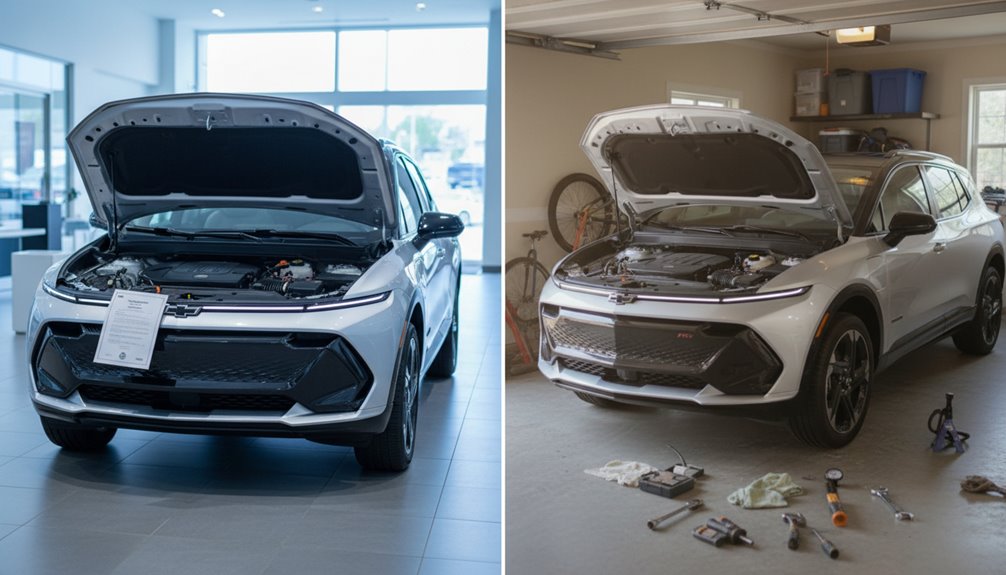

Car shopping for an electric SUV can feel overwhelming, especially when you’re staring at trim levels that seem nearly identical but carry different price tags. With the Chevy Equinox EV, many buyers automatically assume the sportier RS trim justifies its premium over the 2LT, falling into the common trap of equating higher price with better value.
This breakdown reveals why the 2LT trim actually delivers superior bang for your buck compared to the RS. You’ll discover exactly what that extra $1,500 gets you with the RS—and more importantly, what practical features you lose by skipping the 2LT’s standard equipment that becomes costly add-ons elsewhere.
The $1,500 Price Gap: What You’re Actually Paying For
When you’re staring at the $2,300 gap between the LT 2 FWD ($41,900) and RS FWD ($44,200), that 5.5% price bump might feel substantial—but here’s where it gets interesting: the actual value proposition depends entirely on what you prioritize.
You’re primarily paying for aesthetics. The RS adds 21-inch black wheels, a black roof, and matching black accents throughout. Polar White paint replaces Iridescent Pearl. That’s roughly $2,000 of the difference right there—style over substance. The 21-inch wheels also come with a tire replacement cost of approximately $350 each, which is an important consideration for long-term ownership.
You’re primarily paying for aesthetics—21-inch wheels, black roof, and accents account for roughly $2,000 of the price difference.
The remaining $300? You’re gaining access to ventilated seats and a front passenger power adjuster through the Convenience Package II, plus automated walk-up lighting. This modest increment reflects broader industry trends as GM pursues strategic cost recovery measures to offset manufacturing pressures amid softening EV demand.
Meanwhile, you’re not sacrificing performance: both trims deliver identical 319-mile EPA range on FWD, identical charging speeds, identical powertrains.
The math is straightforward. Unless those aesthetic upgrades genuinely matter to you, the LT 2’s practical feature set—roof rails, auto tailgate, 360-degree camera, wireless charging—delivers better bang for your dollar.
Identical Powertrains Across Both Trims
FWD models deliver 319–326 miles while AWD versions hit 285–307 miles. This makes the $1,500 price difference purely a matter of interior appointments and tech features rather than mechanical capability.
That uniformity means your drivetrain choice depends on weather and towing needs, not trim level—a rare clarity in the crossover market. Both the 2LT and RS trims became available starting with the 2025 model year, eliminating the trim proliferation that confused buyers in 2024.
Same Engine, Same Power
Since Chevy engineered the Equinox EV’s powertrain structure around standardization rather than segmentation, you’re getting the exact same motor options regardless of whether you choose the LT or RS trim—and that’s actually a significant advantage worth grasping.
Both trims share identical FWD specs: a single permanent-magnet synchronous AC motor producing 213 hp and 236 lb-ft torque through a direct-drive 1-speed transmission.
Want AWD? You’ll get the same dual-motor setup on either trim—front permanent-magnet (241 hp, 225 lb-ft) plus rear induction AC (90 hp, 121 lb-ft)—delivering combined 288-300 hp and 333-348 lb-ft.
Same 85 kWh battery. Same performance metrics. The front-drive model achieves 319 miles of EPA-estimated range, while the AWD configuration delivers a respectable 285 miles per charge.
RS pricing gains you amenities, not horsepower.
Battery And Range Parity
Whether you’re comparing the LT and RS trims or trying to grasp what you’re actually paying for, here’s the straightforward reality: both trims share the identical 85 kWh usable battery capacity, the same liquid-cooled lithium-ion pack with NCMA cathode chemistry, and EPA-estimated ranges that don’t vary based on trim level.
Choose FWD, and you’re looking at 319 miles per charge. Go AWD, and you’ll see 285–307 miles depending on configuration.
The battery configuration remains constant—10 modules linked together, enhanced for equivalent energy consumption at 31 kWh per 100 miles. You’re getting the same rechargeable storage system, the same thermal management, the same longevity safeguards. Level 2 charging systems across both trims deliver 11.5 kW charging capacity, bringing your battery from empty to full in approximately 8 hours.
What changes between trims isn’t your battery or range; it’s your infotainment, upholstery, and convenience features.
Charging Speed Consistency
Your 2LT and RS Equinox EVs share far more than just a battery—they’re equipped with identical onboard charging hardware, which means you’ll experience the same charging speeds regardless of which trim you choose.
Both trims deliver 150 kW peak DC fast charging capability, replenishing 100 miles of range in 13-15 minutes at CCS1 stations. You’ll reach 80% state of charge in approximately 48 minutes—no performance variance exists between trims at any charging level. However, charging power typically drops sharply beyond 80%, making it inefficient to charge past this threshold on either trim.
Standard 11.5 kW AC Level 2 charging provides identical 35 miles per hour rates across both variants, achieving 10%-80% in 5.4 hours.
Since charging infrastructure, not trim selection, determines your speed advantage, the 2LT delivers equal efficiency for considerably less money.
Why 2LT’s Practical Features Matter More Than 2RS Style
When you’re comparing the 2LT to the 2RS, the real question isn’t whether one looks cooler—it’s whether you’d rather spend an extra $23,000 on red sport accents or actually use your vehicle more effectively.
Here’s what separates practical ownership from aesthetic compromise:
Practical ownership means choosing features that genuinely improve daily driving over cosmetic upgrades that drain your wallet.
- Dual-zone climate control keeps everyone comfortable without paying RS premiums; the 2LT delivers this via the Convenience Package.
- Power-adjustable seating with memory presets means you’re not readjusting daily—your vehicle remembers you.
- Heated and ventilated front seats tackle real-world weather challenges better than RS’s fixed sport upholstery.
Both trims deliver identical 319-mile EPA range on FWD models. Both support DC fast charging equally. The 2LT qualifies for federal tax credits that reduce your effective purchase price.
Your 2LT with Convenience Package runs 19.2 kW Level 2 charging, matching fully loaded RS capability.
The 2LT costs $36,995.
You’re not sacrificing performance or charging infrastructure—you’re choosing features that actually improve daily driving.
That’s the belonging factor: joining owners who prioritize function over flash.
21-Inch Wheels and Run-Flat Tires
You’ll notice that the 21-inch wheels standard on the RS trim come with tires featuring reduced sidewall height—a trade-off that saves weight but gives you less rubber cushioning between rim and road.
This can complicate run-flat tire functionality if you’re considering that upgrade. The LT’s standard 19-inch setup sidesteps this issue (and saves you money on tire replacements).
Though Chevrolet hasn’t documented factory run-flat availability for either trim, you’d need to check with your dealer about aftermarket options and compatibility.
Essentially, larger wheels look sportier but shrink your tire’s shock-absorption capacity, making run-flats a riskier proposition on the RS despite their appeal for peace of mind. The RS trim starts at $44,795, which includes substantial package premiums compared to the LT’s $34,995 base price, so weighing wheel and tire costs against the overall value proposition is essential.
Run-Flat Tire Trade-Offs
Because the 2024-2025 Equinox EV RS rolls on 21-inch wheels wrapped in 275/40R21 rubber, you’re already dealing with a performance-oriented setup—and the tire choice gets more complicated from there.
Run-flat options like the Pirelli P Zero PZ4 ($501) or Michelin Pilot Sport 4 SUV ($502) let you limp 50 miles at 50 mph after a puncture without changing a tire roadside.
But here’s the catch:
- Higher cost: Run-flats demand $200+ premiums over standard all-season tires
- Stiffer ride quality: The reinforced sidewalls transmit more road noise and harshness
- Shorter tread life: Summer run-flats warrant only 20K-25K miles versus 50K-65K for conventional options
You’re fundamentally trading longevity and comfort for puncture resilience and convenience—a calculation worth considering against your actual driving patterns.
Wheel Size Impact Analysis
The wheel diameter you choose—19 inches on the LT or the standard 21 inches on the RS—cascades through nearly every ownership cost and efficiency metric that follows. Your LT’s 19-inch setup preserves range by reducing unsprung weight, a physics principle that directly impacts battery consumption.
You’ll also notice tire pricing heavily favors the smaller diameter; 19-inch options dominate the aftermarket with competitive rates, while 21-inch replacements command premium pricing throughout your ownership.
The RS’s standard 21-inch black aluminum wheels look sharper (RPO code RVV), but that aesthetic comes with thinner sidewalls requiring more frequent replacement.
For practical owners calculating long-term expenses, the LT’s standard configuration simply delivers better efficiency and lower tire costs over the vehicle’s lifespan.
Heated Seats and Steering Wheel on the 2LT
When winter temperatures drop, comfort becomes a practical consideration—and that’s where the 2LT’s standard heated seats and steering wheel make a genuine difference.
You’re getting an eight-way power-adjustable driver seat with multi-level heating paired with a six-way manual passenger seat featuring the same thermal capability.
The leatherette steering wheel includes telescopic adjustment and integrated heating elements controlled through single-zone climate integration.
Here’s what you’re actually getting:
- Eight-way driver seat adjustability with multi-level heating for customized warmth across different climate zones
- Heated steering wheel with leatherette construction, eliminating cold-grip discomfort during winter commutes
- Passenger-side heating so your co-pilot stays comfortable without paying 3LT prices
These features come standard on 2LT—not optional extras requiring additional investment.
You’re fundamentally choosing practical winter usability that base 1LT trims skip entirely, making your ownership experience more accessible regardless of season.
HD Surround Vision and Rear Parking Sensors
When you’re steering through tight parking spots, you’re trading visibility for physics—what you can’t see, you can hit—which is where the 2LT’s standard rear parking sensors and the RS’s optional HD Surround Vision (a full 360-degree camera system) become genuinely practical rather than just nice-to-haves.
The 2LT gives you reliable obstacle detection without the $6,000 upcharge that comes with upgrading to RS trim, though you’ll sacrifice the surround view’s aerial view of your entire vehicle’s perimeter.
Here’s the kicker: both systems improve your urban parking confidence, but the sensors alone prevent most low-speed collisions, while the camera system is more about seeing everything—a distinction worth considering before you justify the trim jump.
Enhanced Parking Awareness Technology
Parking your Equinox EV in tight urban spots or maneuvering crowded lots becomes considerably less stressful when you’ve got an array of cameras and ultrasonic sensors working in concert around your vehicle’s perimeter.
You’ll appreciate the HD Surround Vision System’s 360-degree awareness, which combines rear vision cameras with strategically positioned ultrasonic sensors to detect suitable spaces while you’re driving slowly past parked vehicles.
The system handles steering precision while you maintain control of braking and shifting—a practical balance that keeps you engaged without requiring parking proficiency.
Real-time alerts guide you through “Parking in Progress” prompts on your center display.
What makes this tech genuinely useful:
- Consistent accuracy regardless of driver skill level
- Cross-traffic and pedestrian detection during tight maneuvers
- Parallel and perpendicular parking support with distance measurements
You’re essentially gaining a spotter without the awkward hand signals.
360-Degree Camera System Benefits
Because visibility directly impacts safety—and because tight parking spots don’t give you much room for error—the Equinox EV’s HD Surround Vision system functions as your vehicle’s extra set of eyes. You’ll access multiple camera angles through your 17.7-inch center display: front, rear, overhead close-ups, and side views that eliminate blind spots during low-speed maneuvers.
The system automatically activates when you’re parallel parking or approaching an obstruction within one foot of the vehicle, so you’re not fumbling with buttons while maneuvering. You can toggle between views using onscreen buttons below the camera feed, giving you precision control when steering through confined spaces.
This standard feature across all 2026 Equinox EV trims revolutionizes parking from stressful to straightforward.
Safety Features Worth Comparing
The 360-degree camera system we just covered handles the visual side of parking safety, but your Equinox EV doesn’t stop there—it layers in supplementary protective tech that deserves a closer look before you settle on a trim.
Both 2LT and RS trims include rear park assist with reverse automatic braking, so you’re getting identical proximity detection across the board.
Here’s where value diverges:
- 2LT pairs those sensors with HD Surround Vision—high-definition environmental imaging that clarifies tight spots
- RS delivers the same sensors without the augmented visuals, despite commanding a premium
- Rear cross-traffic braking activates automatically on both, preventing blind-zone collisions
The practical takeaway? You’re not sacrificing safety choosing 2LT. You’re actually gaining superior visibility intelligence while keeping more cash in your pocket. That’s the definition of smart shopping.
Blackout Styling and Red Badging Explained
If you’re eyeing the Equinox EV RS, you’ve probably noticed it doesn’t look quite like the LT—and that’s entirely intentional. The RS slaps on a full blackout package that remodels the vehicle’s entire aesthetic.
You’re looking at a gloss black grille (with body color accents across the bottom), blacked-out Chevrolet bowtie emblem, and black textured lower rear bumper. Gloss black trim wraps the wheel arches, while 21-inch five-spoke wheels painted black sit beneath wider 275/40R21 low-profile Continental tires—a sportier setup than the LT’s standard wheels.
Inside, you’ll find red stitching on seats and steering wheel trim, plus red interior accents throughout. The LT sticks with light blue stitching instead. RS badging appears prominently on the rear and sides in black, contrasting sharply with the LT’s silver or chrome trim.
Sure, it’s aggressive styling. But here’s the question: does aggressive mean better value?
Tire Kits vs. Run-Flat Tires: Trade-Offs
While you’re considering the RS’s aggressive styling against practical ownership concerns, there’s another choice brewing underneath—one that’ll affect your wallet, your range, and what happens when you hit a pothole at the wrong moment.
Run-flats come standard on both LT and RS trims, letting you drive 50 miles at reduced speeds after a puncture. That convenience costs you though. Tire replacements run $300–$500 each, and they’ll chew 5–10% off your range due to higher rolling resistance.
Optional tire assemblies flip the script entirely—they’re under $100, preserve your full 319-mile EPA range, and improve ride quality on 21-inch wheels.
Here’s the trade-off matrix you’re contemplating:
- Run-flats: Avoid roadside vulnerability but sacrifice efficiency and long-term costs ($150+ towing fees)
- Tire assemblies: Maintain performance yet demand safe pull-over locations for repairs
- Your priority: Choose based on driving patterns and risk tolerance
The practical owner? That’s you. Run-flats offer peace of mind. Kits offer economics.
Do These Trim Upgrades Affect Resale Value?
Your trim choice doesn’t just affect what you’ll pay now—it fundamentally shapes what you’ll recover when you sell.
Your trim choice doesn’t just affect what you’ll pay now—it fundamentally shapes what you’ll recover when you sell.
The RS trim, despite its premium features, depreciates sharper than base models: you’ll lose $31,301 over five years versus the general 57% depreciation rate. That’s the luxury tax working against you.
When you trade in, the numbers tell the story. An outstanding-condition RS hits $24,466, while a 2LT reaches $24,255—nearly identical despite the higher purchase price.
Private party sales show similar compression: RS tops out around $26,315, but 2LT sits comfortably at $26,054.
Here’s the practical reality: you’re paying more upfront for features that don’t command proportional resale premiums. The 2LT avoids base-model skimps while sidestepping that depreciating luxury premium.
You’re not losing money—you’re just not throwing it away unnecessarily.
Safety Features: Identical Protection on Both Trims
You’ll find that both the 2LT and 2RS trims ship with identical Chevy Safety Assist suites—meaning forward collision alert, automatic emergency braking with pedestrian detection, lane keep assist, and rear park assist come standard regardless of which you choose.
The real safety equivalence extends beyond basics: you’re getting the same blind-spot intervention, HD surround vision, rear cross traffic braking, and safety alert seat across both trims. So there’s no protection advantage to paying more for the premium option.
Optional upgrades like Active Safety Package 3 and Super Cruise hands-free driving are equally available on either trim, letting you customize your driver-assistance tech without trim-based gatekeeping. This is a revitalizing approach that prioritizes safety accessibility over marketing differentiation.
Comprehensive Safety Suite Standards
Because Chevrolet’s approach to the Equinox EV emphasizes democratizing safety technology, you’re getting an identical protection package regardless of whether you choose the base LT or the 2LT trim—no upselling required, no feature gatekeeping.
You’ll find six advanced Chevy Safety Assist features standard across both trims:
- Automatic emergency braking with pedestrian detection stops threats before they escalate
- Blind zone steering assist prevents lane-drift collisions when vehicles hide in your periphery
- Rear cross traffic braking protects you during parking maneuvers where visibility fails
This extensive suite means your safety doesn’t depend on trim selection. Forward collision warning, lane departure assist, and reverse automatic braking activate identically on LT and 2LT models.
NHTSA and IIHS crash-test ratings apply equally. You’re not compromising protection by choosing the value-oriented trim.
Advanced Driver Assistance Systems
When it comes to active safety technology, the Equinox EV doesn’t play favorites between its LT and 2LT trims—both get the full suite of advanced driver assistance systems that actually matter in real-world driving situations. You’re getting automatic emergency braking with pedestrian detection, lane-keeping assistance, and blind-zone steering assist standard across the board.
The following distance indicator monitors your spacing, while front pedestrian braking detects threats ahead. HD Surround Vision provides 360-degree visibility with rear cross-traffic braking and reverse automatic braking included.
Both trims share identical safety alert seat vibrations for warnings. The Active Safety Package 2—offering a 360-degree camera system and rear pedestrian alert—remains available as an option on either trim without differentiation, making your safety investment genuinely equal regardless of trim choice.
Equal Protection Across Both Trims
Safety features don’t differentiate between the Equinox EV’s 2LT and RS trims—Chevrolet’s approach here breaks from the typical trim-level playbook where lower models often sacrifice protection for price.
You’re getting identical crash protection, the same NHTSA structural ratings, and matching Chevy Safety Assist suites across both configurations. That means:
- Automatic emergency braking with pedestrian detection on every model
- 360-degree camera systems available equally through Active Safety Package 2
- Lane keep assist, blind zone steering assist, and reverse automatic braking standard on each
The physics of collision protection doesn’t change based on your trim selection. Both 2LT and RS deliver over 20 standard safety features, confirming Chevrolet prioritizes your protection uniformly.
You’re not choosing between safety levels—you’re choosing between amenities and pricing.
Battery Range and Charging Speed: What’s the Same?
One of the smartest moves Chevrolet made with the Equinox EV lineup is standardizing the battery and charging system across trims—which means you’re not getting shortchanged on range or charging speed just because you opted for the 2RS over the 2LT.
Both trims pack an identical 85.0 kWh liquid-cooled lithium-ion battery. Whether you choose FWD or AWD, you’ll hit the same EPA-estimated range targets: 319 miles for front-wheel drive, 285 miles for all-wheel drive. The dual motors cost you 34 miles of range but nothing else.
Charging parity holds firm across the board. Your 11.5 kW onboard charger adds 34 miles per hour via Level 2 (whether you’re plugged into a 2LT or 2RS).
DC fast charging? Both trims max out at 150 kW, delivering roughly 70 miles in 10 minutes.
Real-World Driving Experience: The Minimal Difference
Because you’re comparing the 2LT and RS across actual road conditions—not spec sheets—what matters most is how these differences actually feel behind the wheel. The honest answer is: not dramatically different.
The 2LT delivers a cushy, comfortable ride with well-weighted steering that handles everyday driving effortlessly.
The RS trades some comfort for marginally sharper cornering response, courtesy of 21-inch wheels and stiff run-flat tires. Here’s what you’ll actually experience:
- Comfort trade-off: RS’s low-profile tires create a noticeably stiffer suspension feel on rougher pavement
- Handling reality: Cornering improvements remain minimal since the Equinox EV isn’t engineered as a sports car
- Highway performance: Both trims achieved identical 260-mile results at 75 mph, proving wheel-and-tire differences produce negligible efficiency variance
Your practical driving experience won’t hinge on trim selection. Instead, focus on features that genuinely elevate daily ownership.
Why Edmunds Recommends the 2LT for Best Value
While the RS trim’s styling upgrades and performance tweaks might catch your eye, the 2LT represents where Chevy actually packed the meaningful features—and where your money stops getting stretched thin across cosmetic upgrades.
At $41,795, you’re looking at $2,300 more than the base LT 1, but that investment delivers substantive gains: the 17.7-inch touchscreen with Google built-in, Chevy Safety Assist, and HD Surround Vision come standard.
The RS ($44,095) fundamentally charges $9,100 over the LT 1 primarily for black emblems and 21-inch wheels—styling elements that don’t improve your 319-mile EPA range or charging capability.
You’ll access the same 220-hp motor, identical cargo space (57.2 cubic feet), and comparable Level 2 charging infrastructure.
The 2LT hits that sweet spot where essential technology meets reasonable pricing, avoiding the feature-padding spiral that pushes RS models toward $60,000.
The Case for Choosing 2RS: Style and Preference Matter
If you’re willing to spend an extra $2,300 over the base RS, the 2RS trim converts the Equinox EV from practical transport into a vehicle that actually reflects how you want to be seen—and that’s not a trivial consideration when you’re committing six figures (or close to it) over the ownership cycle.
The 2RS doesn’t rewrite performance specs. You’re still getting that 282 horsepower single-motor setup or 300 horses with AWD, covering roughly 515 km per charge.
What changes is presence:
- 21-inch gloss-black wheels with race-inspired styling that photograph considerably better
- Heated rear seats and ventilated front seats, turning comfort into a daily ritual
- Head-up display and memory driver’s seat, small luxuries that compound satisfaction
You’re buying coherence here—visual confidence paired with thoughtful creature comforts.
For owners who view their EV as an extension of identity, not just an appliance, that alignment matters.
Which Trim Fits Your Priorities?
The real question isn’t which trim’s objectively “better”—it’s which one aligns with how you actually drive and what you’re willing to pay for the privilege.
If you prioritize value and practicality, the 2LT delivers. You’re getting 213 horsepower, 319-mile range, heated seats, and extensive safety tech—all standard—for $8,000 to $14,000 less than 2RS.
That’s substantial savings without sacrificing daily usability.
However, if you want aggressive styling, run-flat tires, and sportier aesthetics, 2RS rewards that preference.
The tradeoff? Higher purchase price, stiffer suspension (courtesy of low-profile tires), and increased maintenance costs.
Your answer depends on specifics: Do you value comfort on longer commutes? Choose 2LT.
Want visual distinction at car meets? Consider 2RS.
Most owners find the 2LT’s balanced feature set and cost efficiency align with realistic EV ownership priorities.
Frequently Asked Questions
Can I Upgrade 2LT Wheels and Styling Later to Match 2RS Aesthetics?
You’ll think you’re locked into a basic look, but you’re not. You can absolutely upgrade your 2LT’s wheels and add blackout styling packages later, matching RS aesthetics while keeping your initial $6,000 savings intact.
How Do Run-Flat Tires Perform in Winter Conditions Versus Standard Tires?
You’ll find standard winter tires outperform run-flats in snow and ice. Their flexible sidewalls adjust better to slippery surfaces, while run-flat’s stiffened construction reduces grip and increases harshness on winter roads.
What’s the Warranty Coverage Difference Between 2LT and 2RS Trim Levels?
You’ll find no warranty differences between the 2LT and 2RS—both trims share identical coverage: three-year bumper-to-bumper, five-year powertrain, and eight-year battery protection with matching roadside assistance.
Are There Financing Incentives or Rebates Specific to Either Trim Option?
You’ve got the inside scoop: both trims qualify for identical incentives. You’ll access 0% APR for 60 months, conquest bonuses, and up to $4,000 customer cash equally—no trim-exclusive deals here, just straightforward savings.
How Does the 2lt’s Tire Inflation Kit Compare to Roadside Assistance Coverage?
Your 2LT’s tire inflation kit handles minor punctures you can fix roadside, while your OnStar roadside assistance covers everything—flats beyond the kit’s scope, towing, and fuel delivery—for eight years.


