

Should You Lease or Buy an Equinox EV?
When you’re considering whether to lease or buy a Chevy Equinox EV, you’re really asking yourself two different questions: Do you want the latest tech and predictable costs, or do you want long-term ownership and unlimited miles?
Leasing makes sense if you prefer driving new vehicles every few years without worrying about depreciation or major repairs. You’ll enjoy lower monthly payments—$299 for 36 months—plus access to federal tax credits passed through residuals. However, you’re limited to 10,000 miles annually and face the reality that lease-end buyouts rarely pencil out financially. At higher mileage levels, leasing costs can amount to roughly $0.40 per mile when factoring in insurance and fuel expenses.
Buying offers freedom. You’ll retain your vehicle indefinitely, rack up unlimited mileage, and potentially stack GM rebates for prices near $30,000. The 2025 model year delivers a power bump upgrade that enhances performance without sacrificing the value proposition. The tradeoff? Higher upfront costs and missing the tax credit passthrough that makes leasing appealing.
Your choice ultimately hinges on whether flexibility or predictability matters more to your driving lifestyle.
The Real Monthly Cost: Breaking Down the $279 Lease Deal
Now that you’ve decided leasing makes sense for your lifestyle, here’s where the math gets real: that advertised $279 monthly payment is only the beginning.
You’re looking at roughly $2,500 due at signing—which covers your first payment, acquisition fees, and documentation charges before you even drive off the lot. Over 24 months, those $279 payments total $6,696.
Add your upfront costs, and you’re approaching $9,200 before taxes, title, and license fees hit your wallet.
Here’s the catch: that figure excludes insurance, registration, and any mileage overages beyond your included limits. The Chevrolet Equinox EV’s 300-mile range means you’ll want to carefully track your driving patterns to avoid excess mileage charges during your lease term.
The Detailed Care maintenance plan sounds extensive until you realize excess wear-and-tear charges and the disposition fee apply at lease end.
Compare dealer variations—Airport Chevy quotes $199.99 monthly on 2WD models versus $275.99 for AWD—and your actual cost hinges on credit approval, dealer participation, and vehicle configuration.
The real monthly commitment? Substantially higher than advertised.
Effective Monthly Cost: Why Signing Fees Matter
Because that $279 monthly payment gets all the attention in lease advertisements, you’re probably missing the real financial picture—and it starts before you even make your first payment.
Your due-at-signing costs run $3,103 to $6,149, which fundamentally shifts your effective monthly expense. Here’s the math: add acquisition fees ($799 average), first-month payment, registration, taxes, and title transfers—these aren’t optional extras, they’re mandatory upfront.
When you divide these signing costs across your lease term, you’re actually paying $129 to $171 monthly just to start the agreement.
This recalibrates that advertised $279 payment into $408 to $450 effectively during month one. Even spread across 36 months, those signing costs add roughly $86 to $170 monthly to your true lease expense. Most lease agreements span 36 months typically, making the amortization of upfront fees a significant component of your total cost.
Dealerships sometimes waive acquisition fees or security deposits, but you’ll recoup little ground—registration and taxes remain non-negotiable.
Comprehending this hidden amortization separates genuine lease affordability from marketing fiction.
Five Factors That Determine Your Lease vs. Buy Decision

You’ll want to nail down two critical variables before deciding: your monthly payment ceiling and how many miles you’ll actually drive annually.
If you’re comfortable with $279/month but clock 15,000+ miles yearly, that $0.25-per-mile overage fee changes your lease into a financial trap—whereas buying eliminates mileage restrictions entirely.
Conversely, low-mileage drivers (under 10,000 annually) who value payment predictability often find leasing captures the federal tax credit more efficiently, keeping monthly costs lean. Since high residuals on the Equinox EV pass some federal tax credits to lessees, the effective monthly payment advantage becomes even more pronounced for those choosing to lease rather than purchase.
Monthly Payment Affordability
When you’re comparing lease versus buy options for the Chevy Equinox EV, the monthly payment often becomes the deciding factor—and that’s where things get interesting, because five specific variables shape what you’ll actually pay each month.
A 24-month Equinox EV lease runs $279/month ($349 effective), while the gas model stretches to $299/month ($372 effective) over 36 months.
That gap widens considerably when you factor in interest rates: EV leases sit at 5.09% versus 7.51% for gas models—a GM Financial advantage that directly reduces your payment obligation.
Down payments matter too. You’re looking at $1,679 due at signing for the EV, though strategic incentive stacking occasionally yields $0 at signing. Federal tax credits and state-specific incentives in markets like Colorado and Massachusetts can further reduce effective monthly costs through lease loopholes that benefit consumers.
These variables compound, making the EV lease genuinely competitive for budget-conscious drivers.
Mileage And Usage Patterns
Your actual driving habits—not the vehicle’s capabilities—determine whether leasing or buying makes financial sense, and that’s where mileage becomes the lease’s silent deal-breaker or silent champion.
Standard lease agreements cap you at 10,000–15,000 miles annually, with overage penalties hitting 15–30 cents per mile. Since EV drivers average 12,400 miles yearly—comfortably within limits but requiring vigilance—you’ll need honest math about your commute. The Equinox EV’s 285-319 mile range per charge further incentivizes lease consideration for predictable urban commuters who rarely exceed monthly mileage allowances.
Urban and suburban drivers under 50 miles daily? Leasing works.
Frequent road-trippers or remote workers? A lease’s cumulative mileage cap across the contract term becomes punishing.
Purchasing eliminates penalties entirely, granting unlimited annual driving. That flexibility matters more than raw range when your lifestyle demands freedom from odometer anxiety.
Equinox EV Lease Rates Beat Gas Models: Here’s Why

Though Chevy’s new Equinox EV carries a higher sticker price than its gas-powered sibling—$43,295 for the LT versus the gas model’s lower MSRP—the lease math flips decisively in the EV’s favor.
You’ll find competitive 24-month EV leases starting at $239–$349 monthly, matching or undercutting gas Equinox rates of $239.
The real advantage emerges over time: EV leases bundle charging into depreciation-only payments, while gas models saddle you with fuel and maintenance costs outside the agreement.
For longer 36-month terms, EV payments climb to $413–$548 monthly—still competitive when you factor in fuel savings and predictable electricity costs.
Dealers sweeten EV deals through rebates and incentives that effectively lower your effective monthly cost below sticker. Current lease offers include no security deposit required for well-qualified applicants.
Well-qualified lessees (700+ FICO) release the best rates.
The shorter 24-month terms also reduce depreciation exposure, letting you access higher trims affordably—meaning more features, same payment.
How the $7,500 Federal Tax Credit Cuts Your Lease Payment
Did the $7,500 federal tax credit actually lower your Equinox EV lease payment? Yes—but only if you leased before October 2025.
Here’s how it worked: lessors claimed the federal tax credit, then passed those savings directly to you through reduced monthly payments. GM facilitated this via its financing units, allowing dealers to funnel the full $7,500 benefit into your lease agreement. This mechanism bypassed purchase restrictions since lessors, not lessees, claimed the credit on their tax returns.
| Factor | Before October 2025 | After October 2025 |
|---|---|---|
| Lease Credit Passthrough | $7,500 available | Eliminated |
| Monthly Payment Impact | Reduced substantially | No federal reduction |
| GM Program Status | Active | Terminated |
The catch? This loophole required lessors to have sufficient tax liability exceeding the credit amount. GM terminated the program in October 2025 following regulatory pressure, though Ford and Stellantis maintained theirs. Your 2026 Equinox EV lease now captures only state incentives and that $5,000 cash offer.
State Incentives: Additional Savings in CO, MA, CA, NJ
Beyond the federal tax credit, you’ll find substantial state-level incentives that stack on top of your lease or purchase savings—Colorado kicks in up to $5,000, Massachusetts offers $3,500 through its MOR-EV program, California layers on $2,000-$4,500 (plus $7,500-$12,500 for qualifying low-income buyers), and New Jersey provides up to $4,000 while exempting you from sales tax up to $2,500.
These rebates, combined with utility incentives for home charging installation ranging from $700 to $1,500 depending on your state, can reduce your effective Equinox EV cost by $10,000-$15,000 or more if you qualify across multiple programs.
The real calculus matters: a lease payment that’s already shrunk by the federal credit shrinks further when your state writes you a check, making monthly costs genuinely competitive with gas SUVs in these four markets.
Colorado’s EV Rebate Program
When you’re shopping for a Chevy Equinox EV in Colorado, the state’s layered incentive programs can stack up to meaningful savings—potentially knocking $12,000 or more off your total cost if you qualify for multiple rebates.
| Program | Buying | Leasing | Income Requirement |
|---|---|---|---|
| Colorado EV Tax Credit | $6,000 (base + bonus) | $6,000 | None |
| Vehicle Exchange Colorado | Up to $9,000 | Up to $9,000 | ≤80% AMI |
| Combined Maximum | $15,000 | $15,000 | Varies |
Colorado residents enjoy both the base $3,500 tax credit plus an additional $2,500 bonus for vehicles under $35,000 MSRP. The VXC program stacks on top, offering up to $9,000 if you’re trading in a vehicle at least 12 years old and meet income thresholds. These programs apply at sale, meaning instant savings rather than waiting for tax returns.
Massachusetts Clean Energy Incentives
How much could you save on a Chevy Equinox EV purchase or lease in Massachusetts? You’re looking at substantial incentives stacking in your favor:
- Purchase rebates: $3,500 from MOR-EV for new EVs under $55,000, plus utility company rebates ($750 from SELCO, $450 from TMLP)
- Lease incentives: $3,500 MOR-EV rebate for 36-month leases, available at signing or within 90 days post-lease
- Charging installation: Up to $1,000 through National Grid’s 240-volt circuit program, plus $700 smart charger rebates
These combine with federal tax credits expiring September 2025—$7,500 for new purchases, $4,000 for used vehicles. Income-qualified customers access additional adders throughout.
The stacking potential radically alters your total ownership cost profoundly. Massachusetts’ infrastructure support mirrors its purchase incentives, making EV adoption genuinely economical.
California And New Jersey Benefits
While Massachusetts stacks rebates with genuine infrastructure support, California and New Jersey take different approaches—one leans heavily on dealer cash and financing incentives, the other on state rebates and tax exemptions that fundamentally alter your bottom-line cost.
In California, you’re looking at $3,000–$7,500 in dealer cash plus 0% APR financing up to 60 months for qualified buyers. Lease deals run $209 monthly on the LT trim.
New Jersey flips the script: the Charge Up program delivers up to $4,000 point-of-sale rebates (income-qualified), stacks with the federal $7,500 credit, and throws in a sales tax exemption worth 7–10% of purchase price.
Both states honor GM conquest cash ($1,250) and military discounts.
The Equinox EV’s 307-mile EPA range qualifies everywhere, making either state genuinely competitive for your wallet.
Residual Values Explained: Why Buyout Prices Exceed Market Value

Because lease agreements lock in residual values months before you’d actually buy the vehicle, you’re often facing a predetermined price that bears little resemblance to what that Equinox EV is actually worth on the used market.
Here’s what’s happening behind the scenes:
- Manufacturers embed $4,000–$6,500 in hidden incentives into lease deals, artificially inflating residual calculations to lower your monthly payments.
- EV market volatility causes actual vehicle values to depreciate faster than those 24–39 month old projections anticipated.
- Real-world resale values typically trade 5–10% below what Chevy locked you into at signing.
A 24-month lease might lock your buyout at $25,406.70, but that same Equinox EV could be worth $3,000–$5,000 less when you’re ready to purchase.
The gap widens because dealer networks and manufacturers intentionally set conservative residuals to generate profit on buyouts.
You’re fundamentally paying for their certainty while absorbing the market’s actual depreciation reality.
24-Month vs. 36-Month Leases: Which Saves You More?
The math on 24-month versus 36-month Equinox EV leases isn’t straightforward—one delivers lower monthly payments while the other cuts your per-year cost, and which matters more depends entirely on your situation.
| Metric | 24-Month | 36-Month |
|---|---|---|
| Money Factor | 5.09% | 5.52% |
| Monthly Payment | $279 | $351 |
| Down Payment | $1,679 | $0 possible |
| Annual Mileage | 10,000 | 15,000 |
| Per-Year Cost | ~$350 effective | Lower spread |
Twenty-four-month leases hit you with aggressive financing rates but capture that lower 5.09% money factor. You’re banking on tech upgrades and locking in 2025 tax incentives before they vanish. Thirty-six-month terms? They’re built for stacking rebates and spreading costs across three years, especially if your state requires three-year minimums for incentives like New Jersey does. Higher mileage allowances (15k annually versus 10k) mean fewer overage charges—crucial if you’re genuinely driving. The shorter commitment’s flexibility beats predictability’s savings unless you’ve locked your needs down solid.
Mileage Limits and Excess Fees: What Over-Driving Costs
How much would 5,000 extra miles actually cost you? That overage runs $1,250—a painful reminder that leasing the 2025 Equinox EV demands mileage discipline.
Here’s what you’re working with:
- Standard allowance: 10,000 miles yearly (833 monthly), totaling 20,000 over 24 months
- Overage rate: $0.25 per excess mile, computed at lease-end using odometer readings
- Real impact: Drive 30,000 miles instead? You’ll owe $2,500 for those 10,000 extras
The math’s straightforward: high-mileage drivers face roughly 25% cost increases per 10,000 miles beyond allowance.
Since dealers verify odometer readings at return, there’s no wiggling out of charges.
You’ve got options, though. Track mileage monthly against your 833-mile budget, negotiate higher allowance upfront, or purchase additional miles at signing.
Alternatively, lease buyout eliminates excess-fee anxiety entirely. The choice depends on your driving patterns and risk tolerance.
Equinox EV vs. Ioniq 5: Why Chevy’s Lease Wins

Once you’ve locked in those mileage limits and accepted the overage math, you’ll want to know if you’re actually getting a good deal—and that’s where comparing the Equinox EV to competitors like the Hyundai Ioniq 5 becomes eye-opening.
| Metric | Equinox EV 2LT | Ioniq 5 | Advantage |
|---|---|---|---|
| Monthly Payment | $279 | $900+ | Equinox EV |
| Effective Cost (24-mo.) | $349/month | $2,800+/month | Equinox EV |
| Lease Rate | 5.09% | Higher | Equinox EV |
| Residual Value | 80% (w/ tax credit) | Lower | Equinox EV |
| Total 24-Month Cost | ~$8,400 | $67,200+ | Equinox EV |
Here’s the reality: you’re looking at three times the monthly payment with the Ioniq 5. Chevy’s lease rates run lower, residual values sit higher (thanks to integrated federal tax credits), and the effective all-in cost crushes premium competitors. That’s not just affordability—it’s intelligent value engineering.
Ownership Costs Over 3 Years: Depreciation, Repairs, Registration
While leasing locks you into predictable monthly payments, buying the Equinox EV means absorbing depreciation as your primary ownership cost—and that hit’s substantial enough to reshape your total cost-of-ownership math over three years.
Your biggest expense isn’t maintenance or registration; it’s watching your $40,839 investment diminish. Here’s what you’re facing:
- Depreciation dominates: You’ll lose $20,089 over 36 months, leaving a $20,750 resale value (50.81% residual).
- Repairs stay minimal: Expect only $1,673 across five years thanks to extensive warranty coverage through 36,000 miles.
- Registration varies by state: Factor in annual fees, though some states offer EV incentives that offset costs.
Fuel savings ($449 annually) and low maintenance create genuine advantages, but depreciation remains your elephant—particularly if you’re financing. That’s why three-year ownership works best for buyers committed to keeping their vehicle longer, where per-mile costs eventually favor ownership over leasing’s monthly certainty.
The Lease-End Trap: Why Buyout Prices Are Inflated
When you sign a lease agreement, GM’s already locked in your buyout price—and that’s where the trap springs.
That residual value, set at signing, often exceeds what your Equinox EV will actually fetch on the used market.
Residual values set at lease signing routinely exceed actual used market prices, creating an immediate financial disadvantage for lessees.
Here’s the mechanics: GM inflates residuals to make monthly payments artificially attractive by funneling the $7,500 federal tax credit through lower capitalization costs.
You see $257/month, not realizing you’re prepaying ownership at inflated terms.
Come lease-end, you’re facing a buyout price that ignores market reality.
While used Equinox EVs sell OTD below $30k, your residual sits higher—effectively trapping you between an expensive buyout or walking away.
Add in excess mileage fees ($0.25/mi beyond 10,000/year), a $395 disposition fee, and accumulated wear charges, and that “affordable” lease becomes a financial maze.
The buyout doesn’t reflect actual depreciation; it reflects GM’s lease strategy, not your interests.
Total Cost of Ownership: Lease vs. Buy Head-to-Head

You’re looking at two fundamentally different financial images: leasing locks in predictable monthly payments (think $279–$351 for 24 months) that frontload the federal tax credit’s value, while buying saddles you with a $43,295 purchase price that demands long-term commitment despite potentially higher total outlays.
The lease path wins on monthly affordability and tech flexibility, yet a purchase plays better if you stack rebates on entry-level trims or plan to keep the vehicle beyond six years—when depreciation stabilizes and you’re finally ahead of cumulative lease payments.
Here’s the rub: your mileage habits and tolerance for EV battery degradation concerns will likely tip the scales more than raw dollar comparisons.
Lease Monthly Affordability Analysis
Because the Chevy Equinox EV’s lease deals have gotten genuinely competitive, we should compare what you’d actually pay monthly against buying one outright—and the numbers might surprise you.
You’re looking at an effective monthly cost of $349 for the 2025 2LT model when you factor in the $1,679 due at signing.
Here’s what makes leasing sharp:
- Lower rates: The EV’s 5.09% money factor crushes the gas model’s 7.51%
- Federal credits stacked: That $7,500 tax credit flows through as residual value
- Predictable expenses: No surprise repairs or battery degradation costs
The gas Equinox 1LT? It runs $372 monthly—$23 more despite being cheaper upfront.
When you stack available state incentives with national promotional rates, your effective lease payment drops further.
For practical drivers comfortable with mileage caps, leasing delivers genuine financial advantage.
Purchase Price Long-Term Impact
How much does it actually cost to own an Equinox EV over five, seven, or ten years? When you’re comparing total cost of ownership, the math shifts dramatically between leasing and buying.
Purchasing locks you into unlimited mileage and long-term depreciation risk—EVs face resale uncertainty as technology evolves and charging infrastructure expands. Leasing sidesteps that gamble. You’re paying $349 monthly effective on a 24-month EV lease versus $372 for gas over 36 months.
The federal tax credit artificially inflates EV residual values to 80%, which benefits lessees upfront but makes buyouts unattractive later.
Buy if you’re keeping the vehicle long-term; lease if you want predictable costs and freedom from obsolescence concerns.
The numbers favor leasing for cost-conscious owners managing technological uncertainty.
Warranty Coverage and Maintenance: Lease Advantages Explained
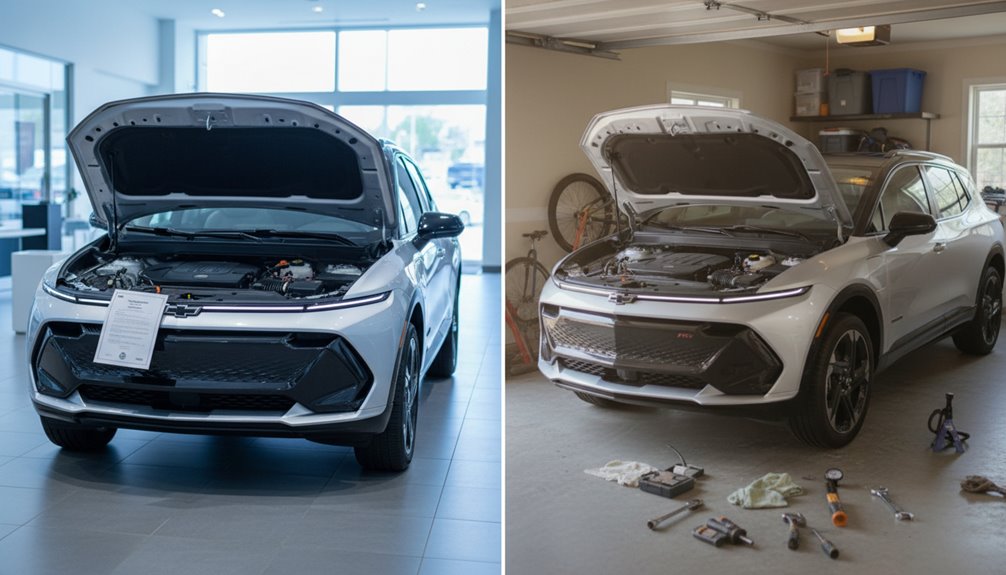
One of leasing’s most underrated perks is that your Equinox EV stays wrapped in factory warranty coverage for the entire lease duration—typically 24 to 36 months—which means you’re fundamentally driving a vehicle that Chevrolet guarantees against defects in materials and workmanship.
Here’s what that protection actually covers:
- Bumper-to-bumper warranty: Full vehicle coverage for parts and labor on defects, excluding routine maintenance like brake pads and filters.
- Powertrain warranty: Engine, transmission, and EV-specific components protected for 5 years or 60,000 miles (extending well beyond your lease).
- First service visit: Oil change, inspection, and tire rotation covered within your first year.
You’re essentially eliminating unexpected repair costs. Battery concerns? Transmission issues? Control module failures? Chevrolet absorbs those expenses through factory-trained technicians at authorized dealerships.
Buyers, conversely, face post-warranty repair bills the moment coverage expires—a financial reality that compounds with aging EV battery systems.
Flexibility to Upgrade: A Leasing Advantage for EV Tech
When you lease an Equinox EV, you’re fundamentally renting access to today’s technology rather than locking yourself into yesterday’s—a meaningful distinction given that EV battery ranges and charging speeds improve yearly.
Software updates introduce fresher safety features like improved pedestrian braking across model generations. You’ll sidestep obsolescence concerns that plague buyers who hold vehicles for five-plus years, since your lease term (typically 24 or 36 months) aligns with meaningful tech cycles instead of fighting against them.
That flexibility to upgrade every few years means you’re never stuck with an 80-mile-range pack or outdated Chevy Safety Assist systems when newer iterations offer measurable performance gains.
Technology Advancement Every Few Years
Because EV technology progresses faster than traditional powertrains, you’re facing a genuine decision: do you want to own that innovation or lease it? Every three years brings meaningful upgrades that directly impact your driving experience.
Consider what’s changing:
- Infotainment systems expand from 17.7-inch touchscreens to integrated Google compatibility with improved real-time data access
- Battery efficiency advances through regenerative braking improvements and cabin preconditioning that preserves range
- Driver assistance suites grow from baseline collision warning to Super Cruise hands-free capability on select highways
Leasing lets you chase these improvements without clutching yesterday’s technology.
You’ll experience the latest 97.4 kWh battery innovations and polished powertrain responsiveness without the depreciation hit that ownership carries.
It’s practical forward-thinking for people who want their Equinox EV matching their evolving needs.
Battery Improvements and Range Gains
While the Ultium battery platform’s modular structure—those large-format pouch cells stacked vertically or horizontally—represents a genuine leap forward, the real advantage for lessees isn’t just what’s under the Equinox EV’s floor today, but what’ll be there in three years.
You’re not locked into last year’s chemistry. As GM integrates high-nickel, LFP, and LMR options across the flexible architecture, leasing lets you step into newer battery tech without the sunk-cost hangover.
Your 2025 model might hit 319 miles; your 2028 lease could exceed that baseline considerably.
Meanwhile, software updates continuously enhance energy management on your current pack. Buyers, conversely, own yesterday’s innovation.
Leasing positions you within the technology curve rather than behind it—a practical hedge against rapid EV advancement.
No Obsolescence Concerns With Leasing
Every three to six months, your leased Equinox EV’s infotainment system refreshes with over-the-air updates that improve motor response, regenerative braking efficiency, and user interface layouts—improvements you’ll experience without visiting a dealer or paying extra fees. You’re essentially driving the latest tech without chasing obsolescence.
When you lease, you sidestep the tech depreciation trap that ownership creates. Consider:
- Battery advancements: Newer lease vehicles incorporate improved chemistry and thermal management
- Software iterations: Quarterly updates ensure your vehicle stays competitive with industry standards
- Hardware compatibility: Leasing cycles align with meaningful tech generational shifts
The EV terrain evolves rapidly—manufacturers invest $1.2 trillion through 2030 in development. Your three-year lease term means you’ll turn in a vehicle while it’s still competitive, then upgrade to genuinely superior technology rather than marginal improvements. That’s the leasing advantage.
When Buying an Equinox EV Actually Makes Sense
If you’re planning to keep your Equinox EV for at least five years and drive more than 12,000 miles annually, buying makes considerably more financial sense than leasing. Here’s why: your cumulative fuel savings reach $10,000 over a decade.
Keep your Equinox EV five years, drive 12,000+ miles annually, and pocket $10,000 in fuel savings alone.
Maintenance costs run 39% lower than gas counterparts. That $1,350 annual advantage (fuel plus maintenance) compounds profoundly for long-term owners.
A $1,000 home charger installation pays for itself quickly through reduced electricity expenses of $396–$660 yearly.
Your total five-year ownership cost sits at $45,406 versus $51,126 for gas models—nearly $9,500 in your pocket.
Depreciation, while substantial at $23,082 over five years, matters less when you’re retaining the vehicle.
Extended ownership reshapes that initial investment into genuine savings, especially if you’re clocking 15,000+ miles annually.
The math simply favors buyers with longer horizons.
Avoid the Lease-End Surprise: What to Know Before You Sign

Lease-end surprises don’t have to wreck your wallet—but they’ll if you’re not paying attention starting now, roughly 12 months before your agreement matures.
Most lessees uncover unexpected charges during that final 30-45 day window after turn-in, when invoices arrive detailing excess wear, mileage overages, and disposition fees totaling hundreds or thousands of dollars.
You’ll dodge these financial landmines by comprehending what GM actually charges for:
- Excess wear: Wheels with scratches exceeding 3 inches, tires below 4/32 inch tread depth, or mismatched specifications trigger charges.
- Mileage overage: Per-mile rates specified in your lease agreement compound quickly if you’ve underestimated driving habits.
- Disposition fee: Up to $395 unless you purchase or lease another GM vehicle.
Schedule your complimentary pre-return inspection within 120 days of lease maturity. Gather maintenance receipts—they’ll offset charges.
You’re essentially auditing your own vehicle before GM does. That proactive step separates financially savvy lessees from bill-shocked ones.
Stacking Incentives: Maximize Your Lease Savings
How much cheaper can you actually make your Equinox EV lease by stacking manufacturer incentives? Substantially cheaper—if you know which offers combine.
Start with the $5,000 Chevrolet customer cash allowance on 2026 models. Add the $1,250 GM Costco Executive member incentive or $1,250 conquest cash if you’re switching from a competing brand. That’s $6,250 before your loyalty discount kicks in ($500 for current GM lessees).
You’re now at $6,750 in combined incentives, stackable with the $7,500 federal lease tax credit that reduces your capitalized cost directly.
This isn’t theoretical math—real deals show $249/month payments after stacking, versus standard $347/month offers.
The layering works because these incentives hit different parts of your lease equation: cash allowances reduce capitalized cost, tax credits lower monthly obligations, and loyalty bonuses compress at-signing figures.
Verify eligibility at signing; some offers expire February 2026.
Your Lease vs. Buy Checklist: Five Questions to Answer First
Before you sign on the dotted line, you’ll need to answer five straightforward questions that’ll determine whether leasing or buying makes financial and practical sense for your situation.
Start by honestly evaluating your driving habits and ownership priorities:
- How often do you drive annually? Standard leases cap you at 10,000 miles yearly; exceeding that costs $0.25 per mile, making high-mileage drivers better candidates for purchasing.
- Do you want long-term ownership? Buying provides unlimited customization after your financing term (up to 84 months), while leasing offers fresh vehicles every 24–36 months.
- Does latest technology matter? Shorter lease cycles align with industry innovation, whereas purchasing locks you into one generation’s tech stack.
Your answers clarify whether you’re suited for lease flexibility or ownership commitment.
Compare the 2025 Equinox EV lease ($349 effective monthly) against purchase economics.
This foundation guides your next decision confidently.
Frequently Asked Questions
What Happens to My Equinox EV Lease if I Exceed the 10,000 Annual Mileage Allowance?
Your mileage overage becomes a financial albatross you’ll carry to lease-end. You’ll owe Chevrolet $0.25 per mile exceeding 10,000 annually—charges that accumulate and hit your wallet at signing-off time.
Can I Customize or Modify My Leased Equinox EV With Aftermarket Parts?
You can install removable aftermarket parts like floor mats and protective films, but you’ll need to restore your Equinox EV to stock condition before returning it at lease end. Permanent modifications aren’t recommended.
What Insurance Coverage Is Required for Leasing Versus Buying an Equinox EV?
When you’re considering your Equinox EV options, here’s what you’ll find: lessors require extensive, collision, and gap insurance with low deductibles, while owners enjoy flexibility choosing coverage levels matching their financial comfort and state minimums.
How Does Battery Degradation Affect Lease Versus Purchase Decisions for the Equinox EV?
You’ll benefit from leasing if you’re worried about degradation—you’re covered under warranty before significant capacity loss hits. Buying works if you’re committed to proper charging habits; you’ll keep 80-90% capacity for years.
Can I Transfer My Equinox EV Lease to Another Person or Vehicle?
You can absolutely transfer your Equinox EV lease—like a telegram passing between hands—to another person in your state. You’ll pay $625, meet credit requirements, and can’t transfer within the first six months or final year of your agreement.


