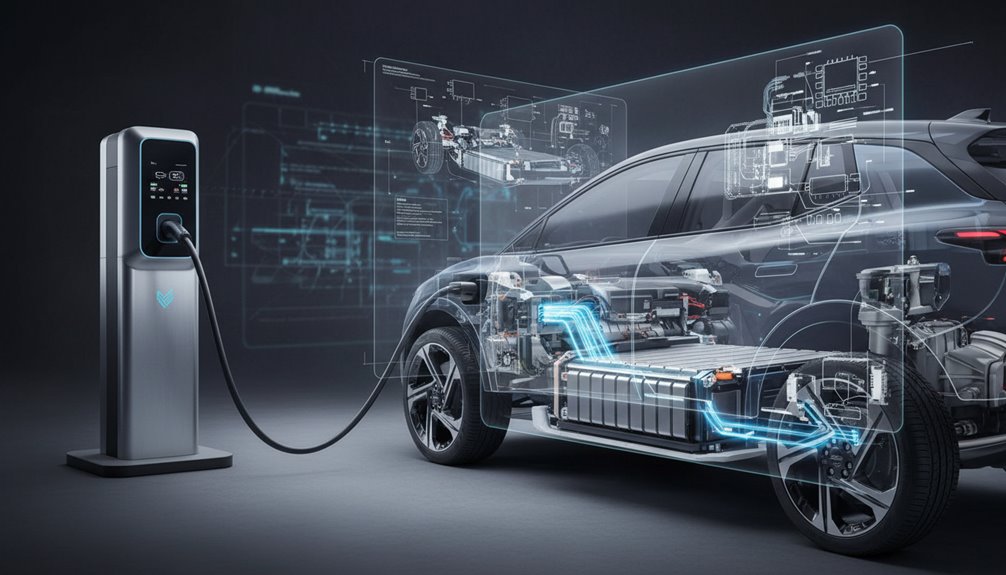

For years, the electric vehicle market offered a difficult choice: overspend for a luxury car or settle for a compromised budget hatchback. The Chevrolet Equinox EV arrives to shatter that divide. With a 319-mile range, a spacious interior, and a starting price near $35,000, it promises to be the first no-compromise electric SUV for the average American family.
It isn’t designed to be a spaceship; it is designed to seamlessly replace your gas car. But does the real-world experience match the spec sheet? From charging quirks to winter range, here is the unvarnished truth about living with America’s most important new EV.
Key Takeaways
- GM designed the Equinox EV on the purpose-built BEV3 platform specifically for mass-market electric vehicle adoption and affordability.
- CES 2023 reveal positioned Equinox EV as affordable and futuristic, targeting mainstream buyers rather than premium EV enthusiasts.
- Aggressive pricing strategy at $34,995 entry price undercuts competitors, aligning with GM’s goal of accessible EV ownership.
- Equinox EV achieved 100.7% year-over-year sales growth in 2025, capturing significant market gap in sub-$40,000 EV segment.
- Multiple trim levels and configurations allow diverse buyer budgets, demonstrating GM’s strategy for practical utility over exclusivity.
Why Equinox EV Is GM’s Affordable EV Game-Changer
When you’re shopping for an electric vehicle that won’t crater your monthly budget, the 2026 Chevrolet Equinox EV fundamentally changes what “affordable EV” actually means.
GM positioned this compact SUV at $36,495—undercutting competitors like the 2026 Hyundai IONIQ 5 ($36,600) and Ford Mustang Mach-E ($39,990).
That affordability impact isn’t theoretical. Real transaction data shows buyers negotiate an average $2,368 discount, reducing the LT1 trim to approximately $32,650. The base LT FWD trim delivers up to 319 miles of range, maximizing value for budget-conscious buyers. The standard 85 kWh usable battery ensures competitive efficiency compared to vehicles in this price segment.
Factor in the federal $7,500 tax credit for qualified purchasers, and your effective ownership cost drops to roughly $26,995.
Monthly payments average just $508, democratizing EV ownership across income brackets.
The 2025 model year sustained this sub-$40,000 pricing while providing 315+ miles of EPA-estimated range—consumer savings that previously seemed impossible at this performance level.
That’s not marketing hyperbole; that’s verifiable consumer advantage reshaping the EV market’s accessibility foundation.
Separate Platform, Separate Purpose: How Equinox EV Differs From Gas Equinox
When you slide behind the wheel of an Equinox EV, you’re experiencing GM’s purpose-built BEV3 platform design—a fundamentally different beast from the gas model’s traditional internal combustion foundation—which enables dedicated EV technologies like the Ultium battery pack and dual-motor configuration that the gas Equinox simply can’t accommodate.
That platform distinction isn’t academic; it translates to a lower center of gravity for improved stability, DC fast charging that adds 77 miles in 10 minutes, and instant electric torque that feels nothing like a supercharged 1.5L engine’s delayed response.
You’re not driving a gas SUV with a battery bolted on; you’re driving a vehicle engineered from the ground up for electric propulsion, which means the performance capabilities, efficiency metrics, and user experience diverge entirely from what gas Equinox owners experience. The Equinox EV’s aerodynamic exterior design has been optimized specifically for maximizing electric range and reducing energy consumption during highway driving.
BEV3 Platform Architecture
they’re built on fundamentally different structures designed for entirely different purposes.
Your Equinox EV rides on GM’s BEV3 platform—a third-generation design purpose-built for electric vehicles, not retrofitted from an internal combustion design.
The BEV3 uses a skateboard layout that positions Ultium batteries between the wheels within the wheelbase, which is where the real magic happens.
This modular design accommodates six to twenty-four battery modules under the floor, giving engineers flexibility they’d never have with a gas platform.
The larger footprint with lower height compared to BEV2 improves weight distribution and center of gravity, enhancing handling.
Battery integration this way delivers greater energy density and faster charging rates—no compromises needed. Production for the 2025 model year began August 26, 2024, marking GM’s commitment to scaling this revolutionary platform.
Design And Underpinnings Distinction
That skateboard design we just covered isn’t just an engineering curiosity—it fundamentally reshapes how the Equinox EV looks, feels, and drives compared to its gas-powered sibling.
You’re looking at two distinctly different vehicles wearing similar nameplates.
The exterior design reflects this separation immediately. The Equinox EV features:
- Futuristic, aerodynamic lines refined for reduced drag and extended range
- Smooth, modern surfaces that telegraph its electric purpose
- A sleek profile versus the gas model’s traditional SUV stance
Inside, you’ll notice the Equinox EV’s interior features larger touchscreens, digitized instruments, and EV-specific charge status displays. The 17.7-inch touchscreen replaces many traditional buttons with touch-sensitive controls, representing a significant leap in modern vehicle interface design.
The gas Equinox retains conventional layouts with physical buttons and smaller screens.
Both platforms deliver spacious cabins, but the EV’s Ultium battery placement lowers its center of gravity, enabling superior cornering stability.
Engineering purpose shapes form—that’s the real distinction here.
Performance Capabilities Reimagined
Because the Equinox EV runs on an entirely different platform with electric propulsion, it doesn’t just perform differently—it performs *according to different rules*.
You’re experiencing electric acceleration unshackled from gear shifting delays. The dual-motor AWD setup delivers 300 hp and 355 lb-ft of torque instantly, rocketing from zero-to-60 mph in 5.8 seconds—no transmission lag. With the 85.0 kWh battery pack, this performance sustains across the vehicle’s 285-mile range.
That’s battery efficiency working simultaneously with performance: the Ultium platform distributes weight low and centrally, enabling 0.81 g skidpad grip and 178-foot braking distances.
The FWD variant trades some dynamism (0.78 g) for extended range—319 miles versus 307.
You’re not choosing between efficiency and capability anymore. You’re choosing which version of both you prefer.
From CES Tease to 8,500 Sales: The Equinox EV Timeline
When Chevrolet rolled out the all-electric Equinox EV at CES 2023, the automaker wasn’t just teasing another EV—it was fundamentally announcing GM’s answer to mass-market EV adoption, complete with a $30,000 starting price that made industry observers sit up and take notice.
You’re watching a deliberate rollout unfold. From that initial CES reveal through the 2024 mid-year launch and into 2025 dealer arrivals, Chevrolet engineered momentum strategically:
- CES 2023 announcement positioned the Equinox EV as affordable, futuristic, and built on the GM Ultium platform for genuine mass appeal.
- 2024 model availability delivered 319-mile EPA-estimated range with multiple trims and state-of-the-art driver-assistance features.
- 2025 expansion added DC fast charging up to 150 kW and Google Built-In infotainment across the lineup.
That $30,000 entry point? It wasn’t accidental.
You’re looking at calculated EV technology designed to democratize electric vehicle ownership while competing directly in the compact SUV segment that dominates American preferences. The available trim levels—from the 1LT through 3RS—ensure buyers can select configurations matching their budget and feature priorities.
What Makes BEV3 the Platform Behind Equinox EV’s Performance?
The Equinox EV’s real performance advantage sits underneath you—literally.
GM’s BEV3 platform positions the 85.0 kWh Ultium battery pack between the wheels within the wheelbase, creating a skateboard-type design that fundamentally changes how this crossover behaves. This battery technology delivers consistent weight distribution and a lower center of gravity—physics that directly translates to roadholding (0.78 g FWD, 0.81 g AWD on the skidpad) and braking performance (178-189 feet from 70 mph).
The direct-drive transmission paired with dual permanent-magnet motors releases electric performance without mechanical complexity.
Front-wheel drive produces 210-220 horsepower and 236-243 lb-ft torque, while all-wheel drive pushes 290 hp and 346 lb-ft. That’s 0-60 in 2.9 seconds (FWD).
Meanwhile, the 150 kW DC fast-charge capability adds 70 miles in just 10 minutes—genuine utility wrapped in platform engineering.
319 Miles of Real Range: What the EPA Rating Means for Daily Driving
All that performance engineering under the Equinox EV means nothing if you can’t trust how far you’ll actually drive on a full charge—and that’s where EPA ratings enter the conversation.
The EPA combines standardized city and highway cycles (55% urban, 45% highway) to calculate your Equinox EV’s official range.
Here’s the catch: that lab-tested number doesn’t account for real-world conditions you’ll encounter daily.
Your actual range depends on several variables:
- Cold temperatures reduce efficiency considerably; winter driving cuts mileage by 20-40%
- Aggressive driving and highway speeds (75+ mph) compress range dramatically versus controlled testing
- HVAC usage and terrain layer additional drain on your battery
The EPA applies a 0.7 adjustment factor to lab results, acknowledging this reality gap.
Still, plan conservatively below published ratings for cold weather and long trips.
Comprehending this distinction between EPA ratings and real-world range prevents charging surprises and keeps you confident on daily routes.
The $30,000 Question: How Pricing Positions Equinox EV Against Competitors
You’re looking at a $34,995 entry point with the 2026 LT 1 FWD—a price that undercuts the Hyundai IONIQ 5 by $1,605 and positions Chevrolet’s offering roughly $5,000 below the Ford Mustang Mach-E, making it genuinely competitive in the sub-$40,000 segment where buyers actually shop.
Factor in real-world dealer discounts averaging 6.7% to 11.3% off MSRP (translating to around $2,400–$3,700 in actual savings), and you’re potentially looking at sub-$32,500 transaction prices that cement the Equinox EV’s standing as America’s most accessible 315-plus-mile EV.
The strategy’s straightforward: Chevrolet’s betting that accessible pricing drives volume in a market where upfront cost remains the primary barrier to EV adoption.
Affordable Entry Point Strategy
While Chevrolet’s $34,995 starting price for the Equinox EV LT 1 FWD sounds competitive on paper, the real story isn’t about what’s printed on the window sticker—it’s about what buyers actually pay and whether that entry-level appeal holds up when you factor in real-world discounts, trim-level jumps, and the practical features you’ll need.
Here’s what the pricing strategies actually reveal:
- Real transaction data: TrueCar shows buyers averaging $32,576 across 226 purchases—an 11.3% markdown revealing how aggressive dealers negotiate.
- The trim-level trap: Jumping to LT 2 FWD hits $41,900, nearly doubling your monthly payment from roughly $508 to $680.
- Feature creep: Base LT 1 lacks conveniences; you’ll likely want the mid-tier’s comfort upgrades.
GM’s entry-level positioning targets practical buyers seeking range without premium pricing. You’re getting 319 miles and essentials—that’s genuine value.
Competitive Market Positioning Analysis
When you stack the Equinox EV’s $34,995 starting price against the Hyundai IONIQ 5 ($42,600) and Kia EV6 ($42,900), GM’s isn’t just cheaper—it’s playing a different game entirely.
That $7,600+ gap reflects GM’s aggressive pricing strategies targeting market trends favoring affordable electrification. You’re getting 319 EPA miles versus the IONIQ 5’s 245 miles and EV6’s 237 miles—superior range-to-dollar value that redefines segment expectations.
Transaction data shows real-world buyers saving an additional 6.7% to 11.3% below MSRP, pushing effective entry prices toward $32,576. This positioning directly challenges competitors’ premium pricing while undercutting gas Equinox models.
GM’s Ultium platform efficiency (109 MPGe) amplifies lifetime ownership savings, making the EV’s initial sticker shock virtually disappear against long-term operating costs.
FWD or AWD: Which Trim and Powertrain Combo Fits Your Needs?
How much performance are you actually willing to trade for efficiency?
You’re facing a genuine tradeoff. FWD advantages shine through increased range—319 miles EPA-estimated versus AWD’s 307 miles—because that single motor demands less battery power. You’ll pocket $33,600 for FWD base pricing, establishing serious cost savings upfront.
However, AWD benefits justify the premium if you prioritize acceleration and traction.
Consider your priorities:
- Daily commuters: FWD’s 220 hp and 236-243 lb-ft torque handle standard driving; 11.5 kW Level 2 charging means overnight replenishment suits routine schedules.
- Performance seekers: AWD’s 300 hp and 333-355 lb-ft torque deliver 5.8-second 0-60 times, altering weekend drives into genuine engagement.
- Budget-conscious buyers: FWD’s efficiency gains translate directly to lower fuel costs and reduced charging infrastructure dependency.
Both configurations share 150 kW DC fast-charging capability and identical 85.0 kWh battery design with liquid cooling.
Your choice hinges on whether you’re optimizing wallet or acceleration.
Why Equinox EV Outsells Other GM Electric Vehicles
The Chevrolet Equinox EV‘s dominance over GM’s broader electric lineup isn’t accidental—it’s the result of deliberate market positioning that prioritizes volume over prestige.
You’re looking at a vehicle engineered specifically for mainstream adoption, which gives it significant Equinox advantages against competitors like the Blazer EV (20,825 units sold in 2025 versus Equinox’s 57,945).
GM’s sales strategies centered the Equinox EV as an entry-level gateway rather than a premium offering.
The base pricing undercuts luxury alternatives like the Cadillac Lyriq, making EVs genuinely accessible to cost-conscious buyers moving from gas vehicles.
This positioning captured a market gap that other GM electric SUVs simply couldn’t reach.
The Equinox EV achieved 100.7% year-over-year growth in 2025, with Q3 deliveries hitting 25,085 units.
That performance reflects consumer preference for practical utility combined with affordability—exactly what you get when engineering prioritizes accessibility over exclusivity.
Equinox EV vs. Tesla Model Y, Ford Mustang Mach-E, and Chevy Bolt EV
Now that you grasp why the Equinox EV dominates GM’s lineup, you’re probably wondering how it actually stacks up against the vehicles buyers really compare it to—namely Tesla’s Model Y, Ford’s Mustang Mach-E, and Chevy’s own Bolt EV.
The Tesla Model Y comparison reveals clear trade-offs. You’ll find the Model Y Performance delivers 390 horsepower versus the Equinox EV RS AWD’s 300, hitting 0-60 mph in 3.8 seconds compared to your Equinox’s 5.7-second launch.
However, Equinox EV features physical buttons and a shift lever—controls you actually manipulate instead of touchscreen guidance. Pricing tilts decisively: the Equinox EV starts at $36,495 versus Model Y’s $46,630.
Where the competition stands:
- Range: Equinox EV FWD matches Model Y RWD (319 vs. 357 miles)
- Cargo: Model Y edges ahead (76.2 vs. 57.2 cu. ft.)
- Charging: Model Y’s 250 kW outpaces Equinox EV’s 150 kW
The Mustang Mach-E and Bolt EV present different positioning entirely—performance-focused and compact respectively.
Is the Equinox EV Worth It? Real-World Value for Buyers
When you’re spending $36,495 to $40,000 on an electric SUV, you’re naturally asking whether the Equinox EV actually provides what Chevrolet promises—and whether that provision justifies the investment compared to alternatives flooding the market.
Real-world performance data suggests you’re getting legitimate value. Front-wheel-drive models achieved 356 miles under ideal conditions—a 12% improvement over EPA estimates. For daily usability, that translates to genuine flexibility; you’re not constantly hunting chargers.
Front-wheel-drive Equinox EV achieves 356 miles in real-world testing—12% better than EPA estimates, eliminating constant charger hunting.
Highway testing at 75 mph yielded 260 miles, confirming practical utility beyond marketing rhetoric. Compared to competitors, the numbers stack favorably. A Kia Niro EV costs roughly $7,000 more while providing substantially less range.
You’re getting cold-weather practicality too—winter testing showed realistic 145-150 mile capability, essential for northern owners. The efficiency metrics (108 MPGe for FWD) and DC fast charging (70 miles in 10 minutes) cement the value proposition.
You’re not compromising on capability or spending premium dollars for middling performance.
Frequently Asked Questions
Where Is the Equinox EV Manufactured, and Which Parts Are Sourced Internationally?
Your Equinox EV’s manufactured at Ramos Arizpe Plant in Mexico. You’ll find fewer Chinese-sourced parts in 2025 models, as GM’s reducing international supplier risks while keeping your vehicle competitively priced.
What Charging Speed Can the Equinox EV Achieve With DC Fast Charging Capabilities?
You’ll achieve DC fast charging speeds up to 150 kW with your Equinox EV, adding 70 miles in just 10 minutes. That advanced battery technology and modern charging infrastructure mean you’re part of a network built for practical, rapid replenishment.
Can the Equinox EV Tow Trailers or Equipment, and What’s the Maximum Capacity?
You’ve got a 1,500-pound towing capacity—perfect for hauling a small utility trailer to the hardware store. Your Equinox EV’s trailer compatibility requires an optional hitch, making weekend projects totally doable.
How Does the Equinox Ev’s One-Speed Transmission Differ From Traditional Automatic Transmissions?
Your Equinox EV’s one-speed transmission eliminates traditional gear shifts, providing instant torque without delay. You’ll experience seamless acceleration thanks to superior transmission efficiency and a direct electric drivetrain connection to your wheels.
Will a Fourth-Generation Gas Equinox Launch Alongside the EV in 2025?
You’re getting both: the fourth-gen gas Equinox launched in 2025 with traditional engine features, while the Equinox EV offers electric comparisons. They’re separate vehicles letting you choose your preferred powertrain.


