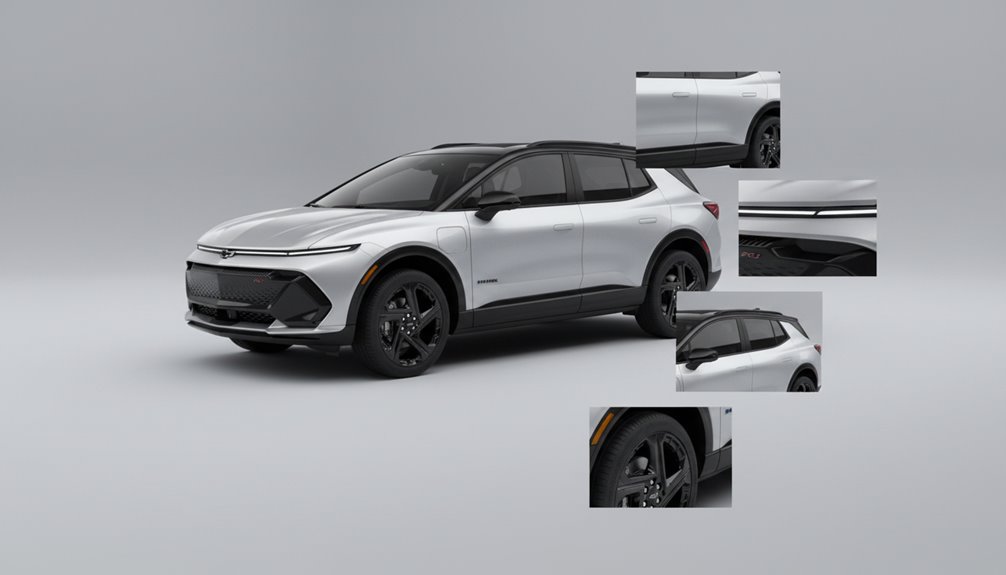

Most EVs talk about efficiency. The Equinox EV actually delivers it—starting with a 116.3-inch wheelbase that produces double-digit aerodynamic gains you’ll feel on every highway mile. This isn’t styling masquerading as function. Flush door handles, a lowered roofline, and an integrated spoiler form a drag-reducing system that measurably extends range. That aggressive stance and sculpted bodywork? They’re solving problems most automakers ignore. The engineering proves what bold design can accomplish when every surface has a job to do.
How Sleek Design Sets the Equinox EV Apart
When you first spot an Equinox EV on the road, you’re seeing the result of Chevrolet’s deliberate design philosophy—one that prioritizes both form and function.
The sculpted front fascia and distinctive grille create an immediate visual statement, while flush door handles eliminate drag and project a futuristic aesthetic.
That commanding stance comes from clean, muscular lines that don’t just look bold—they work harder.
The aerodynamic profile extends throughout.
A smoothly contoured liftgate guides airflow efficiently, and integrated rear spoilers leverage physics rather than simply ornament the design.
Sporty roof rails blend seamlessly into the overall shape, reducing turbulence rather than fighting it.
The advanced electric powertrain pairs perfectly with this aerodynamic engineering to deliver an EPA-estimated driving range of 315+ miles.
The 85 kWh battery pack with NCMA chemistry ensures that this aerodynamic design translates into substantial real-world efficiency.
What sets the Equinox EV apart isn’t mere styling.
Every curve serves a purpose.
The sleek exterior optimization translates directly to real-world efficiency gains, meaning you’re not sacrificing range for appearance.
You’re getting both—a vehicle that turns heads while maximizing every electron your battery holds.
Overall Dimensions: Comparing EV to Gas Equinox
The 2025 Equinox EV stretches 190.4 to 190.6 inches with a 116.3-inch wheelbase that mirrors its gas counterpart, proving you’re not sacrificing packability for electrification.
You’ll notice the EV version sits slightly narrower (75.4–76.9 inches) and maintains the same 63.5–64.8-inch height, though that sleeker aerodynamic profile costs you about 7 cubic feet of cargo space compared to the traditional model—a trade-off between efficiency and hauling capacity.
The math here’s straightforward: the EV’s powertrain and battery integration take real estate where the gas engine once lived, reducing your maximum cargo volume from the gas model’s figure to 57.2 cubic feet with rear seats folded. This compact footprint makes the Equinox EV engineered for diverse terrains in Pennsylvania, where drivers navigate everything from urban parking constraints to rural back roads.
Length And Wheelbase Growth
Because Chevrolet’s engineers stretched the Equinox EV’s platform to accommodate its battery and motor design, you’re looking at a vehicle that’s noticeably larger than its gas-powered sibling—and those extra inches matter more than you’d think.
The EV stretches 190.6 inches overall, a 7.4-inch gain over the gas model’s 183.20 inches. More notably, the wheelbase expands from 107.50 to 116.3 inches—an 8.8-inch increase that changes how your Equinox EV behaves on the road.
That longer wheelbase isn’t just padding. It improves ride smoothness through improved weight distribution, delivers measurable rear legroom gains, and provides genuine stability advantages during highway driving. You’re basically getting midsize SUV proportions packaged into what remains a remarkably maneuverable vehicle. The EV’s 76.94-inch width also contributes to a more planted, confident stance compared to the gas Equinox’s narrower profile.
Width And Height Adjustments
While you won’t notice a dramatic overhaul compared to the gas Equinox, Chevrolet’s engineers made deliberate width and height adjustments to the EV that affect how it drives and how efficiently it moves through the air.
Your EV sits 0.6 inches lower at 64.8 inches—a modest reduction that improves aerodynamics without compromising the compact SUV profile.
More significant: the EV’s body width stretches to 76.94 inches (excluding mirrors), outpacing the gas model by 2.2 inches.
Including mirrors, you’re looking at 84.85 inches total.
That wider stance isn’t cosmetic.
Expanded track widths—63.45 inches front, 63.69 inches rear—enhance stability and handling.
These adjustments enhance the Ultium platform’s battery integration while maintaining ground clearance at 6.4 inches for both models.
The available 21-inch wheel options on higher trims further refine the visual presence and handling characteristics of the EV’s wider platform.
The geometry works.
Cargo Space Trade-Offs
If you’re shopping between the Equinox EV and its gas counterpart, you’ll notice a trade-off baked into the design: Chevrolet squeezed the EV’s cargo hold to 26.4 cubic feet behind the second row, giving up 3.4 cubic feet compared to the gas model’s 29.8 cubic feet.
That deficit stems directly from battery placement—the EV prioritizes range over maximum volume.
However, you’re not entirely losing ground. The EV’s underfloor bin swallows a 20×10.5-inch duffle, adding flexibility the gas model requires floor removal to access. With the second row folded, you’ll hit 57.2 cubic feet maximum, actually exceeding the gas version. The level 2 charger enables convenient daily charging that offsets the slightly reduced cargo footprint for most owners.
Real-world testing shows the difference matters less than specs suggest; both fit three roll-aboard bags comfortably, though the gas model edges ahead with soft duffles.
Why a Longer Wheelbase Powers EV Efficiency
When you’re evaluating the Equinox EV’s design, the wheelbase—that’s the distance between the front and rear axles—might seem like just another spec sheet number, but it’s actually one of the most underrated factors determining how efficiently your EV converts battery energy into miles.
Here’s why: a longer wheelbase reduces rear overhang, which directly lowers aerodynamic drag at highway speeds. You’re not fighting as much turbulence, and that flatter proportional body design means air flows around your vehicle more cleanly.
Simultaneously, the extended wheelbase positions your battery mass ideally between the axles, distributing weight evenly. This stabilized platform requires less energy to overcome weight shifts during acceleration and braking. The longer driveshaft layout also enables smoother power delivery without the mechanical stress that shorter designs experience.
The result? You’ll see a 10-30% efficiency retention advantage on highways compared to shorter designs. Regenerative braking becomes more effective over distances, rolling resistance drops, and your overall MPGe improves by maintaining consistent speed without constant drag adjustments.
Compact Profile: Lower Height, Wider Stance
The Equinox EV’s compact proportions—a 64.8-inch height paired with an 84.85-inch width—represent a deliberate engineering trade-off that you’re probably noticing before you even turn the key. That lower roofline isn’t just about fitting into standard garages; it actively reduces your vehicle’s frontal area, letting air slip over the body more efficiently.
Meanwhile, the wider 63.45-inch front and 63.69-inch rear track widths plant you firmly on the road, providing the stability and confident cornering you’d expect from a properly proportioned SUV.
This stance balances physics with practicality. You get sleeker aerodynamics supporting that 319-mile EPA range while maintaining the planted, athletic look that distinguishes the Equinox EV from taller competitors.
The foldable mirrors compress to 76.94 inches for tight parking situations, proving compact doesn’t mean compromised. Every dimension works together—less wind resistance, more confident handling, fewer trips to the charger.
Ground Clearance: 6.4 Inches of Real-World Capability
Six-point-four inches—that’s your Equinox EV‘s ground clearance specification, and while it mightn’t sound like much compared to traditional SUVs, it’s engineered to deliver real-world capability without sacrificing the aerodynamic efficiency that extends your driving range.
That 163 mm translates to approach and departure angles of 17.8 and 23.3 degrees respectively, which means you’ll traverse unpaved surfaces with surprising competence.
Your actual performance depends on variables: loading weight, terrain type, ambient temperature, and battery condition all factor into what clearance actually buys you.
The Equinox EV’s 1,500-pound trailering capacity (with accessory hitch) and 12.6-inch front disc brakes handle practical demands effectively. With 19-inch Michelin 245/55R19 tires paired to four-wheel anti-lock brakes and traction control, you’re equipped for genuine mixed-surface exploration—not showroom posturing. Lower than the Blazer EV’s 7.89 inches, this measurement suits the compact electric SUV segment perfectly.
Why Lower Height Reduces Drag and Extends Range
Because aerodynamic drag increases exponentially at highway speeds, shaving just 30-40 millimeters off your Equinox EV’s ride height delivers measurable range gains you’ll actually notice on long trips.
Here’s what’s happening beneath the surface:
- Reduced frontal exposure — Lowering the vehicle minimizes exposed wheel area, directing airflow above rather than around the body
- Pressure redistribution — Surface pressure decreases at upper and rear-facing points, cutting overall drag by up to 8%
- Improved flow behavior — Ideal height eliminates underbody impingement on rough surfaces, smoothing airflow separation
- Quantifiable efficiency — A 10% aerodynamic improvement translates to 5% extended range without battery changes
Since aerodynamic drag consumes nearly 48% of highway driving resistance, this isn’t theoretical optimization—it’s practical physics.
Lower your Equinox EV’s stance, and you’re effectively getting more miles per charge while maintaining identical battery capacity.
The math works in your favor.
Aggressive Styling: What the RS Trim Delivers
While aerodynamics handle the invisible work of extending your range, the RS trim handles the visible statement—and it’s unapologetic about what it wants you to notice. You’re getting blacked-out exterior accents paired with exclusive RS badging that distinguishes your Equinox EV from the standard LT.
The 21-inch black painted aluminum wheels—larger than the 19-inch options elsewhere—sit underneath with self-sealing all-season tires, while carbon flash metallic pockets add visual depth.
LED headlamps and taillamps frame the bold, aerodynamic design with modern precision. Black emblems and mirrors come standard, complemented by optional Radiant Red Tintcoat that commands attention against those aggressive dark accents.
The Jet Black interior echoes this theme with red stitching and RS emblems throughout.
This isn’t subtle. The RS trim’s sportier look reflects the electric capabilities underneath, translating performance potential into visual language that other drivers recognize immediately.
Power Mirrors and Roof Rails: Form Meets Function
You’re looking at two features that don’t just improve how your Equinox EV functions—they reshape how it performs.
These aren’t afterthoughts; they’re integral to your vehicle’s capability and presence.
On the RS trim, you get heated power-adjustable mirrors with manual-folding capability.
The LT offers power-adjustable versions.
Both trims include convex exterior mirrors for expanded sightlines and reverse tilt functionality for parking precision.
Here’s what makes them genuinely useful:
- Remote folding via key fob reduces side-swipe risks in tight spaces
- Heated mirror surfaces maintain visibility during winter conditions without manual clearing
- 84.9-inch overall width accommodates larger cargo while mirrors stay protected when folded
- Auto-dimming options minimize glare during dawn and dusk driving
Roof rails complete this functional package.
Available bright rails support up to 1,500 lbs. of towing capacity while complementing your vehicle’s 64.8-inch height profile.
They’re practical enough for outdoor seekers, polished enough for daily commuters.
Black Wheels and Emblems: RS Trim Details
You’ll spot the RS trim’s aggressive styling statement immediately—those 21-inch black wheels paired with blacked-out emblems and badging create a unified, performance-inspired exterior that signals serious intent. The dark wheel finish not just complements the black mirrors and moldings but also reduces visual mass (a trick designers use to make vehicles appear lower and sportier), while the standard black emblems replace the chrome found on other trims, eliminating any visual softness.
This premium trim differentiation matters when you’re deciding whether the $44,795 starting price justifies the aesthetic upgrade, since these high-contrast elements redefine the Equinox EV’s presence on the road without adding mechanical complexity.
Aggressive Styling Statement
When you’re shopping for an Equinox EV that doesn’t whisper—that actually announces itself—the RS trim’s aggressive styling package delivers through a coordinated assault of black accents that fundamentally reshape the SUV’s visual personality.
You’ll notice this intentional aggression through four key design elements:
- Black 21-inch wheels provide a bold foundation, grounding the stance while visually widening the track
- Black emblems replace standard badging, eliminating chrome distraction and sharpening the overall appearance
- Black mirrors contrast against body color, emphasizing width and creating visual tension
- Aggressive fascia designs (front and rear) amplify the performance-inspired attitude throughout
These components work synergistically, not as isolated details.
The black accents unify the exterior into a cohesive, purposeful statement.
You’re not just driving an EV—you’re piloting something that looks like it means business.
Premium Trim Differentiation
The RS trim’s aggressive styling statement crystallizes into concrete hardware specifications that separate it from the LT base model—and the differentiation starts where rubber meets pavement. You’ll roll on 21-inch black wheels featuring a machined-face design with Carbon Flash metallic pockets, a sportier setup than the alternative 19-inch option.
Black mirrors and blacked-out exterior accents coordinate with that distinctive red RS badging, creating visual cohesion that signals performance intent. The grille and front fascia adopt aggressive treatments, while the rear fascia mirrors that bold approach. These aren’t arbitrary styling choices; they’re deliberate design elements that work together.
The jet black interior with red stitching extends this two-tone aesthetic inward, embedding RS identity throughout your cabin. You’re not just choosing a trim—you’re selecting a complete visual philosophy.
The Battery Tradeoff: No Front Frunk, Maximum Range
Because GM’s Ultium platform prioritizes battery safety and structural rigidity, the Equinox EV sacrifices what many drivers expect: a front frunk.
You’re gaining something better: a stiff chassis foundation that improves ride quality and handling behavior. Here’s what this tradeoff actually means for you:
A stiff chassis foundation improves ride quality and handling behavior—trading convenience for engineering excellence.
- Centralized battery layout lowers your center of gravity, distributing weight evenly across the vehicle’s length for superior stability
- Long wheelbase design enabled by under-chassis battery placement contributes to enhanced ride quality and planted cornering
- Structural DNA shared with Cadillac Lyriq demonstrates proven battery integration efficiency across GM’s premium lineup
- 57.2 cubic feet of rear cargo space compensates for missing front storage through ample cabin alternatives
You’re not losing practicality—you’re trading convenience for engineering excellence.
That’s the Equinox EV philosophy: purpose-driven efficiency over luxury appointments.
Why the Equinox EV Sits Shorter Than the Gas Model
If you’ve parked an Equinox EV next to its gas-powered sibling, you’ll notice the electric version sits noticeably lower—about 0.80 inches lower, to be precise, though some side-by-side comparisons suggest closer to an inch. That’s not accident; it’s engineering.
Chevrolet deliberately lowered the EV’s roofline through aerodynamic shaping, which reduces wind resistance and improves efficiency—critical for maximizing range. The lower stance also improves stability during cornering, a practical benefit when you’re managing a heavier vehicle (thanks to battery weight distribution across the floor).
You’re trading vertical headroom for horizontal advantages. Front headroom drops from 40.00 to 39.15 inches; rear headroom falls from 39.20 to 38.49 inches. Most owners don’t notice the difference in daily use.
The strategic height reduction reinforces the EV’s modern design language while serving genuine performance purposes. It’s the kind of compromise where nobody really loses.
EPA Range Performance: How Aerodynamics Hits 319 Miles
How does Chevrolet squeeze 319 miles of EPA-estimated range from the Equinox EV’s front-wheel-drive models when competitors struggle to crack 280?
Aerodynamics. The Equinox EV’s carefully sculpted exterior isn’t just for looks—it’s engineered to slice through air with exceptional efficiency.
The Equinox EV’s sculpted design isn’t aesthetic—it’s engineered to slice through air with exceptional efficiency.
Here’s how the design achieves this:
- Low energy consumption at 29 kWh/100 miles — beating EPA estimates by 6 percent
- 3.2-3.3 miles per kWh efficiency in highway conditions through sleek proportions
- 12 percent range improvement over EPA projections directly attributable to aerodynamic design
- 85-kWh battery paired with efficient bodywork enabling longest-range capability under $35,000
Real-world testing confirms it.
Edmunds achieved 356 miles on an FWD model, surpassing EPA figures by 37 miles.
That’s not luck—it’s physics meeting industrial design.
Your shorter, sleeker Equinox EV displaces less air resistance than taller competitors, meaning every electron from the battery travels farther down the road.
City Driving Burns More Energy: Why Highway MPGe Wins
While highway driving might feel more efficient than city cruising, the Equinox EV’s EPA ratings tell a different story—your city MPGe actually beats highway performance, and it’s not because urban roads are smoother or shorter.
Here’s why: aerodynamic drag scales with speed squared, meaning 75 mph highway driving hammers your battery far harder than stop-and-go city traffic.
You’re not just burning energy fighting wind resistance; you’re running the motor continuously without regenerative braking’s assist.
In cities, you recover roughly 22% of energy during deceleration—free miles practically.
That regenerative advantage compounds through frequent stops, increasing city efficiency 15-25% above highway figures.
The EPA weights its combined rating 55% city, 45% highway, reflecting this reality.
Your Equinox EV thrives on urban congestion that’d exhaust a gas engine’s efficiency.
Counterintuitive? Absolutely. Physics-backed? Entirely.
Wide Track Width: How the Equinox EV Stays Planted
Your Equinox EV’s efficiency advantage in city driving comes partly from how the vehicle’s design—specifically its stance—supports those frequent stops and directional changes without energy-draining body roll.
That planted feeling you’ll notice? It’s engineered. Your Equinox EV features a 63.45-inch front track width paired with a 63.69-inch rear measurement, creating a mere 0.24-inch differential.
This geometry matters because:
- Minimal body roll during cornering reduces energy waste fighting lateral forces through your suspension
- Balanced weight distribution across the wheelbase (116.3 inches) prevents load shifting that demands steering corrections
- Consistent contact patch pressure from the multilink rear suspension maintains tire grip without excessive friction
- Responsive directional control via the 59:1 steering ratio translates that wide foundation into precise, efficient maneuvering
The 38.06-foot turning circle combines with these track dimensions to deliver confident urban maneuvering. You’re not fighting the physics—you’re working with it.
Smooth Ride: MacPherson Struts Up Front, Multi-Link in Back
You’ll find the Equinox EV’s chassis combines MacPherson struts up front with a multi-link setup in back, a pairing that isolates road imperfections from your cabin through independent wheel control on all four corners.
That 17-inch front track width we mentioned earlier? It works in concert with these suspension geometries to plant the vehicle firmly through corners while the disassociated damper and coil design keeps your ride composed without sacrificing responsiveness.
The result is handling that feels both stable and polished—the suspension absorbs bumps rather than transmitting them directly to your spine.
MacPherson Strut Front Design
The MacPherson strut front suspension that supports the Equinox EV’s polished handling is a tour de force in doing more with less—a single telescopic damper serves as both the wheel’s shock absorber and its upper steering pivot, eliminating the need for a separate upper control arm.
You’re getting an optimized setup that prioritizes efficiency:
- Coil spring and shock integration absorbs bumps while maintaining responsive steering feel
- Rubber mounts and bearings at the upper tower handle vibration isolation and pivoting
- Lower wishbone geometry keeps your steering knuckle stable through suspension travel
- Compact packaging frees precious engine bay real estate for battery and cooling systems
This design choice means fewer moving parts, reduced wear points, and lighter overall weight—all contributing to the Equinox EV’s composed ride quality without sacrificing practicality or cost-effectiveness.
Multi-Link Rear Suspension Benefits
While the MacPherson strut front end handles the steering pivot and shock absorption duties with admirable economy, the Equinox EV’s rear suspension shifts strategy entirely—ditching single-damper simplicity for a multi-link architecture that’s frankly overkill if you’re only worried about smooth bumps, but brilliantly engineered if you actually care about how your EV behaves when you’re pushing it.
| Feature | Your Benefit | The Physics |
|---|---|---|
| Independent wheel movement | Bump absorption without jostling passengers | Each wheel reacts separately to road imperfections |
| Camber control | Maximum tire contact during cornering | Links maintain wheel angle during body roll |
| Anti-dive/squat geometry | Stable braking and acceleration feel | Load transfer gets managed across multiple pivot points |
You’re getting a setup that separates ride tuning from handling tuning—something double wishbones struggle with. The triangulated link arrangement eliminates need for a Panhard rod, freeing up articulation. Result: your Equinox EV grips corners while absorbing rough pavement.
Track Width Stability Advantage
If you’ve ever wondered why some vehicles feel planted in corners while others seem prone to tip, track width—that is, the distance between your left and right wheels on the same axle—deserves your attention.
Your Equinox EV benefits from a wider track that resists rollover forces through physics rather than brute force.
Here’s what that wider stance delivers:
- Reduces rollover risk by lowering the effective center of gravity influence
- Decreases weight transfer to inside tires during turns, preserving lateral grip
- Improves cornering stability without requiring stiffer suspension components
- Complements MacPherson struts upfront and multi-link rear for composed handling
When track width increases by just 3%, your stability factor rises proportionally.
That means you’re not just feeling more confident—you’re measurably safer negotiating curves, highway ramps, and emergency maneuvers.
19-Inch Aluminum Wheels: Balancing Efficiency and Control
Choosing between the Equinox EV’s wheel sizes comes down to a fundamental trade-off: you’re deciding whether you want maximum range or maximum grip. The 19-inch setup prioritizes efficiency—that taller sidewall absorbs road imperfections while preserving battery range, hitting 319 miles EPA on FWD models. The 21-inch wheels sacrifice some efficiency but deliver improved handling through reduced sidewall flex and better cornering control.
| Wheel Size | Tire Sidewall | Range Impact | Handling Feel |
|---|---|---|---|
| 19-inch | Higher rubber | 319-mile EPA potential | Compliant, forgiving |
| 21-inch | Lower rubber | Reduced efficiency | Sharper, more responsive |
| Trade-off | Varies by trim | ~15-20 mile difference | Driver preference |
Your Michelin all-seasons on 19s grip confidently in varied conditions, while Continental rubber on 21s demands premium pricing. Most owners in the community stick with 19s for practical daily driving—you’re getting that sweet spot between capability and real-world range that actually matters.
Quick Steering Response: The 38-Foot Curb-to-Curb Advantage
You’ll find the Equinox EV’s 38-foot curb-to-curb turning diameter turns tight urban parking from a three-point ordeal into a single-sweep maneuver, thanks to its progressive steering system that quickens response at low speeds.
This nimble footprint means you’re threading between compact spaces with the precision of a vehicle class smaller than your actual crossover, while the steering wheel’s shorter ratio near parking speeds gives you direct control without excessive hand movements.
Improved parking precision isn’t just convenience—it’s physics (tighter turning radius reduces the effort your front tires must exert), combined with the progressive system’s responsive nature, which adjusts steering feel as you crawl through congested lots or maneuver through tight downtown streets.
Tight Urban Maneuverability
Because maneuvering tight urban streets demands both precision and confidence, the Equinox EV’s 38-foot curb-to-curb turning diameter becomes your best ally in cramped parking situations and quick directional changes.
You’ll notice the vehicle feels genuinely smaller than its actual footprint suggests, thanks to responsive steering that rewards confident inputs.
This tight radius translates into real-world advantages:
- Parallel parking requires fewer steering corrections in standard city spaces
- Quick direction changes utilize the 0.81 g roadholding (AWD) without excessive body roll
- Dual-motor AWD bolsters stability during rapid maneuvers, preventing understeer
- Front-wheel-drive standard (213 hp) supports agile handling for everyday maneuvering
The combination of tight geometry and quick steering response means you’re not fighting the vehicle’s dimensions—you’re working with engineered precision.
This precision is designed specifically for urban environments where space is premium.
Enhanced Parking Precision
The 38-foot curb-to-curb turning diameter that makes urban agility possible becomes even more powerful when paired with the Equinox EV‘s quick steering response—a capability that turns tight parking from a three-point maneuver into a controlled, almost effortless affair. You’re leveraging the electric motor’s instant torque delivery and the integral drive unit’s precision for steering inputs that feel genuinely responsive.
The Advanced Automatic Parking Assist system (available on LT and RS trims with Super Cruise) detects parallel and perpendicular spaces, then executes the maneuver autonomously while you monitor. Rear Park Assist sensors provide low-speed precision, blind zone steering assist offers firm wheel corrections, and Reverse Automatic Braking integrates seamlessly.
The result? Parking confidence backed by physics and technology.
How It Compares: EV vs. Gas Equinox Spec-by-Spec
When you’re deciding between Chevrolet’s electric and gasoline Equinox models, the differences run deeper than just what goes in the tank—they’re fundamentally different machines built on distinct engineering philosophies.
The EV’s aerodynamic exterior prioritizes efficiency, reducing drag to maximize that 300-319 mile range. Its futuristic design isn’t just aesthetic; it’s functional. Meanwhile, the gas Equinox sticks with traditional SUV styling, trading aerodynamic optimization for familiar proportions that most shoppers expect.
Here’s what separates them:
- Design Philosophy – EV focuses on drag coefficient; gas model emphasizes conventional SUV aesthetics
- Efficiency Priority – Electric styling improves battery range; gasoline design maintains market-expected appearance
- Visual Differentiation – You’ll spot the EV’s forward-thinking lines versus the gas version’s proven appeal
- Engineering Trade-offs – EV exterior sacrifices some traditional SUV bulk for performance; gas model preserves familiar proportions
The choice reflects your priorities: state-of-the-art efficiency or established reliability.
Five-Passenger Comfort: 102 Cubic Feet of Interior Space
You’ll find the Equinox EV’s 102 cubic feet of interior volume distributed across five passenger seats through a thoughtfully refined layout that prioritizes both comfort and practicality—front passengers enjoy 41.7 inches of leg room and 58.6 inches of shoulder room, while rear occupants get a respectable 38.0 inches of leg room and a folding center armrest for added convenience.
The cabin’s bucket front seats (upholstered in leatherette as standard) and split-folding rear seatback mean you’re not just getting space; you’re getting versatility that accommodates whether you’re hauling passengers or maximizing your 57.2 cubic feet of maximum cargo capacity.
Head room measurements stay consistent front-to-back at 39.2 inches and 38.5 inches respectively, so taller passengers won’t feel cramped regardless of where they’re sitting.
Spacious Seating For Five
With 102.24 cubic feet of passenger volume, the Equinox EV comfortably seats five adults—a feat that balances practical space with the packaging realities of electric SUV design.
You’ll notice the cabin prioritizes passenger comfort through thoughtfully distributed dimensions:
- Front legroom of 41.65 inches exceeds the gas Equinox by 0.75 inches, giving you generous stretch-out space for long drives
- Rear legroom reaches 38.00 inches, maintaining comfortable positioning for back-seat passengers despite the EV’s battery pack layout
- Front shoulder room spans 58.64 inches—wider than its gas counterpart—ensuring you won’t feel hemmed in
- Hip room measures 55.95 inches up front and 50.70 inches rear, accommodating varied body sizes without compromise
You’re getting spacious seating that doesn’t sacrifice the efficiency electric vehicles demand.
Optimized Interior Layout Design
Those generous dimensions we just covered don’t happen by accident—they’re the result of deliberate engineering choices that maximize usable space within the Equinox EV’s footprint.
You’re getting 102.24 cubic feet of passenger volume, strategically distributed across five seats through careful seat positioning and structural optimization.
The front row offers 41.65 inches of legroom with 39.15 inches of headroom, while the rear provides respectable comfort at 38 inches of legroom.
Chevrolet achieved this efficiency partly through the EV’s platform design—batteries mounted low in the floor eliminate transmission tunnels that’d otherwise intrude on interior space. Your cargo area scales from 26.4 cubic feet behind the rear seats to 57.2 cubic feet maximum when you fold those split-folding seatbacks. That’s practical flexibility built into the design itself.
Passenger Comfort And Accessibility
How does an automaker actually deliver genuine five-passenger comfort in a compact crossover? The Equinox EV answers through thoughtful spatial engineering and accessible design features.
You’re working with 102.24 cubic feet of passenger volume—a figure that translates to genuine breathing room across all five seats.
The front offers 41.7 inches of leg room and 58.6 inches of shoulder room, while rear passengers get 38.0 inches and 55.5 inches respectively. Here’s what creates that comfort:
- Height-adjustable driver seat with 6-way manual controls
- Split-folding 60/40 rear seats with center armrest and cup holders
- Rear ventilation ducts for climate consistency
- LATCH anchors and child safety locks for family security
These features work together—not flashily, just effectively—ensuring everyone aboard stays comfortable during your daily drives.
Frequently Asked Questions
Can I Fit a Roof Rack or Cargo Carrier on the Equinox Ev’s Roof Rails?
You can absolutely fit a roof rack on your Equinox EV. The 2024-2025 models feature flush side rails that accept cross bars from ERKUL, KINGGERI, or Chevrolet’s official kit seamlessly.
What’s the Actual Cargo Capacity With the Dual-Height Floor Fully Utilized?
You’ll find you’re not limited to just the upper floor. With your dual-height floor fully extended, you’ll access 57.2 cubic feet of total cargo space—that’s genuinely more versatile than competing EVs offer.
How Does the Equinox Ev’s Turning Radius Compare to Competing Electric SUVS?
You’ll find the Equinox EV’s 38-foot turning circle sits right at category average, making it competitive with most electric SUVs. It’s slightly larger than the VW ID.4’s 36.4 feet, but you’re getting solid maneuverability for urban driving.
Will Aftermarket Wheels Affect the Epa-Estimated 319-Mile Range Significantly?
You’ll likely see minimal range loss with quality aftermarket wheels, but performance tires and larger, less aerodynamic designs can reduce your 319-mile EPA estimate by up to 10-20%, depending on your specific choices.
What’s the Real-World Ground Clearance for Off-Road or Rough Terrain Driving?
You’ve got 6.4 inches of ground clearance for daily driving and minor obstacles. That’s not enough for serious off-roading, but you’ll handle uneven terrain and light rough patches just fine.


