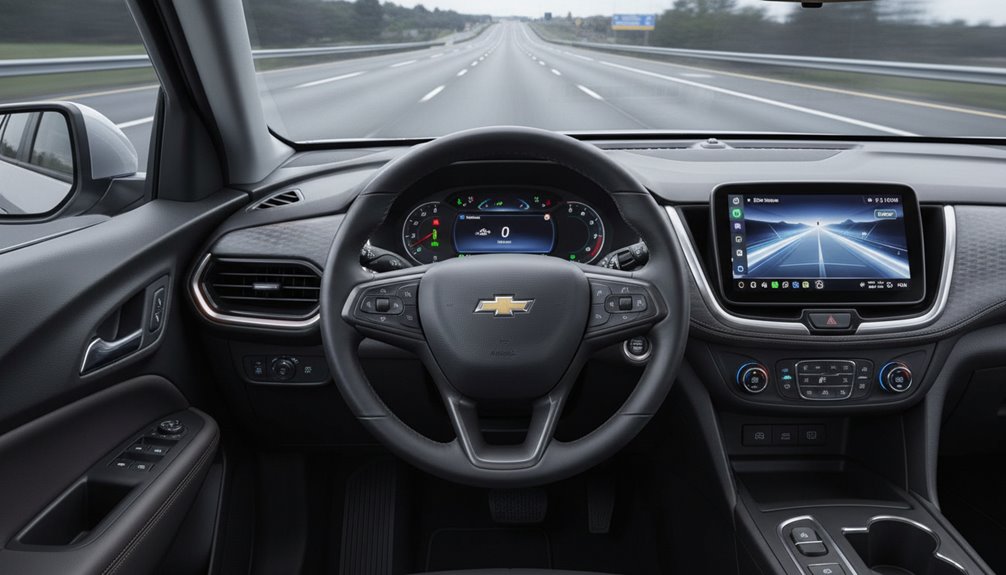

The Equinox EV’s engineers made a choice most buyers won’t appreciate until it’s too late: they sacrificed the razor-sharp handling electric vehicles are famous for and bet everything on comfort instead. That Ultium battery sits low and promises sports-car stability, but the moment you encounter real pavement, the suspension’s philosophy reveals itself—and not everyone will agree with it. Your wheel choice between 19 or 21 inches? It doesn’t just change the aesthetics; it completely rewrites the vehicle’s personality. Then there’s the whisper-quiet cabin that seems like a luxury feature until you realize what it’s actually hiding.
FWD vs. AWD Equinox EV: Which Should You Choose?
When you’re shopping for an Equinox EV, the drivetrain choice between front-wheel drive and all-wheel drive shapes almost everything else—your range, your acceleration, your winter grip, and yes, your final bill.
FWD models deliver 319 miles of EPA-estimated range thanks to a single 220-hp front motor. That efficiency translates to real value: you’re maximizing miles-per-dollar.
AWD swaps that simplicity for capability—a rear assist motor joins the front unit, bumping output to 300 hp and 333 lb-ft torque. You’ll sacrifice roughly 12 miles of range, but you’re gaining planted handling and rear-motor traction engagement when conditions demand it. The AWD model also offers an 11.3-inch infotainment screen, keeping you connected to navigation and vehicle controls even as you tackle challenging terrain. In winter conditions below 20°F, the thermal throttling that affects charging performance is less critical to your daily driving experience than having confident traction.
The trade-off isn’t complicated. Choose FWD if efficiency and range matter most. Pick AWD if winter weather, mountain driving, or agile responsiveness justifies the range penalty and extra cost. Both handle competently; AWD just feels more confident when conditions get sketchy.
Why FWD Models Exhibit Predictable Understeer
You’ll feel the steering go light, notice the hood drifting wider, and have time to correct.
This is understeer—the FWD Equinox EV’s signature move.
Your front tires handle three jobs simultaneously: steering, propulsion, and braking.
Front tires juggle three critical demands at once: steering, propulsion, and braking—a balancing act physics doesn’t favor.
During cornering, that multitasking overloads them.
The motor’s torque adds longitudinal force precisely when you need lateral grip, forcing your front tires to choose: drive or turn.
They choose drive, and the car pushes wide.
Physics amplifies this.
Accelerating through corners transfers weight rearward, unloading the front end further.
Poor tire pressure, worn alignment, or stiff anti-roll bars worsen the imbalance. Adjusting front-end alignment can significantly reduce understeer tendencies and restore responsive steering feel.
Here’s the upside: understeer is forgiving.
Unlike oversteer’s sudden snap, you get warnings—steering judder, visual drift—and recovery options.
Ease off the throttle, regain traction, and straighten your line.
For most drivers, that predictability beats the alternative.
The FWD-Biased AWD System Explained
If you opt for the Equinox EV’s AWD system, you’re getting an engineering compromise that prioritizes efficiency over all-terrain capability—the front wheels handle most of the workload under normal conditions, which is why the AWD model loses 34 miles of range compared to its FWD sibling (285 versus 319 miles).
The system’s intelligence lies in its selective power distribution: it keeps power flowing primarily to the front axle (where the main electric motor lives) during freeway cruising and dry pavement, then automatically shuffles torque rearward the moment your traction sensors detect wheel slip on wet or snowy surfaces.
This FWD bias means you’re trading some all-weather capability for the fuel economy optimization the system was engineered around, resulting in handling characteristics that remain predictable and familiar to FWD drivers even when the rear wheels engage. Drivers who primarily travel on paved roads but encounter occasional snow or rain will find this switchable system particularly valuable for managing variable seasonal conditions without the constant efficiency penalty of full-time AWD.
FWD Bias Engineering Design
Because the Equinox EV’s primary electric motor sits at the front axle, Chevrolet engineered the powertrain to default into front-wheel drive—a design philosophy shared by competitors like the Toyota bZ4X and Subaru Solterra.
This front-biased layout isn’t arbitrary; it maximizes traction where you need it most. The front wheels handle steering and braking simultaneously, so concentrating your motor there improves grip during acceleration and lets regenerative braking capture energy efficiently.
When you engage AWD via the dashboard button, a rear motor activates on demand, transferring power only when your front wheels slip. This hybrid approach keeps you economical on dry pavement (319-mile FWD range) while providing stability when conditions deteriorate. You’re basically getting single-motor efficiency with dual-motor capability when terrain demands it. The rear differential present in AWD-equipped models ensures power can be distributed to both rear wheels for enhanced traction in challenging driving situations.
Handling Dynamics And Performance
Now that you grasp how the Equinox EV’s powertrain prioritizes front-wheel efficiency, it’s worth examining what that setup actually feels like on the road.
The FWD-biased AWD system delivers markedly different behavior than traditional all-wheel setups. You’ll notice front-end grip dominates during acceleration—the dual motors (300 hp, 355 lb-ft torque) push you forward with minimal understeer tendencies. The extended range capabilities ensure you can confidently explore various terrain types without constant range anxiety.
During cornering, the front-weighted weight distribution (thanks to the Ultium platform’s battery layout) keeps the nose planted through turns. The rear motor engages intelligently, preventing the typical AWD understeer you’d experience in lesser-engineered systems.
Braking remains predictable; the 4-wheel antilock disc brakes distribute stopping force evenly. Fundamentally, you’re piloting a vehicle engineered for responsive front-end feedback without sacrificing rear traction stability.
How Equinox EV’s Stiff Chassis Improves Cornering
When you’re throwing the Equinox EV into a corner, you’re benefiting from the Ultium platform‘s battery-integrated chassis, which eliminates the mushiness that plagued earlier Equinox generations by anchoring structural rigidity directly into the floor.
That long wheelbase paired with five-link rear suspension and hydroformed rails doesn’t just feel planted—it actually reduces body roll through precise load-path management, giving you the cornering confidence you’d expect from something built on Cadillac Lyriq architecture.
The stiff structure means your steering inputs translate into immediate, predictable handling rather than the soft compliance that used to characterize gas-powered Equinoxes. The cradle’s double-shear plate bolting to the battery pack maximizes rigidity and ensures every steering correction is transmitted with minimal flex.
Ultium Platform Stability Enhancement
While most shoppers focus on an EV’s driving range and charging speed, the Equinox EV’s real performance advantage hides in its chassis—specifically, how General Motors engineered the underlying Ultium platform to deliver cornering stability that punches above its price point.
You’ll feel this through the steering wheel when you carve a tight corner. GM paired polymer-aluminum mounts at the drive module’s front and rear, isolating vibration while maintaining rigidity. The rear suspension features tall hat sections with aggressive kinking, creating load paths that resist body roll. Double-shear mounting plates bolt the cradle and battery directly to the body, eliminating flex.
| Component | Material | Function |
|---|---|---|
| Front Mounts | Polymer-Aluminum | NVH isolation |
| Rear Mounts | Cast Aluminum | Structural strength |
| Hat Sections | Stamped Steel | Suspension rigidity |
| Mounting Plates | Steel | Load distribution |
| Hydroformed Rails | Aluminum | Weight reduction |
The result: confident, planted handling.
Battery Integration Structural Benefits
Beneath the Equinox EV’s floor sits the real secret to its cornering composure: a structurally integrated battery tray that doesn’t just store energy—it actively stiffens your chassis.
Here’s what’s happening when you grip the wheel through a curve:
- Load path optimization: The battery absorbs roughly 30% of front-crash forces, meaning your body structure handles less stress and resists twisting
- Segmented steel construction: Welded and sealed sections distribute cornering stresses evenly across the underbody rather than concentrating pressure on isolated points
- Cradle-battery-body integration: Double shear plates and bolts lock these components together, maintaining wheelbase integrity under lateral forces
The result? Less chassis flex, reduced body roll, and handling precision that feels genuinely planted.
Your Equinox EV corners like a vehicle that knows exactly what it’s doing—because its structure literally can’t do anything else.
Long Wheelbase Cornering Confidence
As you carve through an interstate merge or steer through a tight parking lot curve, you’re benefiting from something that doesn’t announce itself: the Equinox EV’s 112.2-inch wheelbase working in concert with that stiff Ultium-platform chassis we discussed earlier.
This combination creates what engineers call “planted handling”—your vehicle stays composed rather than wallowing through direction changes. The long wheelbase reduces body roll markedly compared to shorter predecessors, while the rigid structure dampens suspension movement in turns effectively.
You’ll notice this particularly on highways, where the Equinox EV feels more confident and stable than its gas-powered counterpart. The result aligns with premium vehicle behavior: a SUV that handles imperfections while maintaining cornering poise.
It won’t outgrip a Tesla Model 3, but it delivers genuine confidence.
Suspension Tuning: Comfort First, Sport Second
If you’ve driven a family crossover and wondered why it feels planted rather than peppy, the Equinox EV’s suspension tells you exactly why—it’s engineered for comfort first, and the numbers back that philosophy up.
Chevrolet equipped you with a 5-link independent setup front and rear, paired with passive dampers that prioritize ride quality over corner carving.
There’s no electronically adjustable suspension or air springs—just straightforward engineering tuned for daily driving.
Here’s what you’re getting:
- Fixed 6.4-inch ground clearance with no height adjustment, keeping the center of gravity stable
- Disassociated damper and coil setup that isolates suspension movement efficiently
- 18.46:1 steering ratio providing manageable responses without twitchiness
This passive approach isn’t a limitation; it’s intentional.
You’ll traverse bumps and highway changes smoothly without the complexity (or cost) of active systems.
Want sportier handling? Aftermarket air suspension kits exist, though they’re modifications rather than factory options.
For most owners, this suspension philosophy simply works.
What Battery Integration Does for Ride Quality
The Equinox EV’s suspension geometry gets most of the credit for that composed, planted feel we discussed—but here’s what actually makes the whole system work:
the 85-kWh Ultium battery pack, weighs roughly 4,902 pounds, sits low and centered beneath the floorboard, fundamentally reshaping how the car handles every road imperfection you throw at it.
That low center of gravity isn’t just marketing speak. Physics favors you here. The battery’s positioning directly reduces body roll and keeps the chassis stable during cornering and over bumps. Your Equinox EV absorbs imperfections with polished composure rather than the floaty, disconnected feel heavier vehicles often deliver.
The 288V electrical layout supports nimble response despite the mass, while those 55-series tires complement the low weight distribution for genuine plushness. Regenerative braking adds another layer—it recaptures energy while smoothing power delivery, creating consistent ride quality lap after lap. The result: a 319-mile capable cruiser that feels genuinely controlled, not compromised by its battery weight.
Equinox EV Ride Quality: City Streets vs. Highway
Your Equinox EV’s ride quality doesn’t stay constant—it shifts personality depending on whether you’re threading through downtown traffic or cruising interstate straightaways, and that’s actually by design.
In cities, you’ll appreciate the responsive setup that prioritizes maneuverability.
The stiff suspension delivers quick reflexes through tight turns and one-pedal driving, though you’ll feel every pothole and speed hump.
It’s the trade-off for agility in congested streets.
Highways reveal a different character entirely:
- Smooth, composed cruising at 75 mph with 260-mile range on the AWD model
- Well-weighted steering and predictable stability from the low battery center of gravity
- Minimal corner mushiness compared to previous Equinox generations
The chassis handles both environments confidently, though city work exposes its firmness more noticeably.
Highway stretches showcase that stiffness as sure-footed security, making family road trips genuinely comfortable.
Your driving environment determines whether you’re experiencing compromise or optimization.
Should You Choose 19-Inch or 21-Inch Wheels?
You’re basically trading ride comfort for handling precision when you step up to 21-inch wheels, since the lower-profile tires (265/45R21 rear, 245/50R21 front) transmit more road imperfections through the chassis while their wider contact patch sharpens cornering grip and steering response.
On pothole-laden city streets, the 19-inch setup’s taller sidewalls absorb impacts that’d otherwise punish your spine, though you’ll sacrifice some of that cornering confidence—the tradeoff between a smoother commute and crisper handling comes down to your local pavement quality and whether you value highway precision or urban comfort more.
Highway rides feel relatively equivalent between both sizes at steady speeds, but rough urban roads expose the 21-inch’s unsprung weight penalty and reduced suspension compliance, making the smaller wheel your practical win if you’re maneuvering cities like Montreal without building a relationship with a wheel repair shop.
Comfort On Rough Roads
When you’re deciding between the standard 19-inch wheels and optional 21-inch setup on your Equinox EV, you’re really choosing between two fundamentally different ride experiences—and if you’re planning to tackle pothole-laden city streets or rural roads riddled with imperfections, that choice matters more than you’d think.
The 19-inch wheels absorb road harshness far better thanks to taller tire sidewalls that function like shock absorbers. The 21-inch alternatives transmit considerably more bump feedback into your cabin because their shorter sidewalls (265 rear, 245 front) leave less compliance for imperfections. Here’s what you’ll experience:
- Pothole protection: 19-inch wheels markedly reduce curb rash risk
- Sidewall absorption: Taller rubber compresses road shocks more effectively
- Rough pavement feedback: 21-inch setups feel noticeably harsher over uneven surfaces
Test data confirms the 19-inch delivers gentler handling without sacrificing efficiency substantially.
Highway Ride Quality Trade-offs
If highway comfort is your priority, the wheel-size decision on your Equinox EV boils down to a straightforward physics trade-off: the 19-inch setup’s taller tire sidewalls (245 all around) absorb road imperfections more effectively than the optional 21-inch wheels, which sacrifice that compliance for a sportier stance and wider footprint (265 rear, 245 front).
| Metric | 19-Inch Wheels | 21-Inch Wheels |
|---|---|---|
| EPA Range (FWD) | 319 miles | Reduced |
| Ride Quality | Smoother | Firmer |
| Highway Noise | Low | Moderate |
You’ll feel the difference at sustained speeds. The 19-inch configuration delivers noticeably gentler highway manners and quieter Michelin Primacy tires on concrete. The 21-inch option remains composed at 70 mph—it’s not punishing—but sacrifices marginal ride compliance. Choose 19-inch for maximum smoothness and efficiency. Pick 21-inch if aesthetics trump that trade-off.
Handling And Cornering Performance
Cornering performance on the Equinox EV hinges on unsprung weight—that’s the mass of components not supported by your suspension—and the 21-inch wheels tip that balance decidedly upward compared to their 19-inch counterparts.
Here’s what you’re trading:
- Suspension responsiveness: 19-inch wheels respond quicker to road inputs, keeping your vehicle planted through turns
- Bump compliance: Larger sidewalls on 19-inch tires absorb imperfections, maintaining grip during aggressive cornering
- Unsprung mass penalty: 21-inch wheels add roughly 7 lbs per corner, degrading handling behavior noticeably
Both setups maintain comparable range, so you’re choosing purely on feel.
If you frequent twisty roads or pothole-laden streets, the 19-inch setup won’t disappoint. You’ll notice the difference immediately—sharper turn-in, predictable body roll, and confidence in unpredictable conditions.
The Premium Feel That Surprises Entry-Level Buyers
Starting at $33,600 for the LT1 base model, the Equinox EV doesn’t skimp on the features you’d typically expect to find locked behind higher trim levels or expensive option packages.
You’ll find a 17.7-inch touchscreen with Google built in on every trim, paired with a digital gauge display that keeps you connected without distraction. The Chevy Safety Assist suite—over 20 standard safety and driver assistance features—comes standard, not as an afterthought. Step up to the LT2, and heated front seats warm you immediately, while HD Surround Vision cameras eliminate guesswork during tight maneuvers.
The cabin materials tell the real story. Leather-appointed seating, memory driver’s seat settings, and a heated steering wheel create an environment that rivals vehicles costing considerably more. That hands-free power liftgate with presence-based sensing? Standard across most trims.
You’re not compromising; you’re gaining access to technology and comfort features that older buyers remember as luxury markers—now democratized through thoughtful engineering.
Why Equinox EV’s Cabin Stays So Quiet
Because electric motors don’t need to burn fuel to generate power, the Equinox EV’s cabin achieves a quietness that owners often describe as almost unsettling on first drive—and that tranquility comes from fundamental physics rather than fancy soundproofing alone.
You’re experiencing the absence of combustion vibrations.
Traditional engines create constant mechanical noise through firing cycles; electric motors operate with minimal moving parts. This fundamental difference means you’ll hear:
- Tire and wind noise dominating your acoustic environment at highway speeds
- Regenerative braking sounds (minimal whirring) replacing engine braking acoustics
- Drivetrain silence that lets road texture become audibly apparent
That quietness does present a regulatory challenge, though.
Federal standards (FMVSS) require EVs to generate sufficient low-speed noise—between 2 and 6.2 mph—so pedestrians detect movement. Your Equinox EV’s body control module calibrates external pedestrian warning sounds accordingly, ensuring safety without compromising that signature EV serenity you’ve come to appreciate.
Electric Motors Eliminate Engine Noise Entirely
You won’t hear a traditional engine in your Equinox EV because the electric motor produces only a gentle whine—eliminating the combustion process and all its mechanical chaos (valve trains, pistons, gear changes).
That absence of engine noise means you’re experiencing a genuinely quiet cabin, roughly 10 dB quieter than a gas equivalent, which translates to a perceptually massive reduction in vibration, harshness, and the constant drone that gas-powered drivers accept as normal.
The real physics win: your interior stays serene during acceleration, deceleration via regenerative braking, and even idling—no engine pulsations fighting for your attention while you’re simply trying to drive.
Quiet Interior Environment Experience
What you’ll notice first when you slide behind the wheel of an Equinox EV is the absence of something—that constant mechanical drone that’s defined the driving experience for over a century.
You’re experiencing genuine quiet, not marketing fiction. Electric motors eliminate the reciprocating pistons, timing chains, and combustion explosions that traditionally fill cabins with noise.
Your Equinox EV measures 54.6 dB at low speeds—comparable to the Kia EV6 and barely louder than competing EVs. This creates a fundamentally different driving environment:
- Tire and wind noise dominate instead of engine clatter, shifting your acoustic awareness entirely
- Regenerative braking operates silently, eliminating that mechanical grinding familiar from traditional vehicles
- Cabin conversations flow naturally without shouting over engine vibrations
You’ll find that silence itself becomes a feature, not a bug.
Acoustic Advantages Over Gas Engines
While traditional gas engines create their characteristic rumble through controlled explosions happening thousands of times per minute, your Equinox EV’s electric motor operates on an entirely different principle—electromagnetics rather than thermodynamics—which means it produces virtually no combustion noise whatsoever.
That silence stems from a fundamental physics difference.
Gas engines generate sound through cylinder pulsations as fuel combusts and pistons fire repeatedly.
Your Equinox EV’s motor? It’s practically silent, eliminating the roaring, grumbling, and repetitive thumping associated with V-6 or V-8 powerplants.
There’s also no exhaust system—another major noise source simply doesn’t exist.
This absence of engine noise represents the single biggest acoustic advantage EVs possess over combustion vehicles. You’re not gaining quietness through better insulation; you’re gaining it because the primary noise source vanishes entirely.
How Regen Braking Blends With Friction Brakes
Since your Equinox EV’s battery can’t accept unlimited energy, the car’s got to get clever about what braking does—and that’s where the blended braking system comes in.
The system captures regenerative energy through the brake pedal, then seamlessly shifts to friction brakes when needed.
You won’t notice the handoff happening; the driving feel stays consistent throughout.
Several conditions trigger this blending:
- Fully charged battery: Limited regen headroom means friction brakes engage sooner
- Extreme temperatures: Cold or hot batteries reduce regen performance, requiring friction brake support
- Slippery surfaces: Wet, snowy, or icy roads demand traditional friction braking for safety
The regen icon turns gray when limitations kick in, and your gauge displays available power.
This intelligent system extends brake pad life substantially while maintaining reliable stopping performance.
Hard or emergency stops still require your brake pedal—regeneration supplements but never replaces safety.
One-Pedal Driving: Strong Mode vs. Normal Mode
You’ll toggle between Normal and High modes depending on your driving scenario, with Normal providing moderate regenerative braking (ideal for smooth daily commutes) while High engages aggressive deceleration that can feel jarring if you’re not expecting it.
The key difference: High mode recaptures more energy in stop-and-go traffic but demands you modulate pressure on the accelerator more deliberately—essentially trading comfort for efficiency gains.
Think of Normal as your default highway setting and High as your urban traffic tool, though paddle controls on the steering wheel let you fine-tune regen intensity on the fly without fully disabling one-pedal driving.
Strong Mode Intensity Issues
How much regenerative braking is too much? When you engage Strong Mode on your Equinox EV, you’re wrestling with intensity that doesn’t always feel predictable. The one-pedal button sits obscured behind your steering wheel on the horizontal screen layout—exactly where you don’t want to hunt during normal driving.
Here’s what makes Strong Mode tricky:
- Button accessibility requires steering wheel adjustment or awkward head positioning
- Essential driving controls remain hidden during your typical driving position
- Interface design complicates frequent mode switching without road distraction
The aggressive regenerative braking calibration demands constant attention. You’re effectively managing two separate systems simultaneously: monitoring battery state while adjusting throttle response.
Charging inconsistency affects braking feel unpredictably across drive sessions, forcing driver awareness that frankly shouldn’t be necessary for intuitive operation.
Normal Mode And Paddle Control
While Strong Mode‘s aggressive regenerative braking demands constant vigilance, Normal Mode offers a fundamentally different philosophy: moderate deceleration that lets you recapture energy without the intensity overhead.
You’ll experience smoother slowing when lifting off the accelerator—enough to extend range through kinetic energy conversion, yet gentle enough for everyday driving.
The steering wheel’s Regen On Demand paddle works independently or alongside One-Pedal Driving, giving you granular control.
Pull it toward you in Drive or Low to engage additional regenerative braking.
Pressure intensity varies your deceleration rate, and releasing the paddle immediately stops the effect.
Here’s the practical reality: combining Normal Mode with paddle control maximizes energy recovery during mixed driving.
Your brake pedal remains available whenever you need decisive stopping power.
Manual Regen Paddle: When You Want Full Control
When you want to shed speed without touching the brake pedal, the manual regen paddle on your Equinox EV’s steering wheel gives you that capability—provided you’re in DRIVE or LOW gear and willing to pull it toward you.
This paddle converts your vehicle’s kinetic energy into battery charge through regenerative braking, providing instant deceleration without brake pedal engagement.
Here’s what makes manual regen your control lever:
- Variable intensity through paddle pressure—light pulls slow you gently while firm pressure generates stronger deceleration
- Strategic application during approach to stops, traffic merging, and highway off-ramps maximizes energy recovery
- Automatic blending with traditional brakes maintains consistent driving feel across conditions
Hold the paddle and you’ll stop without creeping forward.
Release it, resume normal acceleration.
Just remember: fully charged batteries reduce effectiveness, and extreme temperatures impact regenerative function.
Wet or icy roads? Skip regen and use conventional braking instead.
FWD Acceleration: 0-60 in 7.4 Seconds Explained
The manual regen paddle gives you granular control over slowing down, but it can’t turn the Equinox EV into a performance machine—and that’s by design.
Your FWD Equinox EV hits 60 mph in 7.4 seconds, which sounds leisurely until you grasp the physics at work. That 213 horsepower and 236 lb-ft of torque prioritize efficiency over aggression.
You’ll feel strong torque response around town—the electric motor’s instant delivery makes low-speed acceleration feel snappier than comparable gas four-cylinders. Highway passing, however, occurs gradually. Launch produces zero wheelspin because the power delivery’s calibrated for traction and range preservation rather than drama.
Testing shows quarter-mile completion in 15.9 seconds at 88.2 mph.
For daily driving, this acceleration proves sufficient. You’re not shopping for thrills here; you’re getting predictable, manageable performance wrapped around that impressive 319-mile EPA range.
AWD Acceleration: 0-60 in 5.7 Seconds (and What It Feels Like)
If you’ve been eyeing the AWD Equinox EV, you’re looking at a genuinely different beast—5.7 seconds to 60 mph.
That shaves 1.7 seconds off the FWD version and lands it squarely in territory where you’ll feel the difference at every green light.
Here’s what that acceleration actually feels like behind the wheel:
- Initial hesitation, then surge: The first 15 mph feels sluggish—almost reluctant—before the dual motors engage and you get genuine shove toward 60.
- Torque steer is real: That dominant front motor creates noticeable pull toward one side during hard launches; the rear motor assists primarily for traction control.
- Instant electric response: Unlike gas engines, you’re getting full torque immediately, making traffic maneuvering and highway merging genuinely quicker than the FWD’s 7.4 seconds.
The 333 lb-ft of torque from a standstill feels responsive for around-town driving.
Highway acceleration, though, feels more gradual—comparable to a torquier four-cylinder gas engine. It’s modest power that prioritizes range over theater.
Sport Mode: Real-World Performance in City Driving
Now that you’ve experienced the AWD’s raw acceleration punch, you’re probably wondering how to tap into that performance consistently—especially when you’re threading through city streets where 5.7-second sprints matter less than responsive steering and predictable throttle feel.
Sport Mode delivers exactly that. Accessed via your infotainment screen’s Drive Modes icon, it recalibrates three critical systems simultaneously: sharper steering response for precise urban turns, heightened throttle sensitivity for immediate power delivery, and amplified motor sound that heightens performance immersion.
| System | Normal Mode | Sport Mode |
|---|---|---|
| Steering | Standard calibration | Recalibrated for precision |
| Throttle | Moderate response | Heightened sensitivity |
| Motor Sound | Baseline | Amplified feedback |
The result? Improved responsiveness that turns stop-and-go traffic into engaging maneuvering. Your Equinox responds quicker to inputs while maintaining stability on dry pavement. It’s performance designed for real-world city conditions—where engagement matters as much as control.
Where FWD Runs Out of Power on the Highway
While your Equinox EV’s 319-mile EPA range sounds impressive on paper, highway driving exposes the FWD model’s real limitations.
Not because it can’t complete long trips, but because sustained high-speed cruising demands energy efficiency that single-motor powertrains struggle to deliver.
At 70 mph, aerodynamic drag becomes your enemy. You’ll see approximately 8% range reduction compared to EPA estimates, dropping that comfortable 319 miles to a practical 250–280 miles before requiring a charging stop. Here’s what happens:
At highway speeds, aerodynamic drag cuts your 319-mile range down to a realistic 250–280 miles before needing to recharge.
- Motor strain: Your 220-hp single motor maintains highway speeds adequately (7.4-second 0–60 time), yet operates inefficiently beyond EPA’s 48-mph test average
- Battery consumption: Highway conditions generate substantially higher energy draw than mixed city/highway cycles
- Efficiency gap: EPA highway rating drops to 100 MPGe versus 109 MPGe combined, reflecting real-world physics
Your 85-kWh battery remains adequate for most routes—just not without strategic charging stops on extended highway trips.
Real-World Range Testing: Cold Weather Reality
Highway efficiency isn’t your Equinox EV’s only challenge—cold weather compounds the problem by attacking your range from an entirely different angle.
When temperatures dip below freezing, you’re looking at a 30-40% range reduction, period.
Real-world testing confirms this: in -15°C to -7°C conditions, the AWD LT achieves roughly 145 miles—less than half the EPA rating.
That’s not pessimism; that’s physics.
Your battery’s accessible energy shrinks from 88-90 kWh in warm conditions to just 85 kWh when cold.
Highway efficiency plummets to around 1.7 miles per kWh (compared to 2.9 in mild weather).
The heat pump helps—bumping range recovery by up to 10% over resistive heating—but you’re still working with reduced capacity.
The Equinox EV handles winter better than previous Bolt EVs, retaining 74% of normal range overall.
Still, you’ll need to plan accordingly.
Winter trips demand realistic expectations and strategic charging stops.
How Equinox EV Feels vs. Gas-Powered Equinox
If you’ve spent years behind the wheel of a gas-powered Equinox, sliding into the EV version feels like stepping into a different vehicle altogether—not because it’s radically alien, but because the fundamental physics underneath has completely changed.
The LT2 Equinox EV’s 220 horsepower and 243 lb-ft torque arrive instantly, unlike the gas model’s gradual power build. You’ll notice this immediately during highway merging.
Instant torque delivery from the EV motor transforms highway merging—no waiting for the gas engine’s gradual power buildup.
Meanwhile, that lower center of gravity from battery placement plants you firmly through corners—no more traditional SUV body roll you’re accustomed to.
What separates them most:
- Acceleration response: Electric motors deliver instant torque versus steady forced-induction buildup
- Braking feel: Regenerative systems recapture energy; traditional brakes don’t
- Cabin ambiance: Silent electric operation contrasts gasoline engine intrusion
You’re trading 400-mile tank range for 300-319 electric miles, swapping quick fuel stops for home charging. The EV drives differently overall—more futuristic, decidedly quieter—tailored toward efficiency-minded drivers who value that responsive, modern sensation daily.
Frequently Asked Questions
How Does Cabin Noise Compare to Other Electric SUVS in the Same Price Range?
You’ll appreciate how your Equinox EV matches the quietest competitors like the Kia EV6 at 54.6 decibels. You’re getting premium cabin tranquility that rivals costlier luxury EVs, providing a serene driving experience.
What’s the Actual Difference in Real-World Performance Between FWD and AWD Models?
You’ll notice FWD delivers 319-mile range with modest 213-hp power, while AWD gives you quicker acceleration and better traction with 288 hp but sacrifices roughly 22-34 miles of range for that capability.
Does the Equinox EV Feel More Like a Luxury Vehicle or an Economy Car?
You’ll find the Equinox EV straddles both worlds—it delivers luxury comfort through ergonomic seats and spacious cabin design, yet remains economy-focused with its $35,000 starting price and reduced maintenance costs.
How Quickly Can You Recover Range Using DC Fast Charging on Road Trips?
You’ll recover 50 miles in 7-10 minutes—enough time to grab overpriced gas station coffee. You’re part of an efficient community now: 100 miles takes 13-21 minutes, making you a savvy road-tripper who doesn’t waste hours charging.
What Noise Levels Should Owners Expect During Acceleration and Highway Cruising?
You’ll experience whisper-quiet acceleration with instantaneous torque delivery and near-silent highway cruising. The cabin stays exceptionally hushed at all speeds, outperforming most gas SUVs and competing EVs for noise isolation.


