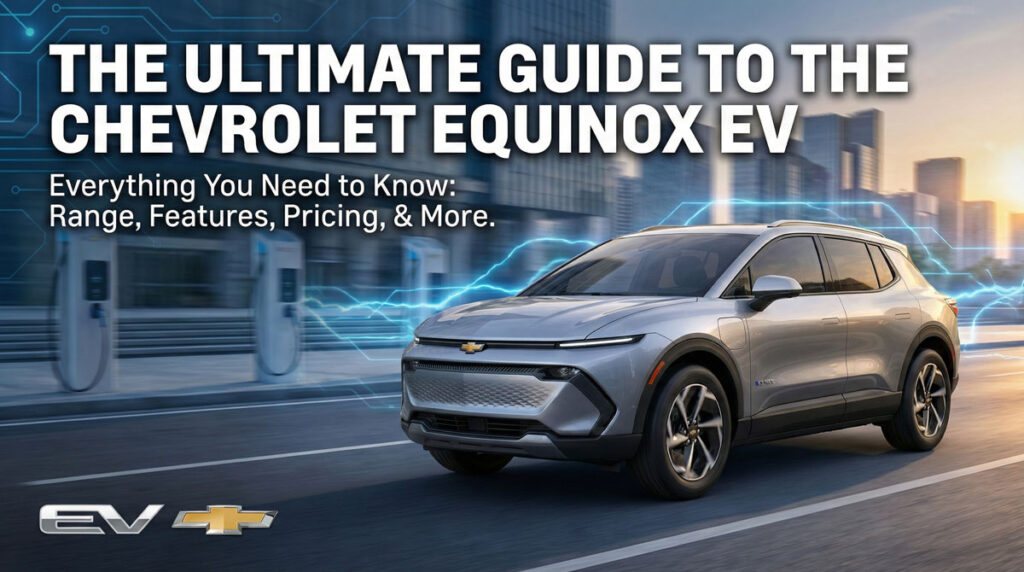

Nearly 40% of electric vehicle buyers scroll past the Chevrolet Equinox EV without a second glance—a mistake that could cost them thousands. This SUV delivers 319 miles of EPA-rated range and starts at just $33,600, yet remains mysteriously absent from most shopping lists.
The real question isn’t whether you choose the 108 MPGe front-wheel-drive or the 300-horsepower all-wheel-drive variant. What matters is understanding how battery degradation and actual charging networks will shape your ownership experience over the next decade. Most buyers make their decision based on incomplete information.
What Makes the Chevrolet Equinox EV a Game-Changer
When you’re shopping for an electric SUV, you’re basically asking three questions: how far will it go, how quickly will it get there, and can it handle the road without feeling like a compromise. The Equinox EV answers all three decisively.
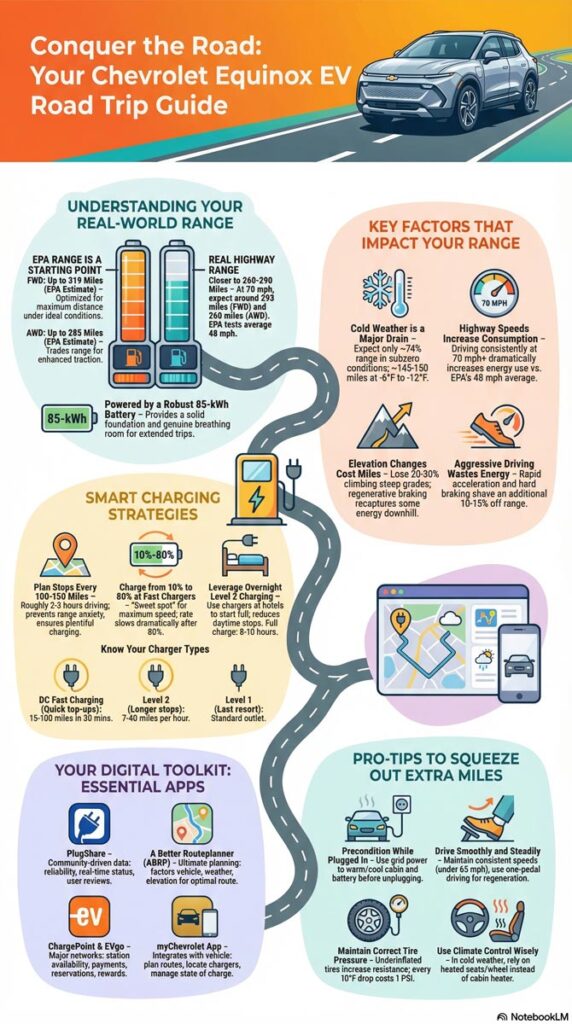
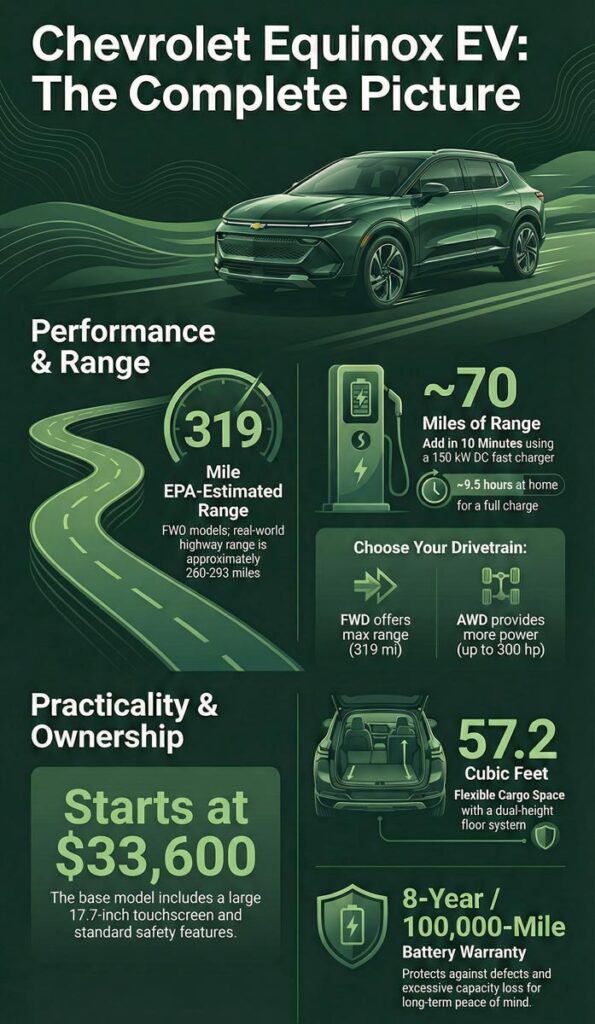
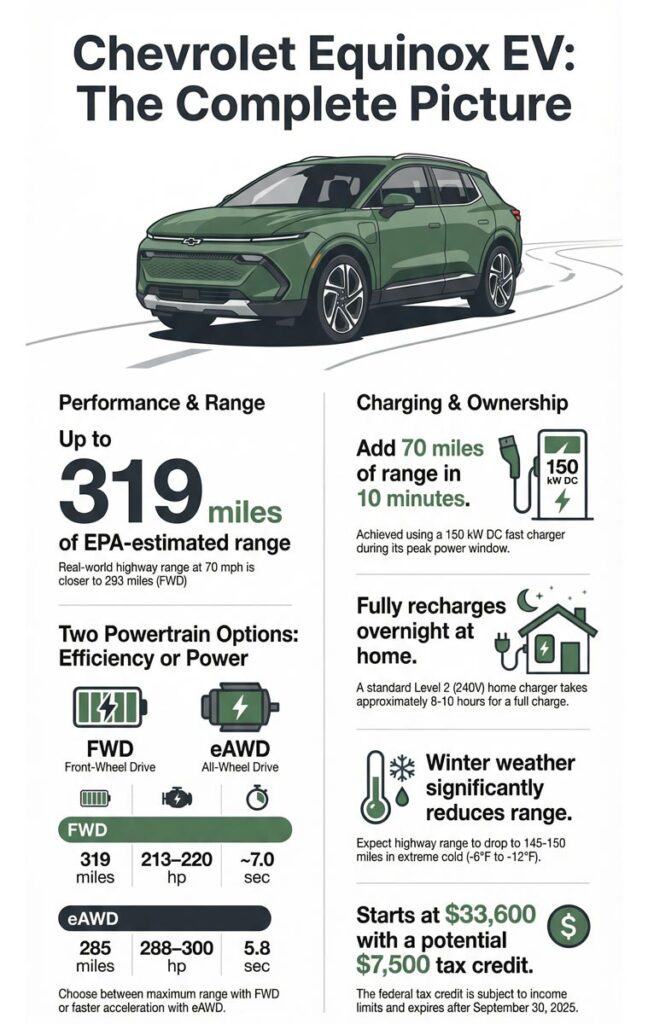
You’re getting 319 miles of EPA-estimated range with front-wheel drive—that’s genuine highway capability, not marketing speak. The standard 85-kWh battery outclasses competitors’ entry-level packs, offering more capacity at your price point. DC fast-charging adds roughly 70 miles in just 10 minutes, making longer road trips practical without extended waits.
On the acceleration front, the all-wheel-drive model sprints to 60 mph in 5.8 seconds with 300 horsepower and 355 lb-ft of torque, turn daily commutes into something genuinely fun.
Handling won’t disappoint either.
You’ll grip at 0.87 g lateral acceleration while stopping from 60 mph in just 111 feet—beating every tested competitor. The extended range capabilities are optimized for longer road trips with minimal charging interruptions. The low center of gravity from the floor-mounted battery enhances stability through corners.
Regular software updates keep your vehicle current, while sustainable materials throughout mean you’re not compromising environmental values.
That’s the breakthrough: genuine performance without sacrifice.
Price Breakdown: What’s Included in the $33,600 Starting Price
At $33,600, you’re getting a 220-horsepower front-wheel-drive powertrain paired with an 85-kWh battery that delivers 319 miles of EPA-estimated range—plus DC fast-charging capability (up to 150 kW) that adds roughly 70 miles in 10 minutes, along with an 11.5 kW onboard charger for home charging flexibility.
The base price includes over 20 standard safety features through Chevy Safety Assist, an 11-inch touchscreen, 19-inch wheels, and seating for five across 57.2 cubic feet of cargo space, though you can step up to an optional eAWD system if you want 300 horsepower and 355 lb-ft of torque for improved traction.
What you’re basically buying is full EV capability without gutting your budget on premium trim levels—the essentials are all there, and the upgrades (larger wheels, all-wheel-drive, hands-free liftgate) are available if your use case demands them. For long-term ownership, the recommended 20–80% charging window helps maximize battery longevity during the vehicle’s lifespan. The 96-month traction battery warranty provides long-term protection for the vehicle’s most critical component, giving owners peace of mind throughout their ownership experience.
Standard Safety Technology Included
Because you’re considering a vehicle at the $33,600 price point, you’ve probably wondered what safety features actually come standard—and whether Chevrolet’s cutting corners on the Equinox EV’s base trim.
They’re not.
You’re getting over 15 standard safety technologies included, no optional packages required. Automatic Emergency Braking, Front Pedestrian Braking, and Lane Keep Assist come standard. Adjustable Cruise Control, Rear Park Assist, and HD Surround Vision round out your foundation. The Adaptive Cruise Control system maintains your set speed while using camera and radar to identify and maintain distance from vehicles ahead.
Here’s the practical angle: these systems communicate continuously, which raises Privacy Implications worth considering—your vehicle collects location and driving pattern data. The system continuously monitors driver attentiveness to ensure you remain engaged with the road.
Chevrolet regularly rolls out Software Updates addressing security vulnerabilities and performance improvements, so you’ll want to stay current.
The LT trim delivers collision avoidance and pedestrian detection capabilities typically reserved for higher-priced competitors.
You’re not compromising safety; you’re just getting smart value.
Powertrain And Performance Options
You’ve already got the battery and charger sorted at your $33,600 starting price—now let’s talk about what’s actually moving this thing down the road. The FWD model pairs a single permanent-magnet synchronous AC motor producing 213–220 horsepower and 236–243 lb-ft torque through a direct-drive transmission. Want more punch? The eAWD upgrade ($3,300) adds a rear induction motor, bumping combined output to 288–300 horsepower and 333–355 lb-ft torque—though you’ll trade 12 miles of range.
| Powertrain | Horsepower | 0-60 Time |
|---|---|---|
| FWD | 213–220 | 6.5 sec |
| eAWD | 288–300 | 5.8 sec |
Both variants include regenerative braking and multiple drive modes for efficiency or spirited driving. The 85.0 kWh battery pack delivers an EPA-estimated total range of 285 miles combined across both powertrains. In real-world city driving with maximized regenerative braking, the FWD model can recover roughly 61.6 miles per charge cycle, effectively offsetting the EPA range penalty compared to AWD.
Charging And Battery Specifications
Grasping what’s actually included when you hand over $33,600 for an Equinox EV reveals the charging reality you’re getting versus what’ll cost extra.
You’re getting the Dual Level Charge Cord Set—nothing fancy, but functional for both 120-volt (1.4 kW) and 240-volt (7.7 kW) outlets.
Here’s what matters:
- Dual Level Cord included – covers basic Level 1/2 needs without additional purchase
- CCS1 connector standard – guarantees DC fast charging compatibility at public stations
- Ultium PowerUp charger – optional 11.5 kW upgrade for faster home charging etiquette
- GM PowerUP+ (19.2 kW) – premium hardwired option requiring professional installation
DC fast charging hardware? Absent from base pricing. The peak charge rate typically occurs between 10% to 40% state of charge to protect your battery during public DC fast charging sessions. Hardwired Level 2 installations demand dedicated circuit protection to eliminate shared electrical loads and ensure consistent charging output.
Public network access demands separate subscriptions.
You’re building your charging infrastructure incrementally, which frankly reflects how most owners approach this anyway.
How to Choose Between FWD and AWD
When you’re considering the Equinox EV’s drivetrain options, you’re fundamentally deciding between efficiency and performance—a choice that hinges on your climate, driving habits, and budget.
The FWD model prioritizes efficiency with its single front motor, providing 319 miles of EPA-estimated range and 213 hp. Its motor packaging keeps weight distribution favorable for regenerative braking at the front axle.
AWD flips the script entirely. You’ll gain a rear motor for on-demand assist, pushing output to 288 hp and 333 lb-ft torque—translating to sub-6-second 0-60 acceleration versus FWD’s sub-8-second performance. The dual-motor system delivers superior traction and stability in snow or demanding conditions, which is particularly valuable for drivers in harsh winter climates. Peak DC fast-charging reaches 150 kW for both drivetrains, ensuring you can replenish either system equally fast during road trips.
That dual-motor architecture sacrifices roughly 12 miles of range (307 EPA-estimated), but you’re getting superior traction and stability in snow or demanding conditions.
Budget matters too. FWD starts under $30,000 with tax credits. AWD costs more but remains genuinely affordable for a 300-mile-capable EV.
Choose FWD for pure range; pick AWD if winter weather or spirited driving appeals to you.
FWD Power and Efficiency: 220 Hp for Daily Driving
The FWD Equinox EV‘s single motor setup delivers exactly what daily commuting demands: straightforward power without the weight penalty of a dual-motor system.
You’re getting 220 horsepower and 243 lb-ft of torque—up 7 hp and 7 lb-ft from the previous year—paired with an EPA combined rating of 108 MPGe.
That efficiency translates to real savings.
Here’s what makes this configuration practical:
- Acceleration performance: 0-60 mph in 7.4 seconds handles most merge scenarios competently
- Energy consumption: 31 kWh per 100 miles keeps monthly operating costs around $63
- Fleet appeal: Simplified single-motor design reduces maintenance complexity for company fleets
- Brand perception: Competitive 319-mile range positions Chevrolet favorably against Tesla Model Y and strengthens customer confidence
The power delivery lacks immediate electric motor thrust, but that restraint actually benefits daily driving.
You’ll appreciate the predictable, controlled response during routine commuting rather than constant acceleration aggression.
The liquid-cooled 85 kWh battery enables consistent performance across varying temperatures and driving conditions throughout the year.
Level 2 charging adds approximately 34 miles per hour, making home overnight charging practical for most daily routines.
AWD Performance: When 300 Hp and Winter Traction Matter
Dual motors fundamentally change what the Equinox EV can do—you’re jumping from 220 hp to 300 hp (some specs cite 288 hp, depending on measurement methodology), with torque climbing to 355 lb-ft, and that extra power arrives instantly, the way electric motors actually work. The front motor delivers 241 hp while the rear contributes 90 hp, enabling sophisticated torque vectoring that improves cornering grip and winter traction simultaneously.
| Metric | AWD | FWD | Difference |
|---|---|---|---|
| Horsepower | 300 hp | 220 hp | +80 hp |
| Torque | 355 lb-ft | 214 lb-ft | +141 lb-ft |
| 0-60 mph | 5.9 sec | 7.0 sec | 1.1 sec faster |
| EPA Range | 307 miles | 319 miles | -12 miles |
| City MPGe | 112 | 117 | -5 MPGe |
Real-world highway testing reveals 260 miles, roughly 15 percent below EPA estimates. The 11.5-kW AC charging capability ensures you can replenish power at a standard wall outlet, making home charging practical for daily driving needs. For longer trips, the vehicle supports 150 kW DC fast charging, which peaks between 10–40% state of charge before tapering as the battery reaches higher charge levels. Thermal management systems keep battery performance consistent during sustained acceleration, while Regen on Demand lets you modulate braking feel and energy recovery simultaneously.
Equinox EV vs. Gas-Powered Equinox: True Cost Comparison
You’ll find the real financial story isn’t just about the sticker price—the Equinox EV‘s $34,995 starting point lands roughly $7,000 above the gas model, but home charging cuts your per-mile costs from $0.13 to $0.05, potentially saving you thousands annually depending on your electricity rate and driving habits.
Factor in the EV’s lower maintenance burden (fewer moving parts, an 8-year/100,000-mile battery warranty, and complimentary first service) against the gas model’s routine oil changes and fluid replacements, and that initial premium begins shrinking fast. State and utility programs including charger rebates can further reduce your effective purchase price beyond the manufacturer’s suggested retail price.
Over a five-year ownership window, the math tilts decisively toward the EV, especially if you charge at home and drive 15,000+ miles yearly—though highway-heavy commuters should account for the EV’s efficiency drop on interstates (91-98 MPGe versus the gas engine’s flat 27 mpg combined). The federal $7,500 tax credit, though expired after September 2025, provided substantial incentive for early adopters, though dealer discounts remain commonly available across inventory.
Purchase Price and Incentives
How much more does it cost to go electric with Chevrolet’s Equinox?
You’re looking at roughly $7,000 more upfront compared to the gas-powered model.
Here’s what shapes your actual purchase price:
- Base pricing: The 2026 Equinox EV LT 1 starts at $35,100 with destination charges included
- Federal incentives: The $7,500 tax credit expired in September 2025, eliminating that offset
- Dealer negotiation: Expect 6.7% discounts averaging $2,698 savings across trims through strategic haggling
- Trade-in value: Your vehicle’s equity reduces net out-of-pocket costs substantially
- Special programs: Military, educators, first responders, and GM employees may qualify for special program discounts beyond standard dealer negotiations.
Without federal rebates, the EV’s value proposition relies on long-term fuel savings and lower maintenance costs. The EPA-estimated 319 miles of range on FWD models reduces charging frequency and extends the intervals between energy costs.
Leasing options (RS trims around $605/month) provide flexibility if you’re hesitant about ownership.
Used inventory remains tight at 59 units, though prices run 30-35% below new vehicles.
Fuel and Maintenance Savings
The real financial advantage of the Equinox EV emerges not at the dealership but over the years you’re actually driving it—where energy and maintenance costs diverge dramatically from the gas model.
You’ll spend roughly $252 annually on electricity versus $1,416 on gasoline at medium mileage.
That’s a $1,164 yearly gap before maintenance even enters the equation.
Here’s where things get interesting: your Equinox EV requires virtually no oil changes, spark plugs, or timing belts.
Annual maintenance runs $157 versus $240–$397 for gas counterparts.
Regenerative braking reduces conventional brake wear by an estimated 50–70%, meaning you’ll replace brake pads far less frequently than gas vehicle owners. Regional savings fluctuate based on local electricity rates and fuel prices, but the break-even timeline typically hits within five years, yielding $10,000–$22,000 savings over a decade. With higher annual mileage like 25,000 km per year, cumulative savings accelerate significantly, maximizing your long-term financial advantage.
EVs’ mechanically simpler motors simply demand less intervention.
Long-Term Ownership Expenses
Those yearly savings on fuel and maintenance add up fast, but they’re only part of the financial scenario—and frankly, not even the biggest one.
Over five years, you’re wrestling with four major cost categories:
- Depreciation ($23,082)—the EV loses value faster than its gas counterpart
- Insurance ($12,030)—repair costs push premiums higher despite reliability gains
- Financing ($6,375)—that larger upfront price generates substantial interest
- Taxes and fees (varies by state)—some regions pile on registration surcharges
Your opportunity cost matters too.
That capital tied up in an EV depreciates at 51% over five years. The rapid advancement of battery and powertrain technology accelerates this value loss as older EV models feel outdated compared to newer competitors.
Meanwhile, parking costs remain identical.
The real win? Long-term ownership beyond year five, when depreciation stabilizes and fuel savings compound considerably. However, scheduled maintenance expenses of approximately $1,686 over this period remain significantly lower than gas-powered alternatives, offsetting some of the higher insurance and financing costs.
Equinox EV vs. VW ID.4 vs. Kia Niro EV: The Real Comparison
When you’re shopping for a compact electric SUV, you’re probably staring down the same three names: the Chevy Equinox EV, the Volkswagen ID.4, and the Kia Niro EV.
Here’s where brand perception and dealer experience matter. Chevy’s nationwide network gives you consistent service access—critical for long-term ownership peace of mind.
The Equinox EV delivers 319 miles EPA range (FWD) against the ID.4’s 291 miles and Niro’s 253 miles. You’ll charge faster too: 51 minutes to 90% versus ID.4’s 29 minutes at ideal conditions, though real-world DC fast charging varies. All Equinox EV trims come standard with dual-level charging cable included, eliminating the need for separate purchases. The Equinox EV also features NACS charging port compatibility that unlocks access to Tesla’s extensive Supercharger network.
Powertrain-wise, the AWD Equinox EV generates 300 hp and 333 lb-ft torque, outpacing both competitors’ single-motor configurations. Cargo space tilts Chevy’s direction at 57.2 cubic feet versus ID.4’s 64.2 and Niro’s 22.8.
Your dealer relationship shapes ownership satisfaction more than specs alone. Consider which network you’d trust.
Your Checklist: Switch From Gas to EV Successfully
Now that you’ve picked your Equinox EV—or you’re seriously considering one—the real work begins: making sure your home, driving habits, and expectations align with EV ownership.
Your ownership mindset matters more than you’d think.
Before signing paperwork, tackle these essentials:
- Home charging setup: Install Level 2 charging (3.3-11kW via dedicated EVSE) to recharge overnight—this lifestyle adjustment eliminates gas station visits entirely. With proper installation, Level 2 home charging costs roughly $13.56 for a full battery charge, making overnight recharging both practical and economical.
- Public charging access: Use the myChevrolet app to locate nearby stations and grasp DC fast charging (50kW+) availability for road trips.
- Budget realization: Factor in installation costs and account for your local electricity rates versus previous fuel expenses. Consider that professional installation labor typically runs $5,000–$15,000 for comprehensive charging infrastructure setup, and remember that regional electricity rates can significantly impact your annual charging costs.
- Driving pattern analysis: Calculate your daily mileage against the Equinox EV’s range to confirm this vehicle fits your actual needs.
This checklist converts abstract EV enthusiasm into concrete preparation.
You’re not just buying a car—you’re adopting a fundamentally different relationship with energy consumption and vehicle maintenance.
85 kWh Battery: How It Affects Range and Performance
The Equinox EV’s 85 kWh usable battery capacity—drawn from ten Ultium modules—doesn’t deliver the same range across every drivetrain, since your FWD model hits 319 EPA miles while AWD versions drop to 285-307 miles due to dual-motor power demands.
That capacity also determines how quickly you’ll refill: your FWD can accept up to 190 kW during DC fast charging, whereas AWD tops out at 150 kW, fundamentally altering real-world charging speed and trip planning.
The battery’s nominal 288-volt design and liquid-cooling system support these peak rates while staying below the 2C charging threshold that typically stresses pack longevity. Peak charging power typically lasts around 10 minutes before thermal and voltage factors cause the rate to decline, making early minutes of a charging session the most efficient window for replenishing range. Above 40% state of charge, battery acceptance rate falls despite charger capability, requiring strategic planning for longer road trips.
Battery Capacity Impacts Range
Because all 2024-2026 Chevrolet Equinox EV models share the same 85 kWh usable battery capacity, you might assume they’d deliver identical range—but you’d be wrong.
That 85 kWh pack weighs considerably more in AWD configurations, and here’s why it matters:
- Battery weight increases rolling resistance, forcing your motor to work harder
- Dual motors demand more energy than single-motor FWD systems
- Payload effects compound efficiency losses—extra passengers and cargo amplify the penalty
- Drivetrain design determines real-world miles, not battery size alone
Your FWD model achieves 319 miles EPA-estimated range, while AWD drops to 285-307 miles.
That’s the same battery doing different work.
The physics is straightforward: more weight and motor complexity sacrifice efficiency. In sustained highway driving, this efficiency gap widens further—FWD models achieve approximately 303 miles at constant highway speeds, while AWD highway performance typically maxes around 257 miles depending on conditions. The ground clearance of 6.4 inches on all trims remains consistent despite these efficiency variations.
Grasping this relationship helps you anticipate actual range and plan charging stops strategically.
Performance Under Different Conditions
While that 85-kWh battery stays constant across every 2024-2026 Equinox EV, what you actually get from it depends entirely on how you drive—and where you’re driving it.
Highway cruising at 75 mph yields 91 mpge versus the EPA’s optimistic 100 mpge rating, translating to roughly 260 real-world miles instead of the estimated 319. Altitude effects and payload impact matter more than you’d think; higher elevations and cargo weight both tax your battery’s usable energy. Aggressive driving, mountains, or cold weather can reduce range by roughly 10–15% compared to ideal conditions.
City driving rewards you differently through regenerative braking, which continuously recovers energy during deceleration. Temperature extremes—extreme cold especially—reduce efficiency noticeably. The standard Drive Mode Selector allows you to optimize performance across varying conditions and terrain. One-Pedal driving mode maximizes this recovery. The takeaway: your actual range sits somewhere between EPA estimates and brutal highway reality, contingent on terrain, load, and driving habits.
EPA Range Decoded: What 319 Miles Means for Your Life
How does a number on your dashboard—319 miles— actually translate to real life?
That EPA estimate represents mixed driving: 55% city, 45% highway at an average 48 mph.
EPA’s 319-mile estimate blends 55% city, 45% highway driving at 48 mph average—reflecting real-world conditions.
Here’s what that means for you:
- Commute coverage: Most Americans drive under 40 miles daily, so you’re charging weekly rather than nightly—eliminating range anxiety for typical routines.
- Real-world buffer: Edmunds testing achieved 356 miles on the FWD model, yielding 12% better efficiency than EPA projections through one-pedal driving and cabin preconditioning. The Ultium battery integration enabling greater energy density contributes to this real-world performance advantage.
- Highway reality check: Speeds above 55 mph consume more energy. Expect roughly 293 miles at sustained highway speeds, per EPA highway estimates.
- Practical longevity: Battery degradation (typically 2-3% annually) means your 319-mile baseline remains viable for years of ownership. Actual range may vary based on ambient temperature, terrain, battery age and condition, loading, and usage/maintenance.
You’re not confined to charging stations. This range supports weekend trips without obsessive route planning, positioning the Equinox EV as genuinely practical transportation.
Cold Weather Reality: Range in Winter and Snow
You’ll lose roughly a quarter of your EPA range once temperatures drop below freezing, thanks to a perfect storm of physics: cold dense air thickens aerodynamic drag, your battery’s accessible energy shrinks from 90 kWh to 85 kWh, and climate control heating demands spike—meaning that 319-mile rating could realistically shrink to 240 miles in subzero conditions.
Snow and ice buildup compounds the problem by interfering with airflow and increasing rolling resistance, so you’re not just fighting thermodynamics; you’re fighting winter itself. The Equinox EV’s Ultium battery packaging with multiple small modules adds extra hardware that increases overall vehicle mass, which amplifies cold-weather inefficiencies beyond what lighter competitors experience. Battery thermal management systems also draw power to maintain operating temperature below 15°F, creating an invisible range tax that further reduces winter efficiency.
The good news? Strategic moves like cabin preconditioning while plugged in, leaning on heated seats over full-blast cabin heat, and clearing accumulated snow before driving can recover 10–15% of that lost efficiency.
Winter Range Loss Factors
When temperatures drop below freezing, your Equinox EV’s EPA-rated range doesn’t just shrink—it collapses.
You’re facing interconnected factors that compound losses beyond the headline 30-40% winter reduction:
- Battery chemistry slowdown: Cold batteries lose regenerative braking efficiency, cutting energy recapture during deceleration by half in subzero conditions. The blended regenerative braking system relies on battery temperature and state of charge to function optimally, triggering friction brake engagement when conditions are unfavorable.
- Cabin heating demands: Your heater and defroster extract significant battery power, with heat pump performance lagging competitors like Tesla (89% retention versus your 74%). Using seat heaters and heated steering wheel preferentially reduces HVAC energy consumption and preserves additional range in cold conditions.
- Tire pressure drop: Cold air contracts tire volume, increasing rolling resistance and consuming more energy per mile.
- Wind exposure and highway speeds: Driving at 75 mph in -18°C Canadian testing yielded just 2.4-2.6 km/kWh efficiency—brutal compared to summer ratings.
Real-world: expect 145-150 miles highway range in extreme cold, roughly half the EPA estimate.
Snow Driving Performance Impact
Snow doesn’t just steal your range—it actively works against every system designed to maximize it.
When you’re driving in -12°F conditions, cold dense air increases aerodynamic resistance while snow and ice buildup on your vehicle impairs airflow, compounding efficiency losses.
The AWD system distributes torque to all four wheels instantly, maintaining traction on slippery surfaces, but this constant engagement demands more battery energy than fair-weather driving.
Your Equinox EV’s regenerative braking captures kinetic energy during deceleration, yet snow-covered roads with salt corrosion create unpredictable traction patterns that complicate smooth energy recovery.
Meanwhile, cabin fogging and heating demands strain your battery further. Firelands Chevy Vermilion recommends using the preconditioning feature while your vehicle is plugged in to warm the battery and cabin before driving, which preserves your full range capability in winter conditions. Frequent remote start usage can drain your Equinox EV battery, so monitor your battery health through the MyChevrolet app during winter months.
Real-world testing shows you’ll achieve roughly 145–150 miles at highway speeds in severe winter—a meaningful reduction from temperate ratings.
Clearing snow before driving and using winter tires directly improve performance.
Cold Battery Efficiency Strategies
Because lithium-ion batteries slow down in cold—it’s basic chemistry, not a design flaw—your Equinox EV’s efficiency doesn’t just dip in winter, it fundamentally changes how the car behaves.
You’ll notice regenerative limits immediately: cold batteries recapture less energy during braking, so coasting saves you nothing. The 2025 Chevrolet Equinox EV’s thermal management system actively protects the battery during these temperature drops, helping maintain some performance even in harsh conditions.
Here’s what actually works:
- Precondition while plugged in (10 minutes gains 5-10% range back)
- Use heated seats over cabin heat (saves significant energy consumption)
- Monitor tire pressure (drops 1 PSI per 10°F, increasing rolling resistance)
- Park in garages (thermal coatings help, but shelter beats everything)
Expect 1.6-1.9 mi/kWh efficiency on interstates below freezing.
That’s reality.
Stack these strategies together, and you’ll see winter range loss drop to 30-40%—manageable, predictable, and far better than prior EV generations.
MPGe Explained: Comparing Efficiency Across EVs
If you’ve shopped for an EV, you’ve probably noticed a big number on the window sticker that looks suspiciously like MPG—except it says MPGe, and honestly, that extra “e” changes everything.
MPGe (Miles Per Gallon Equivalent) measures your Equinox EV’s efficiency by standardizing electricity consumption against gasoline’s energy content: 33.7 kWh equals one gallon.
The EPA calculates this through five rigorous tests—city, highway, high-speed driving, AC operation at 95°F, and heating at 20°F—yielding your combined rating.
Here’s what matters: your Equinox EV’s MPGe directly correlates to charging costs and real-world efficiency, not just theoretical range. EVs convert about 77% of electrical energy from the grid into power for the wheels, which is why they typically achieve significantly higher MPGe ratings than gasoline vehicles. The Equinox EV achieves approximately 2.8–3.2 mi/kWh in fair weather conditions, translating directly to your ownership costs and daily charging expenses.
A higher number means superior energy management.
Standard limitations exist, though; MPGe doesn’t account for grid electricity sources or individual driving habits, affecting consumer perception of true savings.
Understanding this metric lets you accurately compare EVs and project ownership expenses.
One-Speed Transmission: Why This Matters for EVs
Unlike the five, eight, or even ten-speed transmissions packed into gas vehicles, your Equinox EV uses a single fixed gear ratio.
Your Equinox EV’s single fixed gear ratio outperforms the five, eight, or ten-speed transmissions found in gas vehicles.
—and here’s the thing: that’s not a compromise, it’s actually how EVs are supposed to work.
Electric motors deliver maximum torque instantly from a standstill, eliminating the need for multiple gears. This single-speed design gives you:
- Instant acceleration without gear-hunting delays
- Direct power transfer (no clutches or torque converters eating energy)
- Fewer moving parts (roughly 80% fewer than comparable gas engines)
- Simplified maintenance (no transmission fluid changes)
Your Equinox EV’s fixed ratio maintains efficiency across all speeds—something gas engines can’t achieve without multiple gears. The permanent-magnet synchronous AC motor in FWD models delivers 213 hp and 236 lb-ft through this direct-drive architecture, maximizing energy transfer from battery to wheels.
While motorsport modification or aftermarket tuning might tempt you elsewhere, the single-speed design represents EV engineering done right.
You’re not missing gears; you’re experiencing superior reliability and cost-effectiveness baked into your vehicle’s DNA.
Home Charging Basics: 9.5 Hours to a Full Battery
When you pull into your garage at night, you’re not just parking your Equinox EV—you’re initiating the most convenient charging option available to you. Home charging turns your overnight routine into seamless battery replenishment without requiring public station trips.
| Charging Level | Voltage | Range/Hour | Full Charge Time |
|---|---|---|---|
| Level 1 | 120V | 3-5 miles | Up to 48 hours |
| Level 2 (11.5kW) | 240V | 34 miles | ~9.5 hours |
| Level 2 (19.2kW) | 240V | 51 miles | ~6 hours |
| DC Fast Charging | 480V+ | 200+ miles | 30 minutes |
| Public Level 2 | 240V | 25-30 miles | 4-8 hours |
Level 2 charging—your primary at-home solution—delivers 34 to 51 miles hourly depending on your onboard charger capacity. Professional installation through Qmerit handles permits and 240-volt outlet setup. Cable storage near your charging station keeps equipment organized and accessible. You’ll wake to a fully charged vehicle, eliminating dependency on public networks for routine commutes. Adhering to the 20–80% rule during daily charging maximizes your battery’s lifespan while maintaining optimal performance. This approach reduces per-mile energy costs while protecting battery longevity through slower, cooler charging compared to DC fast-charging alternatives.
DC Fast Charging: Adding 70 Miles in 10 Minutes
When you pull up to a 150 kW DC fast charger, your Equinox EV’s battery management system orchestrates a carefully calibrated power delivery that peaks for roughly 10 minutes—during this window, you’re adding around 77 miles of range, or about 5 miles per minute, which the vehicle achieves by operating at high current levels across its 288-volt battery pack (the physics here: lower voltage requires more amps to hit that 150 kW target).
After that initial sprint, charging speed drops intentionally to protect your battery’s long-term health, which is why real-world scenarios matter—a quick top-up at 40% state of charge hits different than topping off near full. This charge taper occurs earlier on 400V systems compared to 800V architectures, which can sustain higher power draw deeper into the battery’s state of charge.
Peak Charging Speed Explained
How fast can you really charge your Equinox EV at a DC fast charging station?
You’re looking at approximately 70 miles of range in just 10 minutes—but here’s what actually happens under the hood:
- Peak power window: Your battery accepts maximum 150-kW input only when state of charge sits between 10-40%
- Thermal throttling: Once temperatures rise, your battery intentionally limits charging speed to prevent damage and protect longevity
- Grid impact considerations: High-current demands from low-voltage batteries strain charger infrastructure during peak usage windows
- Real-world decline: After that initial 10-minute sprint, charging rates drop considerably as your battery fills
Your Equinox EV’s particularly low 288-volt system means chargers work harder, pulling substantial current to deliver peak speeds.
That’s the trade-off: impressive initial rates that taper as you approach fuller states of charge.
For owners leveraging Tesla Supercharger networks, typical charging rates reach up to 131 kW, enabling 80% charge in under 30 minutes when using the official GM NACS adapter.
Real-World Charging Scenarios
Because your Equinox EV’s battery accepts a maximum of 150 kilowatts, you’ll actually pull considerably less range per minute than the charger itself can theoretically deliver—and that gap widens depending on where you’re plugging in.
At ideal conditions (10–40% state of charge, moderate temperatures), you’re grabbing roughly 70 miles in 10 minutes at peak 150-kW stations. That performance holds steady initially, then tapers as your battery charges fuller.
EVgo’s 350-kW chargers? They’ll deliver nearly 8 miles per minute initially, but drop below 6 miles per minute by minute 20.
Both EVgo and Electrify America use CCS1 connectors compatible with your Equinox EV, so network choice won’t hinge on plug compatibility.
Grasping this curve matters for charger etiquette and fleet integration planning. You’re not leaving power on the table—your battery simply won’t accept it faster, regardless of infrastructure capacity.
150 kW Peak Charging: What It Means for Road Trips
What you’re really asking when you glance at that “150 kW peak charging” spec is whether you can actually use it on a road trip—
and the answer’s more complex than the number suggests.
That 150 kW peak holds for roughly 10 minutes, ideal between 10% to 40% state of charge. After that, your charging rate tapers substantially.
For range recovery during highway stops, here’s what actually matters:
- A 15-minute charge from 10% SoC adds approximately 70 miles—enough to reach the next station
- Peak performance requires high-amperage chargers (500A+) like V3 Tesla Superchargers
- Your 288V battery limits acceptance compared to 350-400V competitors
- Temperature and charging etiquette (letting the vehicle adjust) maximize sustained delivery
The practical takeaway?
That peak spec translates to efficient range recovery on road trips, not continuous charging. You’re banking those early minutes strategically, not chasing marketing numbers. Smart road trippers grasp this distinction completely.
V2L Charging Coming in 2025: Power Your Home From Your EV
While your 2025 Equinox EV‘s 288-volt battery pack spends most of its life storing energy to move you down the road, GM’s now asking a more interesting question: what if it powered your house instead?
Vehicle-to-Load (V2L) functionality delivers approximately 6 kW of output through the 19.2 kW onboard charger—enough to run essential appliances during outages or peak demand periods.
You’ll need to verify appliance compatibility before plugging in your coffee maker.
Most household devices operate within V2L’s power window, though high-draw equipment like central air conditioning won’t cooperate.
Legal considerations matter too: check local utility regulations before discharging, as some jurisdictions impose restrictions on bidirectional systems.
The practical reality? Keep your vehicle running during discharge cycles.
The 85 kWh battery pack does not power all appliances equally; a refrigerator will last far longer than an electric range, so selective critical-circuit backup maximizes your useful runtime during extended outages.
It’s not seamless yet, but it’s functional.
Think of V2L as your battery’s interim role before full Vehicle-to-Home integration arrives, offering genuine backup power while infrastructure standardizes across GM’s lineup.
11.5 kW Onboard Charger: What It Does and Why It Matters
You’ll charge your Equinox EV roughly 17 miles per hour at 5 kW—not blazing, but perfectly adequate for overnight top-ups that replenish your 319-mile range while you sleep.
The efficiency gains matter: a 5 kW charger uses less current (about 21 amps on a 240V circuit) than the standard 11.5 kW setup, reducing heat generation and extending battery longevity through gentler charging cycles.
Real-world scenarios show the trade-off clearly—that 5 kW charger handles daily commutes and weekend trips without touching DC fast charging, whereas slower Level 1 (1.4 kW) leaves you perpetually short and scrambling for public infrastructure.
For those managing charging at home, a Level 2 charger paired with proper electrical installation ensures reliable overnight replenishment without the infrastructure complexity of public charging networks.
Home Charging Speed Explained
Grasping your Equinox EV’s onboard charger—specifically that 5 kW module tucked inside the vehicle—matters far more than it might seem at first glance.
This converter converts AC power from your home into usable DC energy, operating at 240 volts for standard Level 2 setups.
Here’s what you’re actually getting:
- 20–25 miles per hour of charging speed (versus Level 1’s 1–4 miles)
- 10–15 hours to reach 80% on the 319-mile battery
- Grid compatibility without electrical panel upgrades or neighbor etiquette concerns
- Foundation for savings through tariff arbitrage during off-peak hours
You’ll restore full range overnight—perfect for daily top-offs. The 85-kWh battery paired with efficient Level 2 charging enables convenient home charging while maintaining the aerodynamic efficiency that delivers EPA-estimated range.
Temperature affects sustained output, though, and DC fast charging (150 kW) remains your go-to for road trips.
This balanced approach prevents residential overload while keeping costs reasonable.
Efficiency Gains Over Standard
Most EV owners don’t realize that their onboard charger isn’t just a passive component—it’s the primary determinant of how quickly they’ll restore range at home, and it directly controls which wall outlets actually work for charging.
Your 5kW onboard charger converts AC power to DC storage, providing roughly 34 miles per hour at Level 2—a dramatic leap from Level 1’s 1-4 miles per hour.
That difference matters for daily usability. Paired with regenerative braking and aerodynamic design, which minimize energy losses during driving, your Equinox EV maximizes every charging session.
A standard NEMA 14-50 outlet pairs perfectly with this hardware, providing consistent 7.2kW output for overnight top-offs. You’re effectively bridging the gap between slow household plugs and premium onboard modules, ensuring your 319-mile FWD range stays accessible without DC dependency. The Equinox EV’s support for up to 19.2 kW on certain trims significantly outpaces comparable competitors that typically max at around 11 kW, giving you faster home charging flexibility for longer commutes.
Real-World Charging Scenarios
When you’re living with an Equinox EV, the 5kW onboard charger becomes less a luxury feature and more the backbone of your daily charging life—and grasping what it actually does (and doesn’t) will determine whether you’re frustrated or relaxed every time you plug in.
Here’s how real-world scenarios shake out:
- Home overnight charging adds 15–20 miles hourly, fully replenishing your 85 kWh battery in 15–17 hours
- Apartment retrofits with dual-level cord sets require zero installation, plugging into existing 240V outlets
- Charging etiquette means topping off during work hours rather than monopolizing public stations
- Emergency portability delivers 1.4 kW from standard outlets when you’re stranded
Your commute under 300 miles? The 5kW charger handles it. The Equinox’s 11.5 kW Level 2 onboard charger delivers approximately 34 miles of range per hour, making it considerably more capable than lower-tier alternatives for rapid home replenishment.
Anything beyond demands DC fast charging’s 150 kW capability.
Comparing Charge Times: 120V vs. 240V vs. DC Fast Chargers
How you charge your Equinox EV matters—a lot—because the difference between a 120V household outlet and a DC fast charger isn’t just about convenience, it’s about the physics of electron flow and what fits your actual driving patterns.
Your 120V Level 1 charger delivers 1.4 kW, adding merely 2–4 miles hourly—workable for overnight charging but impractical for road trips.
Level 2 charging (240V) shifts the equation entirely: 11.5 kW delivers 25–30 miles per hour, achieving full charge in 7–10 hours.
That’s your daily sweet spot, minimizing grid impact and utility rates while fitting seamlessly into your routine.
DC fast chargers obliterate time constraints.
At 150 kW peak, you’ll reclaim 70 miles in 10 minutes—6.8 miles per minute initially.
However, power tapers after 20 minutes; expect 38–40 minutes for 10–80% replenishment across most networks.
The Equinox EV’s 85 kWh usable battery supports these charging profiles across all network types, scaling efficiency to your infrastructure and schedule.
Each technology serves distinct purposes: Level 1 maintains; Level 2 sustains; DC fast charging conquers distance.
Road Trip Planning: Finding and Using Public Chargers
Because you’ve now conquered the charging fundamentals—understanding that Level 2 gets you home and DC fast charging conquers distance—the real skill emerges: finding the right charger at the right moment during a road trip.
You’ll manage this using your myChevrolet app’s maps tab, which displays 250,000+ chargers across North America with real-time availability data.
Here’s your strategic approach:
- Plan routes incorporating DC fast chargers at logical intervals—typically 150-200 miles apart—to add 15-100 miles of range per 30 minutes
- Verify station compatibility and charger etiquette, respecting posted guidelines and moving vehicles promptly once charged
- Check payment options beforehand, since networks require different apps or memberships
- Identify Level 2 backups at shopping centers and hotels for flexibility
Pilot and Flying J networks cover the entire country, eliminating cross-country anxiety.
The expanding IONNA venture and Tesla Supercharger access (23,500 stations) further solidify your options. Google Maps within your Equinox EV displays live port availability for roughly 40,000 DC fast chargers from Electrify America and Tesla networks, showing connector types, power outputs, and operational status to streamline your charging decisions. Scout ahead, confirm availability, and you’re traveling confidently.
Home Charging Installation: DIY or Hire an Electrician
Now that you’ve mapped your road trips and located public chargers across the continent, it’s time to address the charging reality that’ll define your daily Equinox EV experience: what happens in your own garage.
You’ve got two paths forward. The DIY route works if you’re plugging into existing 120V or 240V outlets—your Dual Level Charge Cord handles both without any wiring.
Got a dryer outlet? You’re pulling 7.7 kW and adding range efficiently.
But faster charging demands professionals. GM PowerUP+ delivers 19.2 kW (that’s 58 miles per hour), yet requires licensed electricians, Circuit Upgrades, and Installation Permits.
A 40-amp NEMA 14-50 setup charges 50% to full in roughly three hours—worth the investment since 80% of EV charging happens at home.
The Equinox EV’s 150 kW peak DC fast charging capability means your home setup becomes even more critical for daily convenience, as public network availability may vary.
Don’t risk extension cords or surge protectors. Your safety depends on proper installation.
Highway Driving at 75 Mph: What to Expect for Range
When you’re cruising the interstate at a steady 75 mph, your Equinox EV’s range shrinks faster than it does in EPA testing—and that’s not a flaw, it’s physics.
Highway cruising shrinks your Equinox EV’s range faster than EPA testing—that’s physics, not a flaw.
At highway speeds, you’re fighting aerodynamic drag and headwind impact that EPA cycles don’t fully capture.
Real-world testing shows what you’ll actually see:
- AWD models deliver 260 miles at 75 mph—versus the EPA estimate of 307
- FWD achieves similar results despite its 319-mile EPA rating
- Efficiency drops to 91 MPGe, compared to EPA’s 95-100 MPGe highway figures
- Wheels and tire selection impact range even with identical battery packs
Traffic pacing matters too.
Steady-state driving beats constant acceleration and braking.
Adding roof racks to your setup will reduce EV efficiency by approximately 30%, trimming an additional 50–60 miles of range on highway trips.
Your Equinox EV remains efficient at interstate speeds, but expect roughly 80% of EPA estimates under real conditions.
Plan charging stops accordingly, and you’ll find highway road trips entirely manageable.
5-Passenger Interior: Comfort, Layout, and Headroom
The Equinox EV’s cabin fits five passengers with practical spaciousness—though you’ll notice some tradeoffs compared to the gas model.
You’re getting 102.24 cubic feet of passenger volume (slightly less than the gas version’s 104.3), but the front row compensates with 41.65 inches of leg room—that’s 0.75 inches more than its counterpart.
Your shoulders enjoy 58.64 inches of breathing room up front.
Rear passengers face tighter quarters: 38 inches of leg room versus the gas model’s 39.90 inches. The trade-off reflects the EV’s battery architecture beneath the floor.
You’ll find ISOFIX accessibility for child seats, plus a rear center armrest with cup holders. Standard carpeted floor mats and tilt-telescopic steering create everyday comfort.
Head room measures 39.15 inches front and 38.49 inches rear—adequate for most drivers.
The flat floor enabled by the EV platform eliminates the transmission hump that constrains rear legroom in traditional vehicles, contributing to the spacious rear seat experience.
Noise insulation wraps the cabin, while ventilated seats (available on higher trims) manage temperature control during longer stretches.
It’s practical, not luxurious.
Cargo Space: 26.4 to 57.2 Cubic Feet Explained
You’ll want to grasp how the Equinox EV’s cargo specs actually work in real life—that 26.4 cubic feet behind the rear seats handles your weekly groceries or sports gear, but you’re getting the full 57.2 cubic feet when you fold those seats flat, thanks to a dual-height floor system that lets you choose between a raised upper platform for continuous storage or a completely flat lower surface depending on what you’re hauling.
The dual-level design (upper position for everyday items, lower for bulky cargo) paired with an underfloor storage bin adds genuine flexibility without the gimmickry you’ll find in some competitors. The 60/40 split-folding seats allow you to fold only one side when you need to mix passenger seating with cargo space, keeping your flexibility intact for real-world scenarios.
Here’s the practical upshot: you can accommodate a family of five with luggage, or ditch the passengers and fit camping gear, sports equipment, or construction materials—the Equinox EV doesn’t force you to choose between passenger comfort and hauling capacity the way some smaller EVs do.
Measuring Cargo Dimensions
How much stuff can you actually fit in an Equinox EV’s cargo area? The answer depends on your measurement standards and how you arrange items—especially irregular shapes that won’t cooperate.
You’ve got three practical configurations to work with:
- 26.4 cubic feet with rear seats raised (daily driving)
- 57.2 cubic feet maximum with seats folded (adventure mode)
- Real-world capacity accommodating 4-5 luggage pieces simultaneously
- Dual-height floor system optimizing space for different cargo types
That dual-height floor isn’t just marketing speak—it actually prevents shifting during transport and lets you customize storage based on what you’re hauling.
The trade-off? You’re losing slightly more cargo room than the gas-powered Equinox due to battery integration, but the remaining space handles most family situations without requiring roof racks or external solutions. For buyers prioritizing both cargo versatility and efficiency, the Equinox EV’s 117 MPGe city rating demonstrates how the compact frame maintains strong real-world performance alongside practical storage.
Practical Storage Solutions
Maximizing your Equinox EV’s cargo space requires more than just shoving stuff in the back—it’s about grasping the three-dimensional puzzle that exists between 26.4 and 57.2 cubic feet.
You’ll access real flexibility through the adjustable cargo floor, which slides into upper or lower slots depending on what you’re hauling.
Need to fit a pet crate? Lower the floor 2.7 inches for vertical clearance.
Transporting groceries or a kid station setup? The raised shelf organizes lighter items while underneath storage remains accessible.
The removable 3-piece liner (with three compartments spanning 13.14 x 41.73 inches) prevents shifting.
Fold your rear seats, adjust the hinged panel, and you’ve engineered 57.2 cubic feet of purposeful organization that converts chaos into capability.
Maximizing Interior Flexibility
Now that you’ve got your storage compartments and floor dividers sorted, it’s time to grasp the real math behind your Equinox EV’s cargo flexibility—because those two numbers you’ll see everywhere (26.4 and 57.2 cubic feet) aren’t arbitrary.
They represent fundamentally different vehicle configurations that determine what actually fits when you need it.
Your Equinox EV delivers flexibility through strategic design:
- Raised rear seats provide 26.4 cubic feet for daily hauling
- Folded second row expands capacity to 57.2 cubic feet for major loads
- Continuous load floor eliminates obstacles when seats fold flat
- Underfloor bin adds bonus storage without consuming main cargo space
This modular approach—enhanced by thoughtful sound zoning that isolates road noise—gives you a vehicle that adjusts to your actual needs rather than forcing compromises.
The rear bench’s 60/40 split-fold design preserves structural integrity across the full width while maintaining configurability for both cargo and passenger needs.
You’re not buying fixed space; you’re buying configurability.
17.7-Inch Touchscreen: Navigation, Apps, and Controls
While Chevrolet’s marketing materials highlight a “7-inch touchscreen,” you’re actually getting something considerably larger—a 17.7-inch diagonal center display that ranks among the biggest infotainment screens available in the EV segment.
That screen handles everything: route guidance via Google Maps with real-time traffic, climate control (dual-zone on higher trims), and audio through your six-speaker stereo.
Google integration gives you seamless app access, including Spotify directly on the display.
You won’t find Apple CarPlay or Android Auto here—Chevrolet went all-in on Google’s ecosystem instead. The interface remains intuitive despite its complexity, letting you customize your drive experience through multi-color ambient lighting and hands-free route guidance.
Stay on top of performance by checking Privacy Settings regularly and monitoring Firmware Updates, which arrive wirelessly to keep your system current. All 2024–2026 Equinox EV models share the identical 17.7-inch display, ensuring consistent update pathways and feature access across the lineup.
The touchscreen’s quick response times make daily operation feel fluid rather than sluggish.
Wireless phone charging sits separately, preserving screen real estate for what matters most.
Wireless Phone Charging: How It Works in the Cabin
Beyond that expansive 17.7-inch display sits another convenience feature that’s become standard on most modern EVs: wireless phone charging.
You’ll find the charging pad integrated into your cabin—typically in the front center console, atop the armrest, or near the gear shifter, depending on your model year.
Here’s what you need to know:
- Activation: The charger operates only when your ignition’s in On, Accessory, or Retained Accessory Power mode.
- Alignment tips: Position your phone face-up on the coil symbol, ensuring full coverage for proper induction.
- Case compatibility: Remove cases with metal components or card holders—they’ll block the Qi-standard wireless signal.
- Troubleshooting: Rotate your phone 180 degrees if charging doesn’t start, and clear any interfering objects from the pad.
The Equinox EV’s integrated display and split-view multitasking capabilities make managing navigation and phone charging simultaneously seamless while driving. Your owner’s manual specifies exact pad location for your particular model year.
Heated Steering Wheel: Standard Feature for Winter Comfort
You’ll find the heated steering wheel standard across every 2026 Equinox EV trim—a year-round comfort feature that doesn’t require chasing down optional packages—and it operates through dedicated controls right on the wheel itself with multiple temperature settings for your preference.
The system draws minimal power from the 85.0 kWh battery pack, especially when you precondition the cabin while plugged in (which pulls energy from the outlet rather than your stored charge), making winter driving both comfortable and efficient.
Combined with cabin preconditioning and available heated front seats, you’re looking at robust cold-weather capability that keeps you warm without unnecessarily draining range during those months when you need it most. The Equinox EV’s liquid-cooled thermal management system also helps maintain battery performance and efficiency during sustained winter driving conditions.
Year-Round Comfort Technology
When your fingers go numb before the engine’s even warmed up, a heated steering wheel stops being a luxury and becomes practical winter equipment.
You’ll appreciate how Chevy integrates this feature across 2026 trims, offering genuine relief during those brutal morning commutes.
Here’s what makes this system work for you:
- Single-button activation on the steering wheel’s right side delivers warmth across the entire rim
- Remote start pairing pre-heats everything before you leave your driveway
- Complementary heated seats on LT trims amplify comfort through multiple contact points
- Year-round reliability guarantees consistent performance without seasonal adjustments
The heated wheel improves grip and control when cold weather compromises handling.
Combined with dual-zone climate control on higher trims, you’re managing interior temperature strategically.
This integrated approach—working alongside heated mirrors and windshield wiper park features—demonstrates Chevy’s commitment to thorough winter preparedness.
Since the Equinox EV’s battery thermal management system regulates temperature during all driving conditions, including winter operation, the heated steering wheel complements the vehicle’s sophisticated climate control architecture.
You’re not just staying warm; you’re staying safe.
Energy Efficiency Benefits
Preconditioning your cabin before you leave the driveway sounds like a luxury, but it’s actually a smart efficiency play that directly impacts your range. By activating remote start while plugged in, you’re heating the steering wheel and cabin using outlet power rather than draining your battery.
This thermal management reduces HVAC demands during driving, preserving the 319-mile EPA-estimated range you’re counting on.
For urban benefits, preconditioned cabins mean quicker departures without range anxiety. The full circumferential steering wheel heating maintains grip in sub-freezing temperatures while minimizing battery load.
Combined with dual-zone climate control and heated front seats, you’re optimizing every watt. In extreme cold below 25°F, thermal management becomes even more critical, as cold batteries can trigger turtle mode far earlier and reduce capacity by 20–30%. The carbon reduction compounds when you multiply efficiency gains across daily commutes—your preconditioning strategy supports regen braking effectiveness and overall powertrain efficiency. That’s engineering working for you.
Convenience in Cold Weather
Because your hands grip the steering wheel before anything else touches them on a winter morning, Chevrolet made the heated steering wheel standard across every 2026 Equinox EV trim—no upselling required.
You’ll find glove-friendly controls via a dedicated button on the right side, warming the perimeter evenly within seconds.
This feature integrates seamlessly with your cold-weather routine:
- Remote start preheats both cabin and wheel before you leave home
- Heated front seats and mirrors work simultaneously for complete comfort
- Dual-zone climate control on higher trims lets passengers customize their warmth
- All-weather mats protect floors while you settle in
The 11-inch driver information center displays activation status, and steering controls keep your hands exactly where they belong—gripping warm rubber, not fumbling with accessories.
Adaptive Cruise Control: Hands-Off Highway Driving
If you’ve spent hours gripping the steering wheel in highway traffic, you’ll appreciate what responsive cruise control does:
It maintains your set speed while automatically adjusting to match whatever vehicle’s ahead of you, all without your foot touching the accelerator or brake.
Your Equinox EV’s intelligent system uses radar and camera sensors to detect the vehicle in front, maintaining your chosen gap time—essentially the following distance you prefer.
Press the ACC button on your steering wheel, set your speed, and the system handles acceleration and braking automatically.
However, sensor limitations mean you’ll need driver vigilance in adverse weather or heavy traffic. The system excels on clear highways but may struggle with obscured vehicles or sudden obstacles.
Adjust your gap preference via the steering wheel button, and the vehicle remembers your offset adjustments to detected speed limits.
Research from real-world crash data shows that forward collision warning combined with adaptive cruise control reduces property-damage-liability claims by 8% and crashes by up to 49%.
It’s genuine hands-off highway driving—just keep monitoring the road.
Is Super Cruise Hands-Free Driving Worth the Extra Cost?
Should you shell out an extra $2,700 for hands-free driving on your Equinox EV? That depends on your commute and long-term satisfaction priorities.
Super Cruise works across 189 million miles of compatible roads using GPS, cameras, and lane-detection technology.
Here’s what matters for your decision:
- Daily utility: Hands-free steering reduces fatigue on highway commutes but requires clearly visible lane markings and driver attention monitoring
- Insurance impact: Check with your carrier—some insurers offer modest discounts for vehicles equipped with advanced safety systems, and five-star NHTSA safety ratings can qualify for meaningful premium reductions
- Long-term satisfaction: Owners report genuine appreciation for highway stress reduction, though the system demands consistent engagement
- Activation requirements: You’ll need OnStar integration and must enable the feature when conditions align
That 8% cost premium makes sense if you’re regularly grinding out highway miles.
Skip it for primarily urban driving.
The technology’s legitimately capable, though it demands you stay mentally present—hands-free doesn’t mean attention-free.
Automated Emergency Braking: How It Prevents Crashes
Your Equinox EV’s Automatic Emergency Braking system uses a camera mounted behind your rearview mirror and radar sensors tucked behind the grille to continuously monitor the vehicle ahead, comparing distance and speed data to detect potential collisions before they happen.
When a threat’s identified, the system can apply hard braking between 5–50 mph (or up to highway speeds with improved camera detection) with enough force to bring you to a near-instant stop—or at minimum, reduce impact severity by feet rather than inches.
You’ll see visual warnings escalate from a green vehicle icon to amber alerts to red flashing lights paired with high-pitched beeps, giving your brain precious milliseconds to react while the brakes do the heavy lifting.
How Collision Detection Works
How does your Equinox EV know when a crash is about to happen?
—and more importantly, how does it stop you before impact?
Your vehicle’s collision detection relies on a sophisticated sensor network working in concert:
- Camera and radar fusion – Forward-looking cameras paired with radar measure distance and closing speed with precision
- Progressive alert escalation – Green icon indicates detection; amber warns tailgating; red flashing signals imminent impact with eight high-pitched beeps
- Autonomous intervention – Automatic Emergency Braking activates if you don’t respond, applying braking pressure to achieve near-instant stops
- Customizable sensitivity – Steering wheel controls let you adjust following gap (Far, Medium, Near) based on conditions
These systems require regular firmware updates to maintain effectiveness.
While Privacy Concerns about constant monitoring exist, Chevy Safety Assist comes standard on your Equinox EV, giving you layered protection without requiring additional purchases.
Reducing Impact Severity
When a collision becomes unavoidable, your Equinox EV’s Automatic Emergency Braking system doesn’t give up—it shifts strategies.
Instead of preventing impact entirely, the system prioritizes damage reduction through hard emergency braking application.
By detecting imminent collision threats within seconds, your vehicle engages maximum braking pressure automatically—no driver input required.
This graduated response works alongside traffic calming infrastructure like roadside barriers, creating layered protection.
Real-time vehicle monitoring continuously tracks closing speed and distance, allowing the system to calculate precise braking force needed.
The result? Reduced collision severity through intervention timing.
Your Equinox EV applies braking before impact becomes catastrophic, turning potentially devastating accidents into manageable fender-benders.
Physics favors preparation, and your vehicle’s proactive stance acknowledges that sometimes preventing crashes matters less than surviving them intact.
Lane-Keeping Assist: Active Highway Safety Explained
Because modern highways present split-second decision challenges that’d test even experienced drivers,
Chevrolet equipped the 2026 Equinox EV with Lane Keep Assist—a system that gently nudges your steering wheel to help you stay centered in your lane.
Your forward-looking camera detects lane markings and activates above 37 mph. Here’s how the technology keeps you engaged:
- Nudge Intensity adjusts automatically based on drift severity, providing proportional steering correction without overriding your control
- Driver Engagement remains paramount—the system alerts you through amber icons and three-beep warnings before intervening
- Intentional Changes go undetected when your turn signal’s active, respecting deliberate lane changes
- Real-Time Feedback displays via your Driver Information Center, keeping you informed throughout operation
The system won’t function during acceleration, braking, or poor visibility—it’s assistance, not autopilot.
Lane Keep Assist integrates seamlessly with automatic emergency braking and pedestrian detection, creating robust highway protection you can trust. This safety technology complements the Equinox EV’s federal tax credit eligibility, making advanced protection accessible to more drivers.
Rear Cross-Traffic Alert: Safer Backup Warnings
While Lane Keep Assist watches the road ahead, Chevrolet’s Rear Cross-Traffic Alert system handles what you can’t see behind you—a scenario that catches even careful drivers off guard in parking lots and tight spaces.
Short-range radars embedded in your rear corners monitor up to 65 feet for approaching vehicles when you shift into Reverse, detecting cross traffic that blind spots and mirrors miss entirely.
You’ll receive alerts through multiple channels: red flashing triangles on your Rear Vision Camera display, directional beeps from rear speakers, and haptic pulses in the Safety Alert Seat (if equipped).
The system distinguishes left from right approaches, giving you precise directional information.
Optional Rear Cross-Traffic Braking applies automatic emergency stopping if you don’t respond to warnings—a meaningful community impact feature that reduces collision severity.
Driver trust in this technology grows when you’re aware of its limitations: it won’t detect pedestrians or stationary objects reliably.
For maximum confidence during longer trips, pair this capability with emergency kit essentials stored in your vehicle to handle unexpected roadside situations.
Always verify clearance manually before backing up.
Pre- and Post-Collision Safety: What Actually Happens
How do you stop a two-ton vehicle traveling at highway speeds before it hits something—or someone?
Your Equinox EV doesn’t rely on you alone.
The vehicle’s collision mitigation systems work in coordinated stages:
- Forward Collision Alert employs radar and dedicated cameras to identify obstacles, displaying green then amber warnings with audible tones as closing speeds increase
- Automatic Emergency Braking applies autonomous braking pressure when imminent collision’s detected, potentially stopping the vehicle before you consciously react
- Pedestrian and Bicyclist Braking activates independently for vulnerable road users, applying brakes without driver intervention
- Post-collision OnStar connectivity automatically requests emergency assistance and contacts services on your behalf
Beyond the hardware, you’re covered legally—these systems document what happened through vehicle telemetry.
After impact, psychological recovery matters too.
Modern safety systems reduce collision severity substantially, but having autonomous protection means you’re not carrying full responsibility alone.
That’s genuinely significant for your peace of mind.
Federal EV Tax Credits: $7,500 You Can Claim Right Now
When you’re looking at an Equinox EV‘s $35,000-$45,000 price tag, a $7,500 federal tax credit doesn’t just sweeten the deal—it fundamentally changes your math on affordability.
You’ll qualify for the full credit if you meet income thresholds ($150,000 for single filers, $250,000 for heads of household, $350,000 married filing jointly) and purchase before September 30, 2025.
Your Equinox EV clears all vehicle requirements: it’s assembled domestically, weighs under 14,000 pounds, and meets battery component sourcing standards.
Here’s where legislative outlook matters. That September deadline isn’t arbitrary—OBBBA legislation accelerated the credit’s expiration timeline substantially.
Beyond 2025, only manufacturers under 200,000 U.S. EV sales qualify through 2026. GM’s lease credit program vanishes post-September anyway.
Claim the credit on your federal tax return the year you purchase. You’ll need tax liability matching or exceeding $7,500, though.
Lobby influence shapes these timelines constantly, so verify current eligibility before finalizing your purchase.
State Incentives and Rebates: Know Your Local Offers
Beyond the federal tax credit sits a patchwork of state incentives and utility rebates that can stack on top of your Equinox EV purchase—and honestly, they’re worth the effort to track down.
California’s Clean Air Vehicle program exemplifies how historical trends shape current policy loopholes. You’ll find eligibility tied to MSRP caps ($60,000 for SUVs) and CARB approval status, which the state updates regularly. This creates opportunities if you know where to look.
Your financial toolkit includes:
- State tax credits on new purchases or leases under $80,000 MSRP
- Utility rebates ranging from $260 to $1,750 for charger installation
- Time-of-day pricing programs through local utility companies
- Regional incentives varying by ZIP code across the U.S.
The catch? Eligibility isn’t guaranteed everywhere.
Your location determines what’s available—plug in your address at utility websites to reveal hidden savings. That’s where real value compounds beyond federal credits.
Total First-Year Cost: MSRP, Insurance, and Tax Credits Combined
You’ll want to know your actual out-of-pocket cost before signing paperwork, which means combining the MSRP, federal tax credits you qualify for, and your insurance estimates into one realistic number.
The federal $5,000 credit can drop substantially from your purchase price—especially when stacked with dealer incentives—but your insurance costs (typically $1,800–$2,500 annually for compact EVs) and whether you’re financing affect your true first-year expense.
State and local incentives vary wildly depending on where you live, so checking your specific region’s EV rebates alongside the federal credit eligibility requirements make sure you’re not leaving money on the table.
Federal Tax Credit Eligibility
How much can you actually save on your Equinox EV purchase?
You’re eligible for up to $7,500 in federal tax credits—but only if you meet specific requirements.
Here’s what qualifies you:
- Income limits: Married filers max out at $300,000 MAGI; heads of household at $225,000; others at $150,000
- MSRP cap: Your Equinox EV must stay under $80,000 (MSRP determines eligibility, not sale price)
- Purchase deadline: Binding contracts signed before September 30, 2025, lock in full credits; 2026 models get nothing
- Battery sourcing: 70% critical minerals from U.S./free-trade countries; 70% components from North America
You’ll claim the credit on your tax return or apply it at point-of-sale through dealers.
Note: transferability rules don’t apply to personal purchases, and the IRS won’t audit credit claims for straightforward transactions meeting these thresholds.
State and Local Incentives
While federal tax credits grab most of the attention, state and local incentives are where you’ll find genuine money on the table—especially if you live in an EV-friendly region. Your Equinox EV qualifies for varying state rebates and credits depending on your ZIP code, which means you’ll want to check local providers for specifics.
Many states maintain substantial incentive programs post-federal expiration. Here’s where stacking rules matter: these state credits often combine with utility rebates (cash back, discounted rate plans, EV credits), multiplying your savings.
Utility companies sweeten deals through time-of-day pricing for home chargers and installation incentives. Track application deadlines carefully—some programs operate on first-come, first-served bases.
With pricing under $35,000 before incentives, your actual first-year cost drops substantially when you layer everything available locally.
Insurance Cost Estimates
Insurance costs represent one of the most overlooked expenses in EV ownership—and they’ll hit your wallet harder than you’d expect.
You’re looking at roughly $2,406 annually for your Equinox EV, compared to $1,488 for its gas-powered counterpart.
Here’s what shapes your actual premium:
- Telematics Impact: Insurers track your driving data, rewarding safe habits with lower rates
- Regional Variance: Your location dramatically affects costs—areas with more EVs see reduced premiums due to better claims data
- Coverage Type: Full coverage pushes costs higher than liability-only options
- Vehicle Repair Expenses: EV-specific parts and specialized labor inflate claims
The federal tax credit ($7,500) offsets first-year expenses considerably.
However, insurance comprises roughly 26% of your five-year ownership costs, making rate shopping essential.
Insurance for the Equinox EV: Costs and Discounts
Why’s your Equinox EV insurance bill so much friendlier than you’d expect?
You’re joining a savvy community—the Equinox EV ranks among the cheapest EVs to insure, averaging $2,396 annually, notably below the national SUV average.
Full coverage runs $122 to $277 monthly depending on your provider and coverage selections.
Your rates hinge on several factors: location matters substantially (Los Angeles premiums exceed Inland Empire costs), driving history shapes your baseline, and the Equinox’s reasonable repair costs keep premiums reasonable compared to vehicles with exotic components.
Consider adding rental reimbursement and glass coverage—practical additions that protect against unexpected expenses without dramatically increasing your premium.
Shopping quotes across providers uncovers better rates.
Use available discounts through safety features, clean driving records, and good credit.
The Equinox EV’s solid safety profile and manageable maintenance costs translate directly into insurance savings you’ll actually notice.
Maintenance Savings: No Oil Changes or Fluid Flushes
Because the Equinox EV ditches the internal combustion engine entirely, you’re also ditching one of vehicle ownership’s most persistent maintenance obligations: the oil change.
No more scheduling workshop procedures around fluid intervals. You’ll never buy another oil filter or pay for drain-and-fill services that traditionally occur every 5,000 to 10,000 kilometers.
Here’s what you’re actually eliminating:
- Oil changes and filter replacements (zero required)
- Transmission flushes (the single-speed design needs no fluid service)
- Engine coolant flushes (inspections only at 8-10 year intervals)
- Spark plug replacements and fuel filter maintenance (engine-free advantages)
The reduction gear fluid? Chevrolet considers it lifetime under normal conditions.
Your brake fluid needs inspection every 24 months—not frequent flushes.
Parts availability for these eliminated systems becomes irrelevant.
Workshop procedures simplify dramatically.
You’re effectively trading complex fluid management for straightforward tire rotations every 7,500 to 12,000 kilometers and occasional diagnostic checks.
Battery Warranty: 10-Year, 100,000-Mile Coverage Explained
When you buy a 2026 Equinox EV, Chevrolet covers your battery pack and internal components for 8 years or 100,000 miles—whichever limit you hit first—protecting you against defects, excessive capacity loss, and failures that’d otherwise drain your wallet.
This warranty kicks in the moment your vehicle’s delivered and covers everything from the propulsion battery itself to integrated charging systems, plus full replacement if repairs aren’t feasible (a rare but reassuring safety net).
You’ll want to know what triggers coverage claims, how Chevrolet assesses battery health through their service diagnostics, and what steps you’d actually take if degradation exceeds manufacturer specs—because knowing the process upfront beats scrambling to figure it out when problems appear.
Coverage Period And Limits
General Motors’ federal mandate puts your Equinox EV’s propulsion battery under an 8-year or 100,000-mile warranty—whichever limit you hit first—and here’s what that actually means for your ownership experience.
You’re covered against defects and excessive capacity loss, though the clock starts ticking on delivery day.
Here’s what protects you:
- Battery pack and internal components against manufacturing defects
- Capacity retention guaranteed implicitly through defect coverage provisions
- High-voltage systems specific to electric powertrains (separate from your 12-volt battery)
- Transfer limits apply when selling; check state variations, as some jurisdictions offer expanded protections
Coverage excludes normal wear, maintenance items, and stops at whichever milestone arrives first.
Your actual battery’s expected lifespan spans 10–20 years with proper care—substantially outlasting the warranty period itself.
What’s Included In Protection
Now that you’ve got the warranty period locked down, let’s unpack exactly what GM’s protection actually covers—because the devil lives in those details.
Your battery pack and all internal components get full coverage for eight years or 100,000 miles, whichever comes first.
That means defects and excessive capacity loss (anything beyond normal degradation) fall under protection.
The high-voltage battery systems on your all-electric Equinox EV are fully covered, alongside electric and hybrid components.
However—and this matters—Glass Coverage and Key Replacement typically require separate coverage or dealer fees.
GM’s warranty doesn’t blanket every component touching your vehicle; it’s strategically focused on powertrain essentials.
Grasping these limits helps you budget accordingly and avoid surprise costs when unexpected issues arise.
Replacement And Repair Process
Keeping your Equinox EV on the road means knowing what happens when your battery eventually needs replacement—and yes, it will eventually need replacement.
That day might be further off than you’d think. When capacity drops below that critical 70-80% threshold, you’re looking at a straightforward process:
- Performance assessment by certified technicians determines actual degradation
- Professional installation completes within 2-4 hours at nationwide Greentec locations
- $10,000 replacement cost includes premium components and labor
- 36-month/unlimited mileage warranty covers workmanship and battery performance
You’ll get a $500 core deposit refunded within 45 days upon returning your old battery.
Mobile service options bring technicians directly to you, minimizing inconvenience.
Frame inspection verifies structural integrity during cosmetic restoration work.
Affirm financing distributes costs into manageable monthly payments.
Battery recycling programs offset expenses based on your unit’s condition assessment.
Battery Replacement Costs: What Happens After Warranty Expires
What’ll it cost you when your Equinox EV’s battery finally gives up the ghost after the warranty expires? Expect to pay $10,000–$12,000 for a replacement pack, translating to roughly $194–$242 per kilowatt-hour depending on your vehicle’s capacity.
Dealerships typically quote 2.5 times higher than aftermarket providers—a premium you’ll want to avoid. Labor charges add another $1,000–$2,500 to the bill, though mobile installation from shops like Greentec Auto can reduce hassles.
Here’s the silver lining: aftermarket options save up to 50% without sacrificing quality. Battery failure signals include reduced acceleration, poor mileage, and charging issues.
Consider fire risk and battery theft when selecting replacement sources—reputable providers use certified, tested packs. By 2030, replacement costs should plummet to $3,375–$5,000 as technology advances and manufacturing scales up globally.
Resale Value Projections: What Your EV Will Be Worth
You’ll want to grasp how the Equinox EV‘s depreciation stacks up against market demand and comparable vehicles, because the numbers tell a sobering story.
It sheds 57% of its value over five years (hitting $17,757 from a $40,839 starting price), which actually outpaces the gas model’s 52% depreciation despite the EV’s higher MSRP.
The culprit isn’t mysterious—federal tax credit expiration post-2025 and advancing battery technology expectations compress resale appeal.
Keeping your vehicle in good condition and under 13,500 annual miles helps cushion the slide.
Market demand remains fragmented by geography and condition.
Market Demand Trends
How much of your Equinox EV investment’ll you recover when it’s time to sell?
Market demand for the Equinox EV reflects strong urban adoption and fleet electrification momentum.
Here’s what you’re working with:
- 5-year residual: 42.81% — You’ll pocket roughly $17,757 on a $40,839 purchase
- 1-year hold: 59.38% — Early resale captures $24,250, minimal depreciation hit
- 10-year projection: 27.81% — Long-term value stabilizes around $11,357
- Gas Equinox comparison: 5-year at 48% — EVs depreciate slightly steeper, though pricing advantage narrows post-incentive
The gap between EV and gas residuals tightens considerably when you factor dealer discounts and federal credits (expired post-September 2025).
Your Equinox EV holds value competitively within the segment, especially FWD base trims priced at $34,995.
Condition and mileage drive appraisals substantially—maintain 13,500 annual miles for ideal resale projections.
Depreciation Rate Analysis
Now that you’ve got a handle on where demand sits and what you might recoup in the near term, it’s time to examine the actual mechanics of how your Equinox EV loses value over time.
Statistical modeling and cohort analysis reveal your Equinox EV depreciates 57% after five years, dropping from $40,839 to $17,757 assuming 67,500 miles.
Year one hits hardest—you’ll lose roughly $16,589 (40.62% residual value). The depreciation curve flattens afterward, though years six through ten show steeper drops.
Compare this to the gas Equinox’s 52% depreciation, and you’re facing a 5% penalty. However, lower operating costs—no oil changes, reduced brake wear—potentially offset that disadvantage over ownership’s lifetime.
Ground Clearance and Rough Road Performance
When you’re evaluating whether the Equinox EV can handle the roads you actually drive on, ground clearance matters more than you’d think. It’s the distance between the lowest point of your vehicle and whatever surface lies beneath it, and it directly determines what obstacles you can safely traverse without scraping the undercarriage.
Your Equinox EV delivers 6.4 inches of ground clearance across all trims. It is paired with approach and departure angles of 17.8 and 23.3 degrees respectively.
This geometry supports undercarriage protection on minor obstacles and uneven terrain through thoughtful suspension tuning that balances ride comfort with durability.
Here’s what you’re working with:
- Speed bumps traverse effortlessly without concern
- Light rutted terrain stays manageable with 63.45-inch front track width
- 19 or 21-inch wheel options customize your clearance compromise
- Disc brake systems (12.6/12.4-inch rotors) maintain control on varied surfaces
The Equinox EV prioritizes urban and light rough-road performance—adequate for practical ownership without pretending it’s a trail vehicle.
Mexico Manufacturing: How This Keeps Costs Down
You’re looking at a vehicle that costs roughly $45,000 for the RS trim—a price point Chevy maintains partly because manufacturing happens in Mexico, where labor expenses run considerably lower than US facilities.
The Ramos Arizpe plant‘s proximity to the American market cuts shipping times and logistics costs while its shared platform production with the Blazer EV optimizes supply chains, meaning fewer redundancies eating into your final bill.
Strategic choices like keeping gasoline Equinox production elsewhere let this facility focus purely on EV output, avoiding the tariff complications and labor premiums that would otherwise inflate that sticker price you’d see on a domestically built model.
Labor Cost Advantages
Because the Equinox EV rolls off the assembly line at General Motors’ Ramos Arizpe plant in Mexico rather than a U.S. facility, you’re looking at a vehicle that’s engineered to undercut competitors on price without sacrificing quality.
Labor costs are the primary reason why.
Mexico’s manufacturing advantage stems from several interconnected factors:
- Wage transparency at $16/hour minimum (USMCA-compliant) creates predictable, regulated labor expenses without compromising worker fairness
- Productivity bonuses incentivize efficiency, offsetting lower hourly rates through output gains
- Skilled workforce know-how spanning decades reduces production errors and rework costs
- Shared facilities distribute overhead across multiple vehicle platforms, amplifying cost savings
You’ll notice these efficiencies translate directly to the Equinox EV’s competitive $33,600 base pricing.
That cost structure enables full federal tax credit eligibility, making ownership accessible without quality trade-offs.
Supply Chain Efficiency
The Equinox EV‘s $33,600 starting price isn’t just a matter of Mexican wages—it’s the result of a tightly orchestrated supply chain that’s been systematically redesigned since 2022 to eliminate waste at every node.
You’re looking at components sourced within striking distance of Ramos Arizpe: batteries, electrical systems, and Ultium Drive propulsion assemblies all produced locally by mid-2021.
This proximity cuts logistics costs substantially.
Supplier collaboration with Saltillo’s automotive cluster means castings, gears, and assemblies arrive just-in-time, reducing inventory optimization headaches.
The plant exports to over 40 countries, yet concentrates Mexican production on what you actually want—Equinox EV, Blazer EV, and platform variants.
That efficiency translates directly to your purchase price.
2025 Production Timeline: When You Can Buy or Order
When can you actually get your hands on an Equinox EV?
The timeline’s straightforward if you know where to look—and it’s worth grasping because it affects your buying strategy.
Here’s the production reality:
- Dealer orders opened in April 2025, letting you configure your specific color and trim before factory production ramped up
- Production began August 4, 2025 at Ramos Arizpe Assembly in Mexico, supporting the GM BEV3 platform with Ultium batteries
- Q4 2025 deliveries arrived with strong inventory at dealers like Ray Chevrolet by December
- 2026 model year units became available immediately after, featuring minor updates over 2025 specs
Stakeholder updates indicated production fully underway by late 2025.
Factory tours and community engagement revealed the efficient assembly process justifying GM’s commitment to this platform.
You’re looking at immediate availability now—no extended waitlists.
The supply chain’s stabilized enough that custom orders deliver timely.
That’s genuinely rare in today’s EV market.
Audio System and Infotainment: Entertainment Options
Entertainment in your Equinox EV starts with hardware you’ll actually use—a 17.7-inch touchscreen that runs Google built-in, meaning you’re getting maps, apps, and voice control integrated from the factory rather than bolted on as an afterthought.
The standard 6-speaker system delivers reliable audio across genres, while the three-band equalizer lets you dial in bass, mid-range, and treble precisely.
Upgrading to the Bose premium audio system enhances your commute with concert-quality sound that justifies the investment.
SiriusXM 360L comes pre-loaded, offering podcast exploration and family playlists that keep everyone entertained during road trips.
Natural Voice Recognition handles commands hands-free, and customized driver profiles store your audio preferences automatically.
Two Type-C ports on the floor console charge devices while you stream, while wireless phone charging on select trims keeps your phone topped up.
The infotainment system integrates seamlessly with your smartphone app for remote functionality, ensuring you’re always connected.
Climate Control Zones and Heated Seats: Winter Comfort
While your Equinox EV’s infotainment system keeps you entertained, the climate control system keeps you comfortable—and in winter conditions, that comfort directly impacts your driving range and vehicle efficiency.
Your Equinox EV’s climate zones let you customize cabin conditions without wasteful full-cabin heating.
Here’s how to maximize winter performance:
- Dual-zone control (LT trim and above) lets you and your passenger set independent temperatures, reducing energy waste when preferences differ.
- Heated seats and steering wheel warm occupants directly using substantially less power than traditional heating systems.
- ECO Climate mode with occupant sensing adjusts output based on actual cabin usage, not empty space.
- Vented seats on higher trims provide summer cooling, eliminating A/C reliance during mild weather.
These features work together strategically.
Rather than heating 100 cubic feet of cabin air, you’re targeting warmth where people actually sit.
That’s how you extend your winter range meaningfully while staying comfortable—it’s just smart EV ownership.
Managing Battery Health: Tips for Long-Term Performance
How long will your Equinox EV’s battery actually last? Longer than you’d think.
Chevrolet’s Propulsion Battery Limited Warranty covers eight years or 100,000 miles—whichever comes first—and real-world data proves batteries degrade gracefully.
High-mileage Bolts have logged over 450,000 kilometers with just 5% capacity loss, establishing that your investment holds up.
Your driver education matters here.
Maintain charge levels between 20% and 80% for daily driving, reserving full charges exclusively for longer trips.
This reduces chemical stress on lithium-ion cells considerably.
Avoid frequent deep discharges near zero percent; they accelerate degradation.
Utilize Level 2 home charging overnight rather than relying on DC fast charging, which generates extra heat and degrades batteries faster.
Limit rapid charging to necessary situations only.
Battery replacement occurs if capacity falls below 75% of original value—a threshold most owners never reach through disciplined practices.
Smart charging habits directly impact resale strategies, preserving residual value substantially.
Emergency Roadside Assistance: Coverage and Response Times
You’ll inevitably find yourself in situations where your Equinox EV needs help—a flat tire on the highway, a dead 12-volt battery in a parking lot, or that sinking moment when you’re locked out with the keys inside.
Chevrolet’s roadside assistance covers you for 5 years/60,000 miles on standard services, though tow coverage extends to 8 years/100,000 miles. When trouble strikes, here’s what you’ve got:
- Call 1-888-811-1926 (your EV-specific line) or use the OnStar button for immediate provider vetting and dispatch
- Flat-tire replacement, lockout service, and battery jump starts arrive without deductibles
- High-voltage battery failures get towed to compatible charging stations ($200 max per occurrence)
- Trip interruption coverage provides $200 daily reimbursement up to five days if stranded 100+ miles away
Your call protocols matter—OnStar’s 24/7 integration means help reaches you faster than traditional dispatch.
You’re not just buying coverage; you’re joining a network designed specifically for EV owners who value reliability over uncertainty.
Owner Reviews and Reliability Data: What Current Drivers Say
What’re real Equinox EV owners actually experiencing after months—or even years—behind the wheel?
Drivers consistently rate comfort and tech integration at 4.5 stars, particularly praising the spacious cabin and smooth suspension that handles bumps effectively.
Drivers consistently rate the Equinox EV’s comfort and tech integration at 4.5 stars, praising its spacious cabin and smooth suspension.
One owner logged 359 miles post-charge in real-world conditions, validating Chevrolet’s range claims.
Level 3 fast charging completes 25% to 100% in 35 minutes—practical for road trips.
Community forums reveal owners appreciate the all-wheel-drive model’s 6-second 0-60 acceleration and access to Tesla Supercharger networks, which greatly bolster range confidence.
An eight-month ownership update highlighted pricing accessibility and practical size.
Notably, accessory trends show owners retrofitting improved regenerative braking settings and upgrading park assist functionality.
One-year reviews report zero major reliability complaints, suggesting solid durability.
The verdict? Equinox EV ownership delivers dependable daily driving without surprises.
Trims and Customization: Options Beyond the Base Model
Once you’ve confirmed the Equinox EV’s real-world reliability and practical ownership experience, the next logical step is figuring out which trim level actually matches your needs—and budget.
The lineup gives you meaningful choices:
- LT1 ($34,995 FWD) covers essentials: 19-inch wheels, cloth seats, and the 17.7-inch touchscreen with Google Built-In
- LT2 ($41,795 FWD) adds Accessory Packages including ventilated seats, wireless charging, and HD Surround Vision
- RS ($44,095 FWD) swaps to aggressive 21-inch black Wheel Upgrades, black emblems, and sportier styling
- eAWD option increases power from 220 hp to 300 hp (adding $1,700-$1,800 across trims)
The LT2 represents the sweet spot—you’re gaining practical features under competitor pricing without jumping to RS styling premiums.
Battery capacity stays identical across trims, so your 307-319 mile range depends purely on drivetrain choice, not trim selection. That’s your real customization lever.
Frequently Asked Questions
Does the Equinox EV Qualify for the $7,500 Federal Tax Credit, and Are State Incentives Available?
Yes, you’ll qualify for the $7,500 federal tax credit on your new Equinox EV purchase. Your credit eligibility depends on income limits and vehicle assembly requirements. State-specific local rebates also apply, enhancing your total savings.
How Much Does Home Charging Installation Cost, and What Electrical Upgrades Might I Need?
You’ll need unlimited budget flexibility since installation costs vary wildly based on your panel capacity and permit costs. Qmerit assesses your home, handles permits, and coordinates everything—you’re joining a community of smart EV owners investing in convenience.
What’s the Actual Real-World Range in Freezing Temperatures Compared to EPA Estimates?
You’ll see 30-50% range loss in freezing temps. Battery degradation accelerates cold performance, but preconditioning benefits cut losses by 5-10%. Most owners report 145-150 miles at subzero conditions versus 285-319 EPA estimates.
Can I Tow a Trailer With the Equinox EV, and What’s the Maximum Capacity?
You’ll unleash exploration’s potential: your Equinox EV tows 1,500 pounds with the required $895 hitch. Command tongue weight and trailer sway control like experienced owners do, joining our community of smart EV enthusiasts.
How Does the Equinox Ev’s Resale Value Compare to Gas SUVS After Five Years?
Your Equinox EV retains $1,213 more than gas models after five years, though it depreciates 5% faster overall. Strong market demand and proven battery longevity help offset the higher purchase premium you’re investing.


