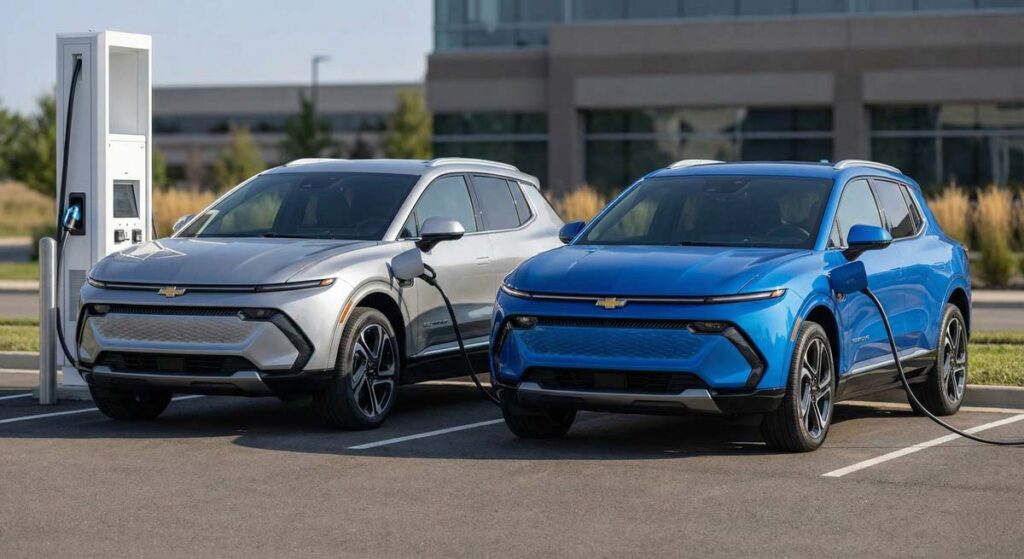

You’re staring at your phone, finger hovering over the “configure” button for a 2025 Equinox EV, when doubt creeps in. Should you pull the trigger on today’s $33,600 model with its 319-mile range, or wait another year for the 2026 version with Tesla’s NACS charging port? The fear of buyer’s remorse is real—especially when you’re talking about dropping serious money on technology that’s evolving faster than your morning commute.
This breakdown cuts through the marketing noise to show you exactly how NACS will impact your daily driving reality versus the immediate savings and proven track record of the 2025 model. You’ll walk away knowing whether that charging port upgrade justifies delaying your EV purchase by a full year, plus get the real numbers on what that 300-horsepower AWD option actually costs per mile of excitement.
Should You Wait for NACS: The 2025 vs. 2026 Equinox EV Question?
When you’re shopping for an Equinox EV, you’ve probably heard the NACS buzz—and you’re wondering if waiting for the 2026 model year makes sense.
Here’s the honest answer: we don’t have enough data yet to give you a definitive recommendation. Current search results reveal 2026 specifications but lack concrete details about 2025 charging framework and confirmed NACS availability across both model years.
We lack concrete details on 2025 charging standards and confirmed NACS availability to give a definitive recommendation.
To make an informed decision, you’d need specifics we’re still hunting down: whether the 2025 uses the older CCS standard, if 2026 definitively switches to NACS, and what real-world advantages that shift actually delivers for your charging routine.
The NACS changeover matters—faster charging speeds, standardized connectors—but it’s not necessarily a deal-breaker if the 2025 meets your needs now. The 2025 model includes a 150 kW DC Fast Charging capability that provides solid performance for most driving scenarios. Both model years support access to over 250,000 public charging stations nationwide, giving you substantial flexibility regardless of which generation you choose.
We’re gathering the comparative intel you deserve. Check back soon for the complete breakdown.
The 2025 Equinox EV LT: $33,600, 213 HP, 319 Miles
You’re looking at the entry point to Equinox EV ownership—$33,600 gets you 213 horsepower, 236 lb-ft of torque, and an EPA-estimated 319 miles of range.
Chevy achieves this through an 85 kWh battery and a 1-speed automatic transmission that eliminates gear-shift losses. The onboard 11.5 kW charger enables a full recharge in 9.5 hours at 240VAC, making overnight charging convenient for most owners.
That pricing strategy places the LT trim roughly $10,000 below the RS variant, banking on the assumption you’ll prioritize range and efficiency over the creature comforts rather than raw performance metrics (spoiler: the horsepower stays identical across trims).
The real question isn’t whether these specs justify the cost—it’s whether you can live with 2025 model year charging limitations before the 2026 NACS-equipped version arrives with broader network access.
Entry-Level Pricing Strategy
The 2025 Equinox EV LT hits a strategic price point—$33,600 for the base front-wheel-drive model—that’s genuinely notable for the EV market, though you’ll want to factor in destination fees and taxes before celebrating.
You’re getting 213 horsepower and 236 lb-ft of torque from that single-speed electric motor, which translates to predictable acceleration without transmission lag.
The 319-mile EPA range means you’re not constantly hunting for charging stations on daily drives. With access to over 250,000 public chargers across North America, your charging options extend well beyond your driveway for longer trips.
At this entry-level tier, you’re not sacrificing essentials either: Google built-in guidance, adaptive cruise control, wireless charging, and comprehensive airbag coverage come standard.
Chevrolet’s positioned this LT trim to compete directly with gas-powered crossovers price-wise, making the EV shift feel financially accessible rather than revolutionary.
Performance And Range Specs
While the 2025 Equinox EV LT‘s 213-horsepower electric motor doesn’t break any performance records, it delivers the acceleration profile you’d expect from a practical crossover designed for daily commuting rather than quarter-mile bragging rights. What matters more is the range: you’re getting 319 miles EPA-estimated on the FWD model, or 307 miles with AWD. That’s genuine real-world capability for most American driving patterns.
The efficiency ratings—117 MPGe city and 100 MPGe highway—translate directly into lower charging costs versus gas alternatives.
Combined with the 11.5kW onboard charging capability, you’re looking at reasonable home-charging times. The DC fast charging at 150 kW can replenish the battery to 80% in approximately 36 minutes, making road trips more practical.
The 1-speed transmission keeps things mechanically simple, meaning fewer components to maintain.
For 2026, Chevy’s holding these specs steady, which suggests they’ve already nailed the performance-to-efficiency sweet spot.
The 2026 Equinox EV RS AWD: 300 HP, $56,470, Missing Specs
You’re looking at a $22,870 price jump from the base 2025 to the 2026 RS AWD—a leap that hinges on that extra 87 horsepower from the dual-motor setup and the performance credentials that come with it.
Though Chevy’s held back some critical specs (exact torque figures, battery capacity, real-world acceleration times) that’d help you actually justify the premium.
The dual-motor configuration doesn’t just add power; it fundamentally changes how the vehicle behaves under load and in various weather conditions. The Drive Mode Selector allows you to customize performance across Tour, Sport, Snow/Ice, and AWD modes to optimize for different driving situations.
But without those missing technical details, you’re essentially buying on faith that the $56,470 price tag reflects genuine capability rather than trim packaging alone.
Performance Gains Over 2025
If you’re eyeing the 2026 Equinox EV RS AWD, that 300-hp dual-motor setup represents a meaningful bump from 2025’s selections, though Chevrolet’s spec sheet leaves some performance questions unanswered.
You’re gaining 64 additional horsepower over the 2025 RS AWD’s 236-hp baseline, courtesy of the dual-motor configuration. That translates to sharper acceleration off the line—electric motors deliver instant torque without the lag conventional engines introduce.
However, Chevy hasn’t released 0-60 times or top-speed figures for either generation, so real-world acceleration comparisons remain speculative.
What’s concrete: the 2026 maintains competitive EPA-estimated range (307 miles for AWD) while offering substantially more punch. Both generations grant access to over 250,000 public chargers across North America through the myChevrolet mobile app for route planning and charger finding.
For enthusiasts wanting measurable performance improvement without sacrificing practicality, that horsepower gain matters.
Price Premium Justification Analysis
That 64-hp advantage matters on the road, but here’s the harder question: does it justify a $22,475 jump from the base model? You’re gaining genuine capability—all-wheel drive traction, quicker acceleration, and improved winter performance—but you’re also paying for luxury touches: ventilated seats, wireless charging, and that HD Surround Vision camera system.
The RS AWD’s $56,470 price tag represents a 62% premium that positions it squarely in compact luxury territory.
Meanwhile, the base FWD model keeps you at $34,995 with identical core tech: that massive 17.7-inch touchscreen, Google integration, and full Chevy Safety Assist. The 2026 model adds dual-level charging cable as standard across all trims, enhancing convenience at every price point.
If you’re highway-focused and live in cold climates, the AWD justifies itself through physics. If you’re mostly commuting, you’re fundamentally paying luxury pricing for practicality you mightn’t need.
What Is NACS and Why It Matters to Equinox EV Owners
The North American Charging Standard (NACS)—that sophisticated five-pin connector Tesla developed and eventually opened to the rest of the automotive industry—is about to reshape how you’ll charge your Equinox EV.
Here’s what you’re actually getting: a compact plug half the size of the older CCS connector, capable of providing up to 1 MW of DC fast charging through identical conductors for both AC and DC power. No moving parts means fewer failure points.
| Feature | 2025 Equinox EV | 2026+ Equinox EV |
|---|---|---|
| Port Type | CCS1 + adapter | Native NACS |
| Supercharger Access | Via adapter | Direct connection |
| Infrastructure Compatibility | Growing | Dominant (75% of US fast chargers) |
| Future-Proofing | Limited | Full ecosystem access |
Why this matters: you’re joining 2:1 NACS-equipped vehicles already on roads. By 2026, adapter fumbling becomes obsolete. You’ll plug directly into Tesla’s unmatched Supercharger network alongside Electrify America’s expanding NACS stations. That’s genuine infrastructure reliability.
Does the 2026 Equinox EV Actually Have NACS?
You won’t find NACS listed in the 2026 Equinox EV’s official specs—it stays secured to CCS1/J1772. Yet the industry’s shift toward Tesla’s connector standard leaves you wondering what that actually means for your charging future.
The gap between what’s built into your vehicle and what adapters can enable creates a peculiar situation: you’ll access Superchargers through a $275 NACS DC adapter (ordered via myChevrolet app), but you’re not getting native hardware, which won’t arrive until the 2027 model year and beyond.
That distinction matters less at public networks like Electrify America or EVgo, where your CCS port handles 250+ kW speeds without modification, but it signals a temporary compromise during GM’s transition window.
Official Specifications Remain Silent
When Chevrolet’s official spec sheets dance around a straightforward question, you know something’s worth clarifying—and NACS compatibility on the 2026 Equinox EV is exactly that kind of situation. You’ll find yourself digging through documentation because the answer isn’t prominently featured upfront. Here’s what you’re actually looking at:
- NACS adapter availability listed as standard or optional depending on trim level
- 150 kW peak charging rate supported through NACS infrastructure
- Vehicle-to-home power capability introduced as new feature for 2026
The 288V electrical architecture enables this maximum charging speed. Rather than broadcasting NACS as a headline feature, Chevrolet embedded it within specification details—a choice that leaves prospective buyers hunting answers.
That’s where clarity matters for your purchasing decision.
Industry Trends Point Forward
Now that we’ve acknowledged Chevrolet’s reluctance to spotlight NACS upfront, here’s what the industry terrain actually reveals: GM’s betting big on this standard, and the 2026 Equinox EV sits squarely in the middle of that shift. Starting with the 2026 Cadillac Lyriq, every future GM EV adopts NACS natively. You’re looking at a company-wide commitment, not a one-off experiment.
| Feature | 2026 Equinox EV | Future Models |
|---|---|---|
| NACS Access | Via adapter | Built-in port |
| Peak Charge Rate | 150 kW | 150 kW+ |
| Supercharger Network | Unlocked | Direct access |
The adapter strategy bridges your current infrastructure gap while GM transitions fully. That 150-kW peak charge rate? It’s real, and it’s competitive. You’re not waiting for theoretical infrastructure—you’re joining an established 250,000-charger ecosystem that’s actively expanding.
Charging Access Implications Unclear
Despite industry headlines suggesting GM’s full shift to NACS, the 2026 Equinox EV ships with CCS1—not a native NACS port—which creates a real clarity gap between marketing messaging and actual hardware.
You’re getting a CCS1 charge port as standard equipment across all trims, period. Here’s what that means for your charging reality:
- DC fast charging taps Electrify America and EVgo networks using your native CCS connector
- Tesla Superchargers remain accessible via adapter—an extra step, admittedly
- Public network access covers 250,000+ stations through myChevrolet app integration
The takeaway? You won’t experience some magical NACS advantage in 2026. Your charging flexibility depends on CCS compatibility and adapter availability, not port redesign.
That’s the actual story beneath the noise.
How Fast Can You Charge an Equinox EV With NACS?
Because the Equinox EV’s charging speed depends entirely on what the vehicle will accept rather than what the station can deliver, you’re looking at a maximum DC fast charging rate of 150 kW—which sounds impressive until you compare it to competitors pushing 200+ kW. Your real-world gains matter more than peak numbers anyway.
| Charger Type | 10-Minute Range | 10-80% Time |
|---|---|---|
| 350 kW EVgo | Up to 80 miles | ~40 minutes |
| Tesla V3 Supercharger | 66-68 miles | 36-37 minutes |
| 150 kW Standard | 50 miles | 40+ minutes |
That 150 kW ceiling limits your replenishment rate to roughly 5 miles per minute using EPA range—respectable for road trips but not class-leading. You’ll hit peak power for about 10 minutes between 10-40% state of charge, then taper to 125 kW. Cool weather consistently delivers 36-37 minute 10-80% sessions on Tesla Superchargers, making temperature management essential for predictable charging windows.
Wait for 2026 or Buy Now? The Price Trade-Off Explained
The $1,500 price jump from 2025 to 2026 looks like a reason to buy now—until you factor in what Chevy’s actually offering to sweeten the 2026 deal.
Here’s the reality: yes, the 2026 LT1 FWD costs $36,495 versus $34,995 for 2025. But stack the incentives against that gap, and you’re looking at a different equation entirely:
The $1,500 price jump dissolves when you stack 2026 incentives against the MSRP gap—the math shifts entirely.
- 0% financing for 60 months saves roughly $4,000 in interest charges
- $1,250 conquest bonus applies if you’re trading a non-GM vehicle from 2011 or newer
- Combined incentive package totals $5,250—more than triple the MSRP increase
That means your effective 2026 cost undercuts the 2025 base price, even after negotiation. You’re not paying more; you’re getting financing perks that weren’t available before. Range stays identical at 319 miles FWD, battery tech remains unchanged, and infotainment specs match.
The timing advantage isn’t about the vehicle itself—it’s about dealer incentive timing working in your favor.
Equinox EV Performance: FWD vs. AWD Real-World Driving
Once you’ve locked in that 2026 deal, you’re probably wondering what you’ve actually bought—and whether choosing FWD over AWD (or vice versa) matters when you’re behind the wheel.
Here’s the straightforward answer: it depends on your priorities. The FWD model delivers 220 hp and 243 lb-ft of torque, hitting 0–60 in 7.4 seconds—adequate for daily commuting but slower than most compact SUV competitors.
The AWD dual-motor setup ups the ante considerably: 288 hp and 333 lb-ft, translating to noticeably quicker acceleration and superior traction in snow or rain.
The trade-off? Range. Your FWD nets 319 miles EPA-estimated; AWD drops to 307 miles due to extra weight and drivetrain losses. Both pack the same 85-kWh battery, so that 12-mile difference reflects physics, not engineering compromise.
For most owners, AWD’s confidence advantage justifies the modest efficiency penalty—especially if weather demands it.
Your Wait-or-Buy Decision Tree: Price, Power, and Charging
By the time you’ve narrowed your drivetrain choice, you’ll face a sharper question: should you purchase the 2025 now or wait for the 2026?
Here’s what tips the scales:
- Price gap narrows with financing: The 2026 LT1 costs $1,500 more at $36,495, but 0% APR for 60 months on both years effectively erases that difference—you’re looking at roughly $32,650 after typical discounts.
- Power gains matter for AWD buyers: The 2026 AWD jumps to 300 hp and 355 lb-ft torque versus 288 hp and 333 lb-ft in 2025, delivering noticeably stronger acceleration and hill performance.
- NACS port grants access to Tesla Superchargers: Direct access eliminates adapter hassles for long trips, though both generations maintain identical 319-mile FWD range.
Your move depends on urgency. Need immediate ownership? The 2025 saves upfront cash. Planning road trips? The 2026’s charging infrastructure upgrade justifies waiting.
Buy the 2025 If… Buy the 2026 If..
Since your choice fundamentally hinges on what you value most—immediate savings, charging convenience, or raw performance—here’s where each model genuinely shines.
Buy the 2025 if you’re budget-conscious and ready to drive now. You’ll pocket $33,600 for the LT trim, access 319-mile range capability, and enjoy standard adaptive cruise control plus heated steering wheel without waiting. The 213-hp powertrain delivers solid acceleration (236 lb-ft torque). CCS charging via home 240V takes 9.5 hours—reasonable for overnight sessions. You’re getting real tech: Google built-in directions, wireless charging, and complete safety features including side and curtain airbags.
Buy the 2026 if charging infrastructure matters most. Native NACS compatibility means Tesla Supercharger access—a game-changer for road trips. You’ll gain 300-hp AWD (355 lb-ft torque), improved cabin refinement, and potential range upgrades reflecting real-world feedback. The $56,470 RS AWD carries premium features: dual-pane sunroof, improved infotainment, and better handling behavior.
You’re paying extra for performance, future-proofing, and convenience.
Frequently Asked Questions
Can I Retrofit a 2025 Equinox EV With a NACS Port Later if Needed?
You can’t retrofit a NACS port to your 2025 Equinox EV. GM hasn’t announced an official retrofit program, and the charge port’s design makes modification impractical. Your $225 NACS DC adapter grants access to Tesla Superchargers instead.
What Public Charging Networks Currently Support the 2025 Model’s CCS Standard?
You’re not limited to obscure stations—Electrify America and ChargePoint support your 2025 Equinox EV’s CCS standard across over 250,000 chargers nationwide, with DC fast-charging positioned regularly along highways for seamless travel.
How Does AWD Affect Real-World Range and Efficiency in the 2026 Model?
You’ll see a 12-mile EPA range reduction with AWD—307 miles versus 319 for FWD. That second motor decreases efficiency, though you’re still gaining all-weather capability and confidence that justifies the trade-off.
Are There Warranty Differences Between 2025 and 2026 Battery or Powertrain Coverage?
You’ll find no warranty differences between 2025 and 2026 models—both offer identical 3-year/36,000-mile basic coverage and 5-year/60,000-mile powertrain protection. Battery coverage falls under powertrain, so you’re equally protected either year.
What Trim Levels Will the 2026 Equinox EV Offer Beyond the RS AWD?
You’ll find Chevy hasn’t announced additional 2026 trims beyond what’s currently offered. The LT 1, LT 2, and RS remain your lineup options. We’re tracking any new announcements for you.


